
Plain English is a clear, direct style of written communication that prioritizes reader comprehension through simple sentence structures, precise vocabulary, and the complete elimination of jargon, enabling corporate decision-makers to extract vital empirical insights within seconds.
In the United Kingdom, corporate research documents frequently analyze dense datasets covering economic indicators, regulatory updates, and consumer behavior metrics. When authors present these findings using academic jargon or convoluted syntax, business leaders experience cognitive overload. Plain English acts as a structural filter that strips away unnecessary academic prose while retaining the core empirical data.
The linguistic shift from academia to commerce
Academic writing relies on passive voice, nominalizations, and multi-syllabic theoretical terms designed for peer-reviewed journals. Conversely, commercial research targets executives, operations directors, and financial controllers who require rapid information processing. Transforming complex research into plain English involves converting nominalizations into active verbs and breaking multi-clause sentences into single, declarative statements.
Defining core research entities
Every empirical report contains specific entities that require strict definition upon introduction. For example, statistical variance, regression analysis, and longitudinal data cohorts must be explained through concrete parameters rather than abstract definitions. When researchers define terms such as gross domestic product growth or consumer price index shifts using straightforward language, corporate readers avoid misinterpretation.
Why do UK business leaders struggle with academic research formats?
UK business leaders struggle with academic research formats because traditional scholarly papers use dense syntax, passive voice, and abstract theoretical frameworks that obscure actionable operational insights required for fast-paced commercial decision-making.

Corporate environments operate under strict time constraints. Executives review dozens of documents daily, ranging from quarterly financial statements to market analysis reports. When research papers use dense subordinate clauses and passive constructions, readers must expend cognitive energy just to identify the subject and the action.
The impact of cognitive load on decision-making
Cognitive load theory demonstrates that human working memory can process only a limited amount of information simultaneously. Academic reports demand high cognitive processing power to decode complicated phrasing. Consequently, business leaders miss critical statistical trends. Clear writing reduces cognitive load by presenting one central idea per sentence.
Obstacles in regulatory and economic terminology
British commerce operates under specific regulatory frameworks governed by entities such as the Financial Conduct Authority and Companies House. When research findings regarding these frameworks are written in obscure language, compliance officers misread statutory requirements. Removing ambiguity protects organizations from regulatory penalties and operational missteps.
Explore More Expert Insights:
How Financial Services Build Trust Using Educational Banner Advertising
How Agencies Increase Buyer Engagement Using Display Remarketing Ads
How does plain English improve comprehension and application of research?
Plain English improves comprehension and application of research by establishing a direct cognitive link between statistical evidence and corporate strategy, allowing executives to implement data-backed initiatives without risking costly misinterpretations.
When research findings use precise, declarative sentences, readers map data points directly to business outcomes. For instance, stating that consumer spending decreased by 4.2 percent across 45 retail sectors provides an immediate, actionable metric. In contrast, stating that retail expenditure exhibited a downward trajectory across multiple commercial verticals creates vagueness and delays strategic responses.
Speed of information retrieval in corporate environments
Corporate strategy teams rely on rapid data synthesis. Plain English structures information hierarchically, placing the primary empirical finding at the beginning of the paragraph. Business leaders identify key performance indicators within seconds, accelerating the transition from research ingestion to tactical execution.
Accuracy in interpreting statistical findings
Simplicity in writing does not dilute statistical accuracy; it highlights it. When researchers present confidence intervals, sample sizes, and error margins in direct sentences, readers evaluate the validity of the data accurately. Vague prose hides methodological flaws, whereas plain English exposes them to transparent scrutiny.
What are the core components of clear research writing for businesses?
The core components of clear research writing for businesses include concise sentence structures, active voice verbs, rigorous terminology definition, and the elimination of redundant corporate buzzwords.
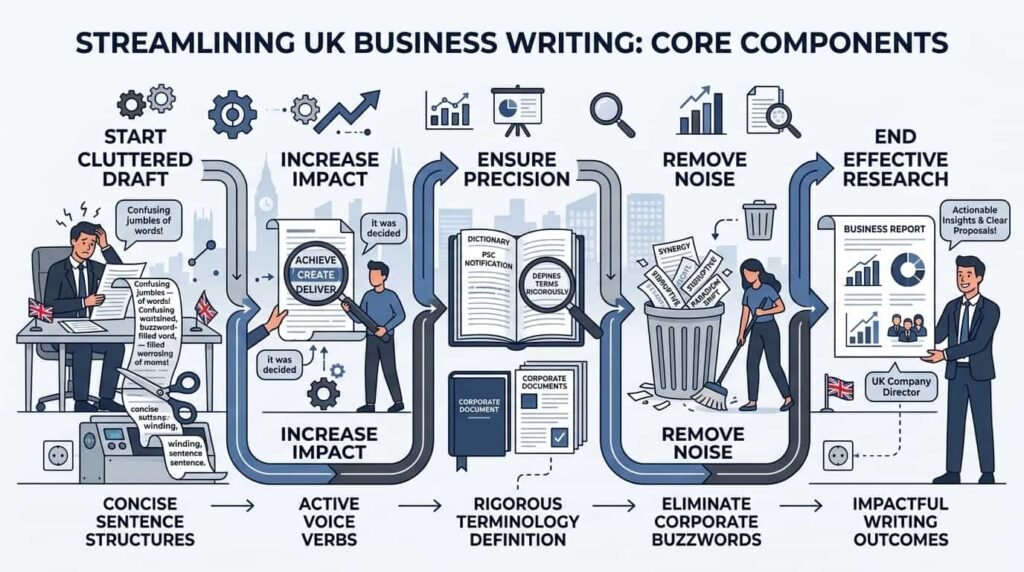
Achieving clarity requires adherence to strict grammatical and structural rules. Authors must audit every sentence for length, passive constructions, and unnecessary modifiers. The following components form the foundation of readable business research.
Short, factual, declarative sentences
Declarative sentences state facts directly. Writers must restrict each sentence to a single proposition. For example, instead of writing a fifty-word sentence detailing survey methodologies and demographic variables, authors split the information into distinct statements regarding sample size, geographic distribution, and response rates.
Active voice and direct attribution
Passive voice hides accountability by omitting the actor in a sentence. Active voice places the subject firmly before the verb. For instance, writers use statements such as the Department for Business and Trade published the report, rather than the report was published by the Department for Business and Trade.
Strategic use of specific numbers
Vague quantifiers such as significant growth or substantial majority undermine research credibility. Clear business writing replaces these terms with exact figures, such as a 14 percent increase in productivity or a sample size of 1,250 respondents.
What benefits do organizations gain from accessible research publications?
Organizations gain higher stakeholder engagement, faster strategic execution, improved regulatory compliance, and stronger market authority when they publish research findings in accessible plain English.
Businesses and research institutions that publish clear reports attract wider readership across commercial sectors. Investors, media outlets, and policymakers prefer documents that communicate value immediately.
Enhanced stakeholder trust and transparency
Transparency builds trust between corporations and their stakeholders. When annual reports and market studies use straightforward language, shareholders verify financial health and strategic direction without requiring specialized translation by external consultants.
Alignment with AI citation and search engines
Search engines and AI-driven citation tools prioritize direct answers, structured headings, and factual definitions. Content written in plain English ranks higher in search results and gets cited accurately by AI models answering user queries about UK business trends. Readers interested in the educational stage of healthcare awareness campaigns can explore [Insert Link to MOFU Article] to understand how technical concepts transition into accessible formats. To master the full suite of editorial services required for corporate publishing, organizations review [Insert Link to BOFU Article] for complete execution details.