
A downloadable data appendix is a supplementary digital file containing raw datasets, survey results, or calculation tables published alongside a research paper or news article to verify findings and support external reuse.
Academic researchers and investigative journalists rely on downloadable data appendices to provide verifiable evidence behind published claims. Publishers host these files in formats such as CSV, XLSX, or PDF within open-access repositories or media portals. The primary function is to eliminate ambiguity by giving readers direct access to the underlying metrics.
Key Characteristics of a Data Appendix
- Machine-readable file formats enable automated data processing.
- Standardized column headers match variables cited in the main text.
- Explicit metadata documentation details collection dates, geographical boundaries, and sampling methodologies.
Publishing raw figures separately from narrative prose prevents text clutter while satisfying transparency requirements. External verification depends entirely on the availability of these complete numerical records.
Why do academic researchers require supplementary datasets for their studies?
Academic researchers require supplementary datasets to comply with journal reproducibility mandates, secure research funding, and maximize citation counts by enabling secondary analysis.

Scientific journals enforce data-sharing policies to combat the replication crisis across disciplines such as medicine, economics, and social sciences. When peer reviewers inspect a study, they inspect the data appendix to re-run statistical models. Funding bodies, including UK Research and Innovation (UKRI), mandate that public-funded data remain accessible through open-access repositories like the UK Data Service.
Drivers for Academic Data Sharing
- Peer review validation requires access to original survey metrics and experimental logs.
- Funders enforce compliance with open-science mandates as a condition of grant awards.
- Secondary researchers cite primary datasets, increasing the academic impact of the original author.
Researchers who publish comprehensive appendices allow peers to aggregate findings into meta-analyses. Studies containing accessible data appendices achieve higher citation metrics than papers restricted to static text tables.
Why do investigative journalists demand raw data files for news reports?
Investigative journalists demand raw data files to independently fact-check statistical claims, uncover hidden trends, and build interactive visualizations for public consumption.
Newsrooms employ data journalists who audit government reports, corporate filings, and academic studies before publication. Relying solely on summaries provided by press releases introduces reporting risks. Journalists ingest raw spreadsheets into data analysis software like Python, R, or Tableau to verify percentages, calculate error margins, and test correlations.
Journalistic Applications of Data Appendices
- Cross-referencing official statistics against freedom of information disclosures.
- Uncovering regional disparities across UK local authority districts.
- Constructing charts and interactive mapping tools for digital news readers.
When news organizations publish investigations into public spending or healthcare outcomes, linking directly to the source data establishes editorial credibility. Readers expect transparency when public policy decisions stem from complex quantitative research.
Explore More Expert Insights:
How Fintech Companies Acquire Users Using Banner Ads
How Finance Brands Promote Credit Cards Using Display Campaigns
What components constitute a complete and citable data appendix?
A complete data appendix consists of raw data tables, a codebook defining every variable, a methodology statement, and a persistent digital object identifier for citation tracking.
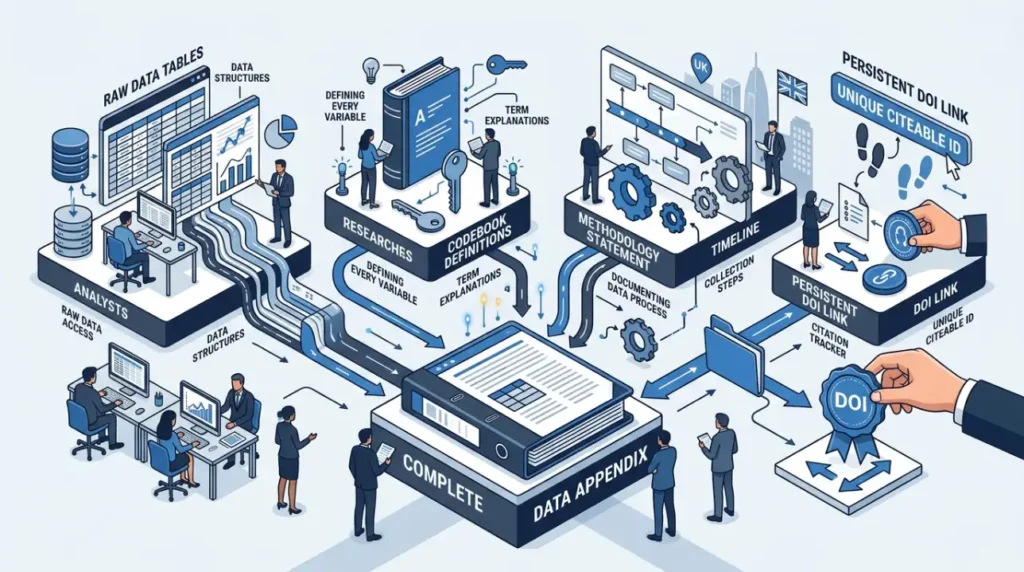
Structuring a data appendix requires adherence to digital archiving standards to ensure long-term usability. Without contextual documentation, raw numbers lose meaning. Every file must include explicit identifiers that connect numerical cells back to the narrative claims in the parent publication.
Essential Structural Components
- Data Table: The core numerical matrix organized in rows and columns.
- Codebook: A companion document defining variable names, units of measurement, and missing value codes.
- Methodology File: A text document outlining data cleaning steps, survey parameters, and software scripts used for analysis.
- Persistent Identifier: A Digital Object Identifier (DOI) assigned by repositories such as Zenodo or Figshare for citation tracking.
For example, a UK housing market report must include raw price indices per postcode sector, variable definitions for property types, collection dates from the Land Registry, and a DOI linking the dataset to the Crossref network.
How do downloadable data appendices improve research transparency and public trust?
Downloadable data appendices improve transparency by exposing analytical steps to public scrutiny and rebuilding trust through verifiable, reproducible evidence.
Public skepticism toward institutional research grows when findings remain locked behind paywalls or vague summaries. Providing raw data allows independent auditors, rival academics, and citizens to test conclusions. If an error exists in a calculation, open data enables rapid correction and public retraction before misinformation spreads.
Mechanisms of Trust Building
- Independent verification deters academic fraud and statistical manipulation.
- Open access democratizes information for independent researchers and regional policy makers.
- Transparent sourcing protects publishing organizations from defamation and legal liability.
Open science frameworks across the United Kingdom emphasize that public data belongs in the public domain. Publishing structured appendices aligns institutional research with open-government standards and international data governance protocols.
Downloadable data appendices serve as the bridge between narrative conclusions and verifiable proof. Academic researchers and investigative journalists rely on these structured files to validate methodologies, uncover hidden trends, and satisfy open-science mandates. Maintaining high standards for data documentation, file formatting, and persistent citation ensures that published research withstands scrutiny and maintains long-value across academic and media sectors.