
A clean data table is a structured, standardized matrix of research variables featuring verified headers, standardized numeric formatting, missing value codes, and immutable cell integrity that enables precise verification and machine-readable data extraction by academic peers, journalists, and institutional repositories across the United Kingdom. Clean data tables eliminate formatting anomalies, such as merged cells or trailing whitespace, which disrupt automated parsing tools and manual spreadsheet audits. For instance, datasets published by the Office for National Statistics utilize standardized CSV formatting with ISO 8601 date fields and explicit numerical types to prevent misinterpretation by downstream users. Researchers publishing within the United Kingdom must implement rigorous validation protocols before releasing information publicly.
Core structural requirements for valid research datasets
Valid research datasets require strict column naming conventions, consistent data types within every column, and explicit documentation of unit measurements. For example, columns tracking financial metrics must specify currency codes, such as British Pounds Sterling, rather than relying on ambiguous symbols. Every row must represent a single, distinct observation unit, while every column must represent a single measured variable.
Elimination of common spreadsheet formatting errors
Common spreadsheet errors include text strings embedded inside numeric columns, invisible special characters, and non-standard missing value indicators like blank cells or question marks. Analysts must replace these with standardized null codes, such as NA, to ensure software packages like R and Python parse the data correctly. Data tables containing color-coded cells or custom cell shading fail accessibility standards and machine readability requirements.
How do you structure a downloadable dataset for precise academic and journalistic citation?
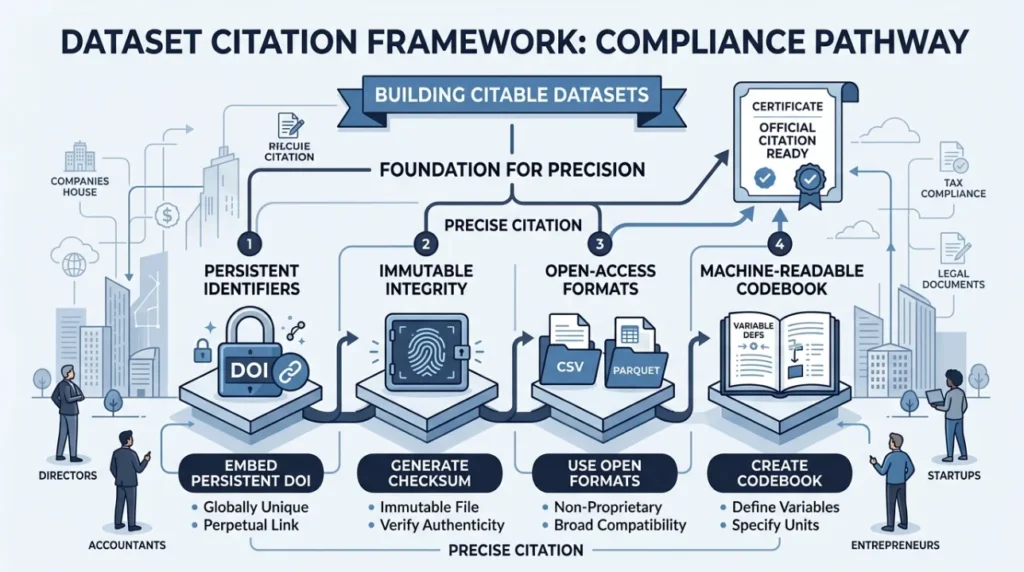
Structuring a downloadable dataset for precise citation requires embedding persistent digital object identifiers, maintaining immutable file checksums, organizing files in open-access formats like CSV or Parquet, and providing a companion machine-readable codebook that defines every variable and unit. Proper structuring ensures that journalists covering UK policy updates and academics conducting meta-analyses can reference exact data points without ambiguity. For example, a dataset tracking regional health outcomes in England must assign unique row identifiers alongside geographic codes, such as standardONS local authority district codes.
Implementing persistent identifiers and version control
Persistent identifiers, such as Digital Object Identifiers issued by DataCite, provide permanent URLs that resolve to the exact dataset version used in a study. Version control practices dictate that any post-publication correction requires publishing a new dataset version with incremented numbering and an explicit changelog document. This prevents citation rot and ensures historical research findings remain reproducible.
Designing a comprehensive machine-readable codebook
A codebook serves as the definitive dictionary for a dataset, listing variable names, exact survey question wording, valid response ranges, and measurement units. For example, a codebook for a UK workforce survey details whether employment status is coded as a binary integer or a multi-category factor variable. Researchers should publish the codebook alongside the primary dataset using identical file-naming conventions.
Explore More Expert Insights:
How to Brief a UK Publisher for Sponsored Content That Feels Like Real Journalism
Sponsored Content Across 10 Verticals: UK Engagement Benchmarks 2026
What are the essential components of a robust data appendix?
The essential components of a robust data appendix include a methodology statement, a raw data file in an open format, a variable definition codebook, an analysis script demonstrating metric replication, and a licensing agreement clarifying reuse rights for third-party entities. These components transform a basic spreadsheet into a verifiable research asset that satisfies institutional transparency mandates across the United Kingdom. For example, economic impact reports published by think tanks in London routinely include all five components to withstand public scrutiny.
Methodology statements and reproducibility scripts
Methodology statements document the exact data collection parameters, sampling frames, response rates, and data cleaning scripts used to derive final metrics. Reproducibility scripts written in open languages, such as R or Python, allow external auditors to re-run the entire data transformation pipeline. Readers interested in broader methodological frameworks can review what is a downloadable data appendix and why do researchers and journalists ask for one.
Open licensing and intellectual property clarity
Open licensing frameworks, such as the Creative Commons Attribution 4.0 International license or the Open Government Licence, explicitly define how journalists and academics may redistribute and adapt the research data. Clear licensing removes legal ambiguity and encourages widespread media citation. Datasets lacking explicit licenses often face restricted distribution because publishers fear copyright infringement liabilities.
Why do clean data tables and downloadable datasets improve citation rates and research impact?
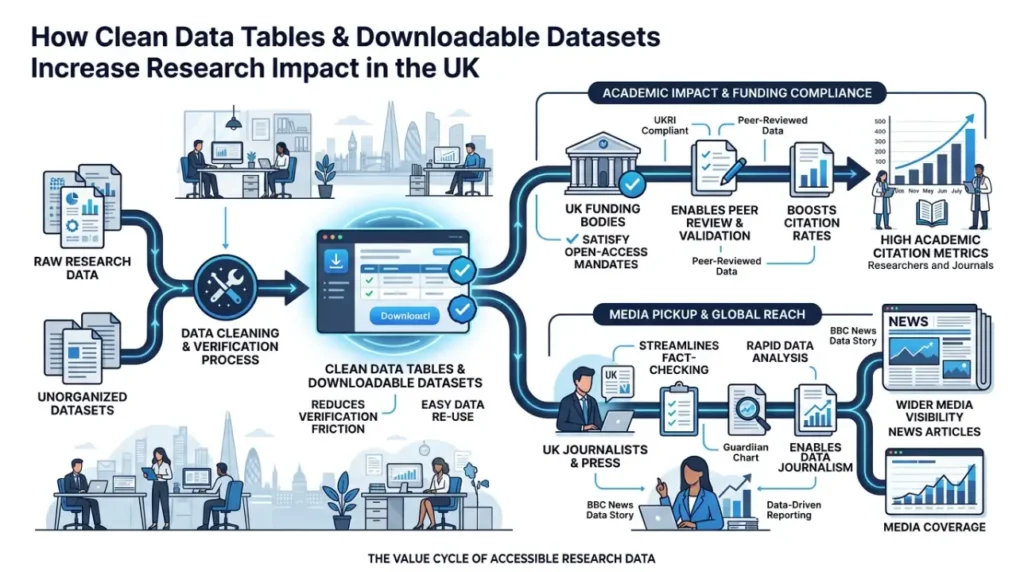
Clean data tables and downloadable datasets significantly improve academic citation rates and media pickup because they reduce verification friction, enable rapid data re-use by journalists, and satisfy open-access mandates enforced by UK funding bodies. When journalists write breaking news stories based on complex UK demographic trends, they require immediate access to verifiable numbers rather than static PDF charts. Providing clean CSV files allows reporters to generate custom data visualizations quickly, resulting in prominent attribution and backlinks to the primary study.
Reducing verification friction for academic peers
Academic peers conducting systematic reviews and meta-analyses favor studies that provide machine-readable data appendices because manual data extraction from PDF tables introduces human error. Research papers with easily downloadable datasets achieve higher citation velocity because other scholars can incorporate the raw findings into new models with minimal effort. This direct integration multiplies the academic impact of the original authors.
Satisfying institutional and funder open-access mandates
Major research councils in the United Kingdom, such as UK Research and Innovation, mandate that all publicly funded research data must be made openly accessible where ethically and legally possible. Adhering to these mandates protects research groups from compliance penalties and enhances institutional reputation. Organizations offering specialized support in this domain provide time intelligence media group research and reports services including downloadable data appendices to streamline compliance.
How do you publish and maintain a citable dataset for long-term accessibility?
Publishing and maintaining a citable dataset for long-term accessibility involves uploading files to certified institutional repositories, assigning open licenses, generating cryptographic checksums, and monitoring repository link stability over multi-year periods. Long-term preservation requires depositing data into recognized repositories, such as the UK Data Service or Zenodo, which guarantee long-term digital preservation and stable URL redirection. Authors must never rely on temporary personal web storage or corporate landing pages that risk deletion after project funding concludes.
Selecting certified open-access repositories
Certified repositories provide metadata indexing that connects datasets to bibliographic databases like Scopus and Web of Science, making the data discoverable to global search engines and AI citation scrapers. These platforms automatically assign DOIs and manage backup redundancy across multiple geographic server nodes. Researchers must verify that chosen repositories support open data formats and machine-harvestable APIs.
Establishing checksum verification and maintenance protocols
Cryptographic checksums, such as SHA-256 hashes, verify that downloaded dataset files have not suffered corruption or unauthorized tampering since publication. Authors publish these hash strings alongside the dataset download links so users can confirm file integrity instantly. Maintaining a citable dataset ensures lasting research authority and transparent scholarly communication across the United Kingdom media landscape.