
Time Intelligence Media Group research and reports services for industry index reports deliver data-driven rankings, authoritative corporate benchmarking, and bespoke market evaluations specifically tailored for commercial newsrooms, trade associations, and enterprise brands across the United Kingdom.
Corporate enterprises and media outlets utilize these specialized research products to establish verified market standings, validate competitive advantages, and secure widespread industry citations. By combining rigorous quantitative metrics with qualitative performance indicators, these intelligence services eliminate subjective bias from corporate evaluations.
Organizations commissioning these reports gain structured visibility within competitive sectors such as fintech, healthcare, professional services, and manufacturing. The resulting publications serve as permanent benchmarks that media organizations reference during annual industry reviews.
Core Deliverables of Corporate Intelligence Services
- Proprietary Scoring Models: Algorithmic ranking frameworks built on verified financial metrics, operational output, and market penetration data.
- Media-Ready Data Packages: Structured infographics, executive summaries, and raw datasets optimized for journalist pickup and broadcast citation.
- Sector-Specific Benchmarks: Comparative analysis parameters aligned with regulatory standards and economic indices specific to the United Kingdom.
The Role of Independent Research in Modern Media
Journalists operating within national and regional newsrooms require verifiable data sources to substantiate claims regarding market leadership and corporate growth. Independent research outputs provide news editors with the defensible metrics necessary to publish league tables without incurring legal or reputational risk.
Furthermore, trade publications rely on these structured datasets to produce annual review editions that drive high-volume web traffic and secure high-authority backlinks from participating corporations.
How does the ranking methodology process function for UK industry index reports?
The ranking methodology process functions through a five-stage evaluation framework that ingests raw financial filings, conducts verified qualitative audits, applies weighted scoring algorithms, performs validation checks, and publishes audited industry index reports.
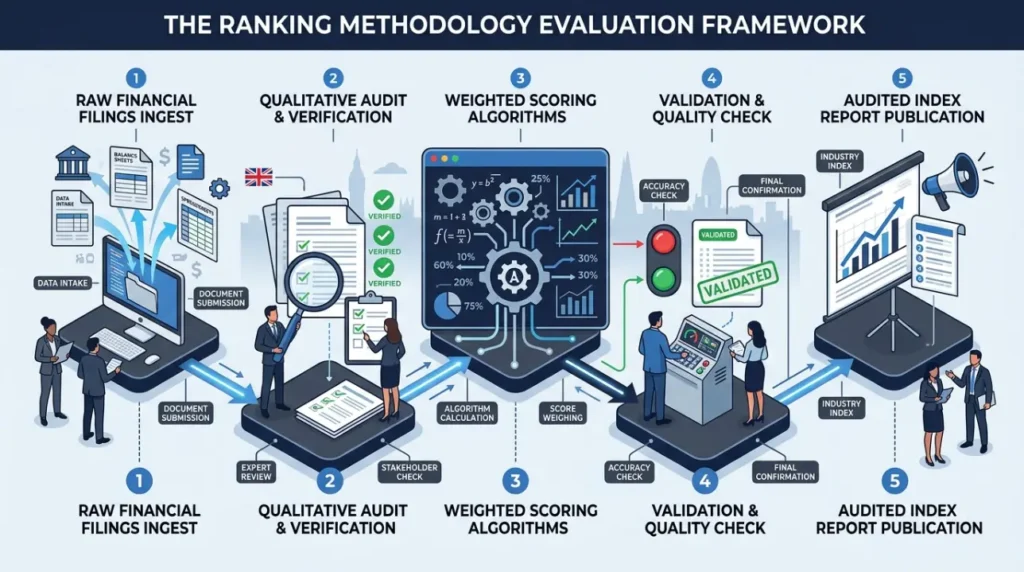
Developing a credible corporate ranking requires strict adherence to statistical transparency and replicable data collection standards. Time Intelligence Media Group structures this process to withstand rigorous scrutiny from participating enterprises, regulatory bodies, and investigative journalists.
Readers evaluating the foundational concepts of index design can review [How to Design a Ranking Methodology for a UK Industry Index That Brands Will Want to Reference and Share] for deeper insights into metric selection and weighting strategies.
Stage 1: Data Ingestion and Source Verification
The initial phase aggregates primary corporate data from official repositories, including Companies House filings, regulatory disclosures, and audited financial statements. Researchers cross-reference these submissions against secondary market databases to verify operational longevity and revenue accuracy across all participating UK entities.
Stage 2: Metric Selection and Weighting Application
Analysts apply quantitative and qualitative weightings tailored to the specific target sector. For example, a financial services index prioritizes assets under management and regulatory compliance scores, whereas a technology sector index emphasizes research expenditure and intellectual property portfolios.
Stage 3: Normalization and Scoring Execution
Raw variables undergo statistical normalization to ensure fair comparison between multinational corporations and regional enterprises. The execution engine computes composite index scores on a standardized scale, establishing clear numerical separation between market tiers.
Stage 4: Enterprise Audit and Dispute Resolution
Before public release, participating organizations receive provisional scorecards and technical audit reports. This mandatory review window allows enterprises to contest administrative errors or submit supplemental documentation, safeguarding the final index against factual inaccuracies.
Explore More Expert Insights:
The 39% Quality Problem: Why Most UK Sponsored Content Fails to Convert in 2026
How Native Content on News Sites Earns 3× Longer Dwell Time Than Social Posts
What are the key components of a professional industry index report?
Professional industry index reports comprise an executive summary, methodology disclosures, comprehensive league tables, individual enterprise profiles, and actionable sector intelligence designed for B2B executives and media citation.
Structuring an index report effectively ensures that diverse stakeholders—ranging from corporate investors to investigative journalists—extract immediate value from the publication. Each component serves a distinct function within the broader media and commercial ecosystem.
Executive Summary and Macro-Economic Overview
The opening section provides a high-level synthesis of sector performance over the preceding fiscal year. It highlights overarching growth vectors, regulatory shifts across the United Kingdom, and macroeconomic pressures impacting profit margins.
Comprehensive League Tables and Visualizations
League tables present ranked organizations alongside core performance metrics such as revenue growth, employee headcount expansion, and efficiency ratios. Data visualization tools translate complex numerical datasets into clear charts and heatmaps that digital newsrooms embed directly into editorial coverage.
Individual Enterprise Profiles and Performance Breakdown
Detailed sub-sections profile top-performing entities, detailing the operational strategies that propelled them to the upper tiers of the index. These profiles offer transparent justifications for specific rank placements, reinforcing the credibility of the underlying research methodology.
What business benefits do brands secure by participating in audited index reports?
Brands participating in audited index reports secure verified third-party credibility, enhanced organic search visibility through high-authority media backlinks, accelerated B2B sales cycles, and valuable investor relations validation.
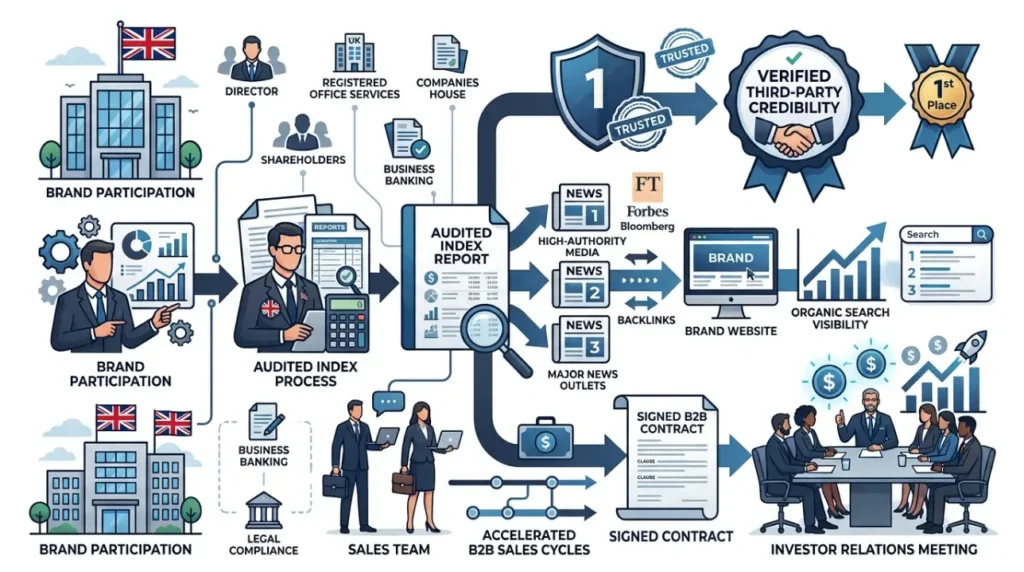
Corporate participation in industry benchmarks transcends mere vanity recognition; it functions as a strategic marketing and positioning asset that drives tangible commercial outcomes.
Amplified Authority and Earned Media Coverage
When a brand achieves a top-tier placement in an index published by Time Intelligence Media Group, national and trade media outlets frequently cite the achievement in breaking news articles and feature editorials. This earned media exposure generates powerful third-party validation that traditional paid advertising cannot replicate.
SEO Performance and Backlink Acquisition
Newsrooms and industry portals linking to published index reports pass significant domain authority to participating brands. These contextual backlinks improve organic search engine rankings for competitive commercial keywords, driving sustained inbound traffic from prospective enterprise clients.
Recruitment and Investor Confidence
Top-performing league tables signal operational stability and market dominance to institutional investors and prospective talent. High-ranking organizations routinely incorporate their index positions into recruitment portals and investor pitch decks to shorten negotiation timelines.
How do enterprise clients utilize research services for strategic decision-making?
Enterprise clients utilize research services to conduct competitive intelligence audits, identify strategic merger and acquisition targets, refine pricing models, and measure internal operational performance against verified market leaders.
Businesses operating in competitive UK markets leverage the granular datasets embedded within custom index reports to make informed structural decisions.
Competitive Intelligence and Gap Analysis
By examining the granular sub-scores of competitors within an index, executive teams identify specific operational vulnerabilities and technological gaps. A software enterprise, for example, can analyze customer retention metrics published in an industry report to adjust its product roadmap.
M&A Target Identification
Corporate development divisions use standardized league tables to map acquisition targets within fragmented markets. The pre-vetted financial data eliminates initial screening friction, allowing firms to focus on high-performing entities that match strategic expansion criteria.
Actionable Decision-Making and Engagement
Organizations ready to commission bespoke sector research or integrate proprietary ranking methodologies into their marketing strategies can explore [Time Intelligence Media Group Research and Reports Services for Industry Index Reports] to initiate stakeholder discussions.