
Data ownership in UK commissioned research defaults to the creator or media partner unless an explicit assignment agreement transfers intellectual property to the commissioning enterprise. Under the Copyright, Designs and Patents Act 1988, the commissioning of a market research report does not automatically grant the client full copyright ownership of the underlying data sets, raw survey responses, or analytical frameworks. Commercial entities commissioning studies must execute formal assignment clauses to secure legal title.
Statutory Copyright Defaults
The commissioning client possesses ownership of the physical or digital document delivered under the contract, but statutory copyright remains with the media partner or independent researchers who authored the text and compiled the database. For example, if a London-based financial services firm hires a media partner to produce an industry benchmark study, the firm owns the final PDF report. However, the firm does not automatically own the underlying SPSS data files or verbatim interview transcripts.
Contractual Overrides via Assignment
Parties must use written assignment contracts to alter statutory defaults. A legally binding contract must explicitly state that intellectual property rights in both raw data and final analytical deliverables transfer entirely to the client upon full payment. Without this explicit transfer, the media partner retains the right to license the same data insights to third parties.
How Should Parties Structure Data Licensing Terms Prior to Project Kickoff?
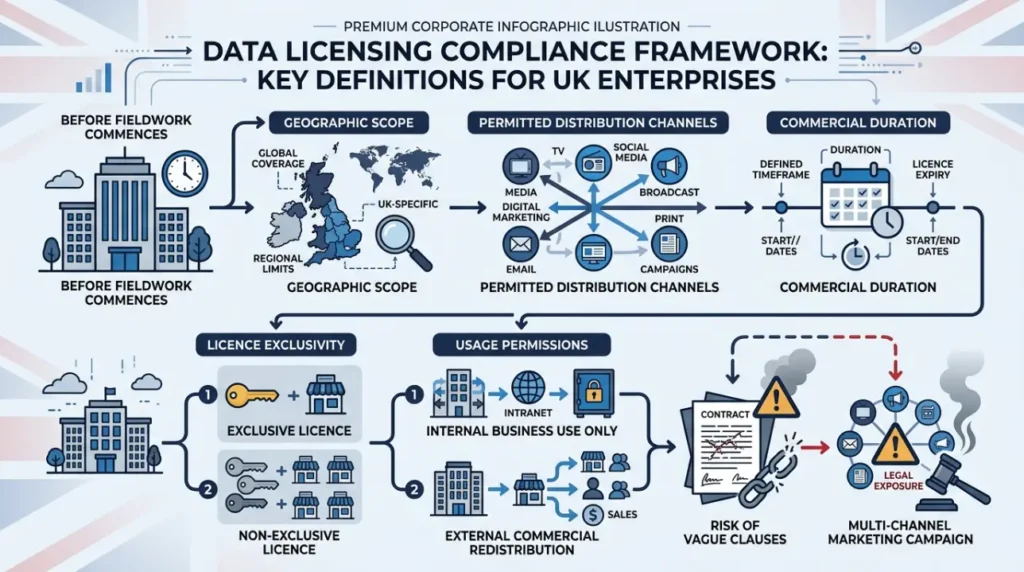
Data licensing terms require precise definitions regarding geographic scope, permitted distribution channels, and commercial duration before fieldwork commences. Enterprise clients must establish whether their licence is exclusive or non-exclusive, and whether it permits internal business use only or external commercial redistribution. Vague licensing clauses create significant legal exposure during multi-channel content marketing campaigns.
Exclusive Versus Non-Exclusive Licences
An exclusive licence prevents the media partner from selling the same research findings to competing organizations within the United Kingdom. A non-exclusive licence permits the media partner to syndicate identical data points across multiple client portfolios. Enterprises commissioning proprietary market research must demand exclusive licensing terms for a minimum period of 12 months post-publication.
Defining Geographic and Format Boundaries
Licensing agreements must specify exact territories and media formats. For instance, a contract can grant a UK-based retail brand the right to publish survey findings across digital whitepapers, corporate websites, and physical seminar brochures within Great Britain, while withholding broadcast syndication rights.
Explore More Expert Insights:
The 39% Quality Problem: Why Most UK Sponsored Content Fails to Convert in 2026
How Native Content on News Sites Earns 3× Longer Dwell Time Than Social Posts
What Clauses Define Reuse and Syndication Rights for Derived Content?
Reuse rights dictate how commissioning brands can repurpose research statistics into secondary marketing assets like infographics, webinars, and paid social campaigns. Media partners frequently restrict the extraction of isolated data points to protect the integrity of the broader research narrative. Clear contractual definitions prevent disputes over derivative works.
Derivative Works and Data Atomization
Commissioned research reports generate hundreds of individual data points that marketing teams repurpose into social media graphics, blog posts, and slide decks. Contracts must explicitly permit data atomization. For instance, an agreement can state that the client holds full rights to adapt statistical tables into 10 distinct infographic assets for B2B distribution.
Third-Party Syndication and Public Relations
If a commissioning enterprise intends to distribute the research findings through national media outlets via a PR agency, the contract must include explicit press syndication permissions. Media partners often require mandatory attribution clauses, such as citing the specific research agency in all press releases and media pick-ups.
What Are the Operational Benefits of Finalising IP Terms During the [Insert Link to MOFU Article]?
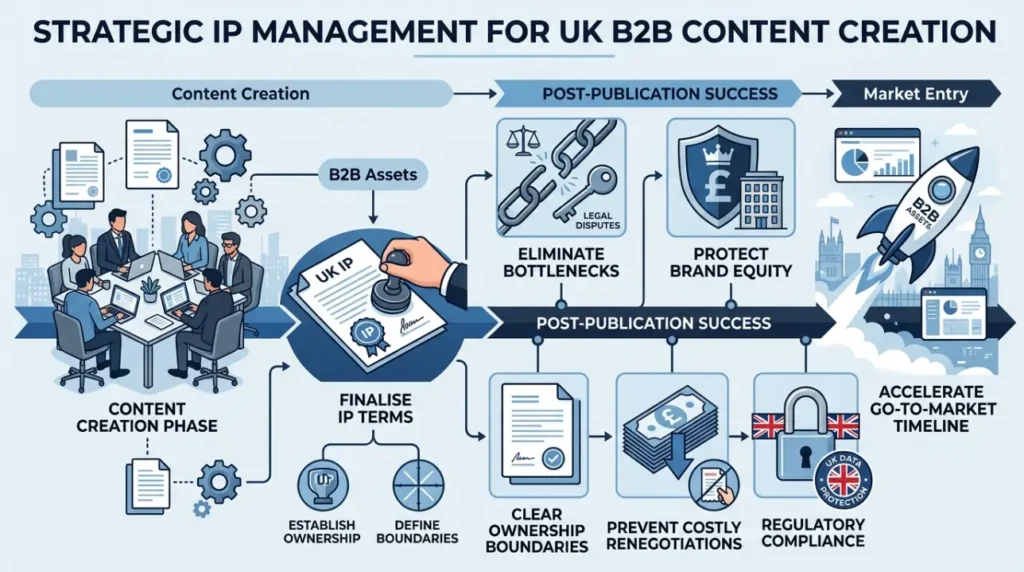
Finalising intellectual property terms during the [Insert Link to MOFU Article] eliminates post-publication legal bottlenecks and protects brand equity. Establishing clear ownership boundaries early prevents costly renegotiations, ensures compliance with UK data protection regulations, and accelerates the go-to-market timeline for high-value B2B assets.
Risk Mitigation and Compliance
Early resolution of intellectual property clauses ensures compliance with UK GDPR standards regarding respondent data anonymity and lawful processing. Media partners retain accountability for secure data collection, while commissioning brands secure unencumbered commercial exploitation rights.
Budget Certainty and Milestone Alignment
Clear legal scoping prevents unexpected licensing fees discovered late in the production cycle. When intellectual property ownership is integrated into initial [Insert Link to MOFU Article] discussions, procurement teams can align project milestones directly with payment schedules tied to the delivery of raw data tables and final deliverables.
How Do Enterprise Buyers Execute Compliant Research Commissions With Media Partners?
Enterprise buyers execute compliant research commissions by deploying structured master service agreements that incorporate comprehensive data ownership schedules and outcome-driven procurement frameworks. Leading media organizations and specialist research agencies utilize standardized commissioning workflows to guarantee legal clarity from project conception to final delivery.
Step-by-Step Commissioning Workflow
- Define project scope, target sample sizes, and primary research objectives with the media partner.
- Draft a bespoke intellectual property schedule specifying absolute transfer of raw data ownership or exclusive licensing terms.
- Establish clear usage rights for derived marketing assets, including webinars, whitepapers, and PR distribution.
- Review contract compliance regarding UK data privacy laws and respondent anonymity standards.
- Finalize financial terms linked to data handover milestones, ensuring all deliverables are secured through [Insert Link to BOFU Article].
Securing Long-Term Value
Securing comprehensive ownership and reuse rights transforms a one-off research report into an evergreen corporate asset. Organizations utilizing structured commissioning frameworks maximize return on investment, protect their proprietary market positioning, and eliminate ambiguity across all commercial distribution channels.