
A research headline is a declarative factual statement that summarizes the primary empirical finding of an academic study or market report for journalists. UK editors evaluate these statements against strict national news values, reader relevance thresholds, and editorial guidelines before assigning coverage to staff reporters or publishing press agency wire copies.
Research headlines function as the primary filter for national print and broadcast media outlets in London, Manchester, Edinburgh, and Cardiff. Editors receive upwards of 500 press releases daily through the PA Media wire and direct email channels. A precise headline strips away academic jargon and presents verifiable numerical data or policy impacts.
UK newsrooms operate under the Independent Press Standards Organisation (IPSO) Editors’ Code of Practice, which mandates accuracy and prohibits misleading claims. Therefore, a newsworthy headline relies on direct causation, verified sample sizes, and definitive statistical shifts rather than speculative projections. Editors discard vague titles that lack immediate societal relevance or fail to name the specific demographic groups affected.
The Role of Empirical Data in Newsrooms
Empirical data forms the core metric for assignment editors across BBC News, The Guardian, The Telegraph, and The Times. A headline containing a specific metric secures higher engagement rates than a conceptual title. For example, stating that 42% of British small businesses face insolvency within 12 months provides an immediate factual hook. Editors look for benchmarks, year-on-year comparisons, and percentages derived from recognized statistical bodies or academic institutions.
Distinguishing Academic Titles from Media Headlines
Academic titles prioritize methodological precision and exhaustive context, whereas media headlines prioritize immediacy and public impact. An academic paper titled “An Econometric Analysis of Longitudinal Household Expenditure Variations Post-Inflationary Shocks” fails in a newsroom environment. Editors translate this into a direct finding, such as “UK household energy spending rose by 34% in 12 months.” Understanding this translation process dictates whether a press release survives the initial 10-second evaluation window by a news desk assistant.
How do UK editors evaluate research for publication?
UK editors evaluate research by assessing statistical sample sizes, geographic relevance to British constituencies, institutional credibility, and exclusivity windows. News desks prioritize studies with a minimum sample size of 1,000 respondents for consumer surveys or complete national datasets from the Office for National Statistics (ONS).
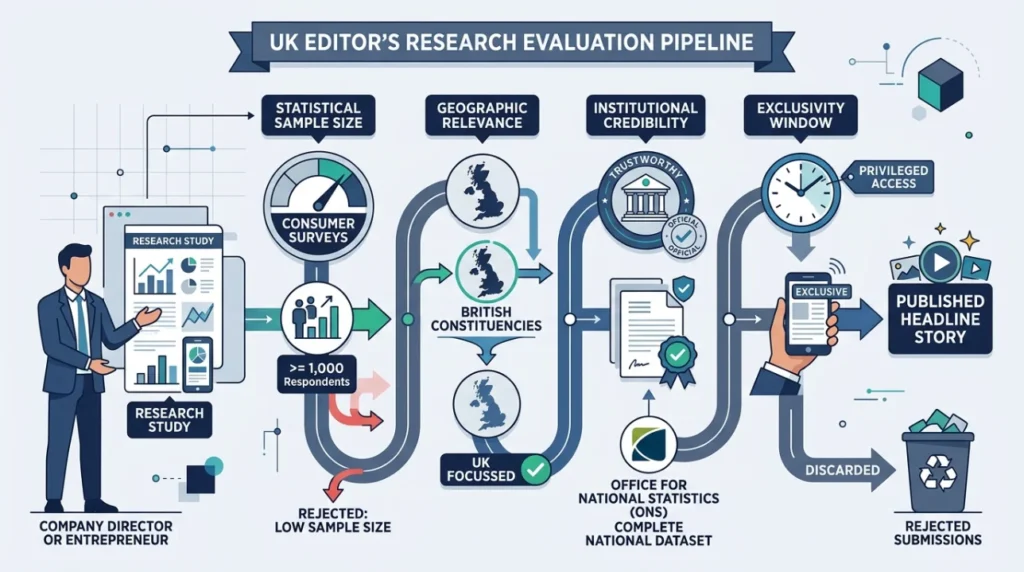
The evaluation workflow follows a rigid sequence within British news organizations. When a press release arrives, a news editor checks the methodology section for transparency. Studies conducted by recognized universities, think tanks, or regulated financial institutions bypass initial skepticism. Conversely, commercial brands commissioning self-published surveys face rigorous scrutiny for bias and self-serving statistical framing.
Geographic specificity dictates editorial placement. Regional editors across the UK press network require localized breakdowns for Scotland, Wales, Northern Ireland, and English regions. A national headline claiming average rental costs exceed 1,200 pounds sterling per month holds less value unless accompanied by regional variances showing London versus North East disparities.
Institutional Credibility and Peer Review Status
Editors verify whether the underlying research underwent peer review or originated from an accredited body such as the London School of Economics, the University of Oxford, or the Nuffield Foundation. Unverified white papers from unknown corporate entities require independent expert verification before publication. News organizations maintain blacklists of organizations flagged for releasing skewed data sets or utilizing unrepresentative polling methodologies.
The Impact of Exclusivity Windows
Newsrooms award prominent placement to exclusive research findings. Editors reject studies simultaneously blasted across mass email distribution networks unless the data holds overwhelming national importance. Providing an exclusive 24-hour embargo window to a single national newspaper or broadcast outlet increases the probability of front-page placement or lead digital placement on news homepages.
Explore More Expert Insights:
How Financial Services Build Trust Using Educational Banner Advertising
How Agencies Increase Buyer Engagement Using Display Remarketing Ads
What are the core components of a newsworthy research headline?
The core components of a newsworthy research headline include a definitive subject noun, an active verb indicating change or status, a precise numerical metric, and a direct UK geographic or demographic qualifier. These elements combine to form a complete factual sentence that answers the reader’s primary question within five seconds.
Every effective headline contains structural constraints designed for rapid digital scanning and print layout fitting. Editors measure headlines by character limits for mobile screens and column inches for print editions. The inclusion of precise entities ensures search engines and AI citation engines index the finding accurately without misrepresenting the scope of the study.
- Subject Noun: Identifies the specific group, sector, or entity studied, such as NHS nurses, London commuters, or UK manufacturing firms.
- Active Verb: States the measured action or outcome without hedging, using terms like rise, fall, lose, or generate.
- Numerical Metric: Quantifies the finding with a percentage, currency amount, or time value, such as 3.2 billion pounds or 14 hours.
- Geographic Qualifier: Restricts the scope to UK jurisdictions, England, Scotland, Wales, or specific municipal authorities.
Avoiding Speculative Language and Hedging
Professional newsrooms ban words like could, might, potentially, and perhaps in headlines because they weaken factual authority. A headline stating “UK housing prices could drop” lacks journalistic weight compared to “UK housing prices fall by 5.4% in annual decline.” Editors demand certainty derived from completed data analysis rather than speculative modeling.
The Danger of Clickbait in Journalistic Standards
UK regulatory frameworks and newsroom ethics committees penalize sensationalized headlines that misrepresent study findings. Clickbait phrasing destroys institutional trust and invites formal complaints to IPSO. A newsworthy headline matches the exact conclusions found in the executive summary of the research report without exaggeration.
Why do research headlines fail to gain editorial traction?
Research headlines fail to gain editorial traction due to excessive corporate jargon, unverified sample sizes, lack of national relevance, and disguised commercial promotions. Editors instantly reject press releases that read as marketing collateral or fail to deliver a distinct statistical takeaway.
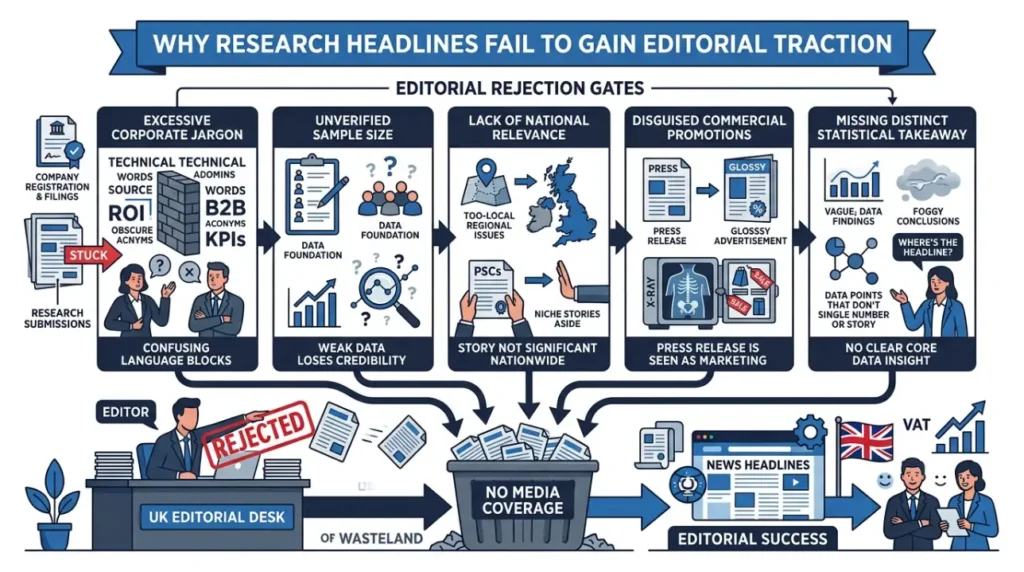
The primary cause of rejection is self-promotion disguised as empirical research. Studies funded exclusively by commercial software vendors or retail brands attempting to prove the superiority of their products face immediate deletion. News desks employ dedicated science and data journalists who audit methodologies and identify conflicts of interest before assigning stories.
Another frequent failure point involves outdated data. Research conducted more than six months prior loses timeliness unless tied to a breaking legislative event or a sudden policy change by HM Treasury or the Department for Health and Social Care. Editors require real-time relevance that aligns with current parliamentary debates or economic indicators published by the Bank of England.
Common Pitfalls in Data Presentation
- Global Datasets Lacking UK Focus: Presenting worldwide statistics without isolating British figures eliminates domestic appeal.
- Inadequate Sample Sizes: Utilizing surveys with fewer than 500 respondents invalidates claims of national representation.
- Vague Percentage Claims: Stating “most consumers” instead of precise figures like “78% of consumers” triggers editorial skepticism.
- Overly Complex Terminology: Using academic shorthand that alienates general news readers and digital audiences.
How does headline development integrate with research launch strategies?
Headline development integrates with research launch strategies by establishing the core news hook during the initial questionnaire design phase of the study. Researchers align survey questions and data aggregation parameters directly with anticipated media demands to guarantee a publishable finding upon release.
Organizations aiming for widespread media pickup design their research methodologies backward from the newsroom. Instead of compiling data and searching for a compelling angle post-completion, communications teams draft target headlines before fieldwork begins. This ensures survey instruments include specific cross-tabulations for age, income, and geographic region that UK editors require for localized reporting.
For those expanding their public relations strategy, understanding how to [Insert Link to MOFU Article] provides foundational insight into structuring overarching media angles. Furthermore, executing a comprehensive campaign requires alignment with specialized frameworks detailed when exploring [Insert Link to BOFU Article] for enterprise-level media distribution and message architecture.
The Phased Integration Workflow
- Hypothesis Generation: Formulate potential news hooks based on current political and economic debates in Westminster.
- Methodology Alignment: Ensure survey panels meet professional standards set by the British Polling Council (BPC).
- Data Isolation: Extract primary anomalies, unexpected contrasts, and record-high or record-low metrics during analysis.
- Headline Testing: Draft multiple headline variants and evaluate them against strict journalistic criteria before public distribution.