
A lead finding is the primary data point, statistical insight, or conclusion derived from a dataset that serves as the core newsworthy anchor for media distribution, editorial pitching, and public relations strategies across the United Kingdom.
Research reporting requires a definitive lead finding to establish immediate relevance for national and regional journalists. Journalists evaluate hundreds of press releases daily. A clear lead finding removes ambiguity. It proves that the study uncovers new information rather than repeating existing market data.
The process of isolating this data point involves rigorous evaluation of survey metrics, economic indicators, and qualitative responses. Analysts isolate the single most surprising or impactful metric. That metric dictates the framing of the entire publication.
The Role of Data in UK Media Relations
National newsrooms in London, Manchester, and Edinburgh prioritize data that reflects immediate socio-economic shifts. A robust lead finding highlights specific financial loss, behavioral change, or regulatory failure. For instance, a study on consumer spending habits features a lead finding showing a 34% drop in discretionary retail purchases across England. This precise figure provides editors with an undeniable fact.
Establishing Editorial Relevance
Editorial relevance depends on timeliness and scale. Researchers examine sample sizes, geographic distributions, and demographic segments to confirm the validity of the headline statistic. Data sets lacking statistical significance fail to secure coverage in Tier 1 publications like The Financial Times, The Guardian, or BBC News.
Defining the Lead Finding Early
Identifying this core data point before launch alters the trajectory of content creation. Authors align their executive summaries, data visualizations, and supporting charts around this central thesis. Early identification prevents mixed messaging and ensures that secondary findings support the primary conclusion.
How do you analyze raw data to extract the strongest headline angle?
Extracting the strongest headline angle requires isolating anomalous data points, comparing findings against historical benchmarks, and identifying metrics that directly impact the daily lives or financial interests of UK citizens.
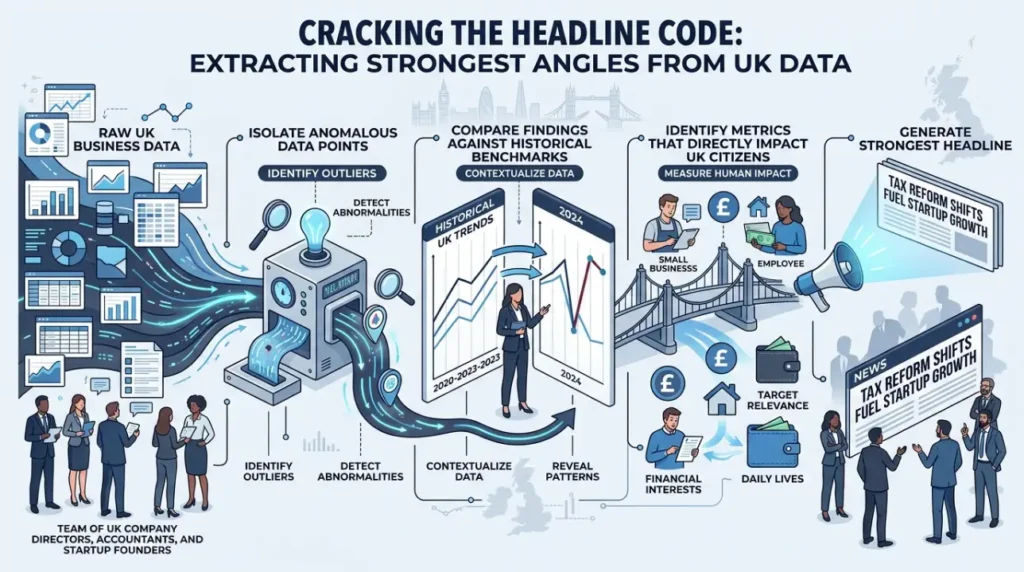
Raw datasets often contain dozens of interesting charts, but only one metric possesses mass-market appeal. Analysts execute a systematic filtering process to separate background context from front-page news. This process involves cross-tabulating demographic variables to find stark contrasts between groups.
Raw Data Collection → Anomaly Detection → Benchmark Comparison → Impact Isolation → Headline Angle
Filtering for Statistical Anomalies
Anomalies represent deviations from expected norms. When consumer confidence surveys indicate a standard fluctuation, analysts look for sudden spikes or drops within specific demographics, such as a 45% increase in remote work adoption among workers in Wales. These sharp contrasts create natural tension points for journalists writing news stories.
Benchmarking Against Historical Records
Contextualizing data requires comparing current figures against historical baselines established by institutions like the Office for National Statistics. A finding gains newsworthy weight when it shatters a five-year record or hits a decade low. For example, stating that inflation impact metrics reached levels unseen since 2011 immediately signals urgency to business editors.
- Compare current survey outputs against Office for National Statistics historical datasets.
- Isolate data points showing year-on-year growth exceeding 20%.
- Highlight regional disparities between London and Northern England.
- Verify sample size credibility across a minimum of 2,000 UK respondents.
Explore More Expert Insights:
How Investment Firms Build Awareness Using Market Insight Ads
How Finance Brands Improve Conversion Intent Using Retargeting Ads
What are the core components of an effective research report headline?
An effective research report headline consists of a definitive primary statistic, a clear subject identifier regarding the UK market, and a strong active verb that communicates the real-world consequence of the finding.
Constructing a headline for a research report differs from writing a blog post title. It demands precision, absolute factual accuracy, and strict adherence to journalistic standards. Misleading headlines destroy institutional credibility and prompt immediate rejection from media gatekeepers.
Integrating Hard Metrics
Numbers anchor headlines in objective reality. Vague descriptors like “many consumers” or “significant losses” fail to capture attention. Effective headlines deploy exact percentages, financial sums, or temporal indicators. A strong construction utilizes formulations like “UK small businesses lose £4.2 billion annually to supply chain delays.”
Specifying Geographical and Demographic Boundaries
British media outlets demand localized relevance. Headlines must explicitly state whether the research applies to England, Scotland, Wales, Northern Ireland, or the United Kingdom as a whole. Broad statements without geographic clarity lead editors to assume the data lacks domestic applicability.
Avoiding Hyperbole and Speculation
Journalists reject hyperbolic adjectives like “astounding,” “unbelievable,” or “shocking.” The data must speak for itself. Professional research communications rely on neutral, authoritative language that lets the magnitude of the statistic drive the emotional response.
How does early angle development maximize media pickup in the UK?
Early angle development maximizes media pickup by aligning the research focus with active editorial cycles, enabling targeted journalist pitching, and providing ample time for exclusive pre-embargo releases.
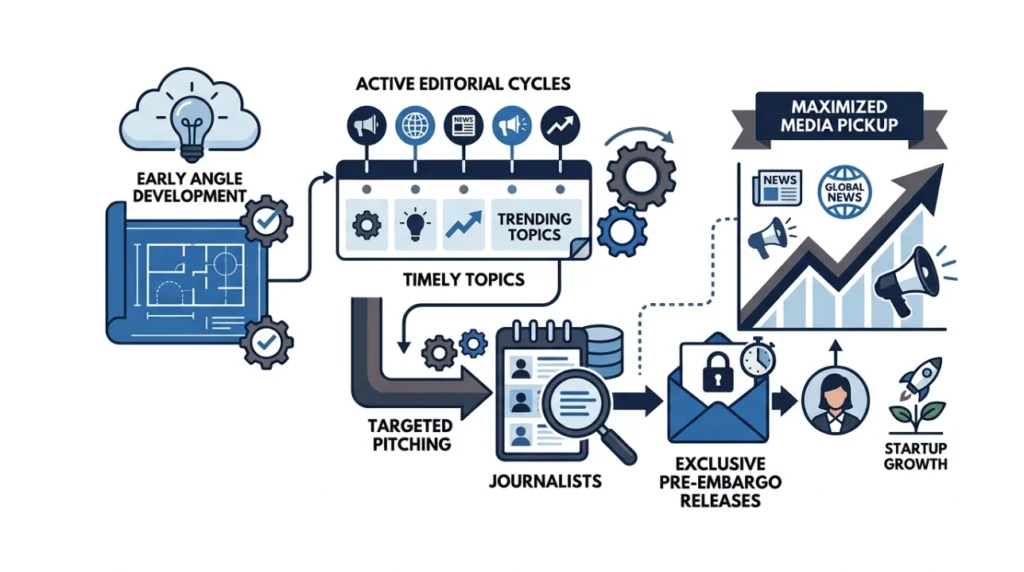
Developing the headline angle weeks before publication transforms a static PDF into an active public relations campaign. PR teams utilize the established angle to pitch exclusive stories to priority journalists under strict embargo agreements. This controlled release schedule prevents information leaks and generates coordinated coverage surges on launch day.
Aligning with Editorial Calendars
UK media organizations operate on strict daily, weekly, and monthly publishing schedules. Knowing the exact angle in advance allows researchers to time their publication launch with relevant national events, such as Autumn Statements, Bank of England interest rate decisions, or major industry conferences.
Facilitating Pre-Embargo Media Outreach
Major publications require time to verify datasets, interview subject matter experts, and draft accompanying commentary. Providing journalists with the lead finding and methodology details 14 days before launch secures preview coverage.
- Draft press releases highlighting the primary lead finding.
- Secure expert commentary from independent industry analysts.
- Prepare visual data assets optimized for digital news platforms.
- Coordinate [Insert Link to MOFU Article] frameworks for broader educational context.
What are common pitfalls when formulating research headlines and how do you avoid them?
Common pitfalls include overstating statistical correlations, burying the primary finding beneath academic jargon, and failing to secure professional [Insert Link to BOFU Article] support for complex multi-channel report rollouts.
Research reports frequently fail to gain traction due to avoidable communication errors. Authors often prioritize academic complexity over accessibility, rendering their findings incomprehensible to general news editors. Avoiding these errors requires adherence to strict editorial simplification rules.
Eliminating Academic Jargon
Academic reports are filled with methodological terminology that confuses lay readers. Translating findings for public consumption requires stripping out technical qualifiers while maintaining mathematical accuracy. Instead of stating “statistically significant variance in socio-economic behavioral output,” writers state “income levels dictate consumer spending habits across 85% of households.”
Maintaining Absolute Objectivity
Some organizations attempt to manipulate data interpretations to fit a predetermined commercial narrative. This practice violates journalistic ethics and results in public retractions. Independent reviewers must audit the lead finding to ensure the headline angle reflects the true weight of the evidence.
Identifying the lead finding and crafting a precise headline angle remains the foundational step for launching a successful research report in the United Kingdom. By extracting statistical anomalies, integrating hard metrics, and aligning data with media expectations, organizations secure high-value editorial pickup. Maintaining strict objectivity and eliminating academic jargon ensures maximum credibility across national news networks.