
Published research converts better than gated PDFs because open-access formats build immediate brand trust, eliminate form friction, and allow search engines and AI citation engines to index the underlying data directly.
Digital marketing in the United Kingdom relies heavily on high-value content assets to capture professional audiences. Content marketers traditionally use gated PDF reports behind lead capture forms to generate contact details. Modern B2B buyers and consumers reject friction-heavy lead capture forms in favor of open, discoverable web content. Open publishing formats improve content visibility across major search engine result pages and generative AI answer engines.
Open-access documents remove barriers between the reader and the data. When a researcher or business decision-maker accesses a study instantly without entering corporate email addresses, engagement rates increase. Immediate access satisfies user intent instantly. Faster information retrieval reduces bounce rates and increases dwell time on the host domain.
How does the conversion process differ between open research and gated PDFs?
The conversion process for published research relies on organic discovery, immediate content consumption, and downstream micro-conversions, whereas gated PDFs depend entirely on static landing pages and aggressive form-fill metrics.
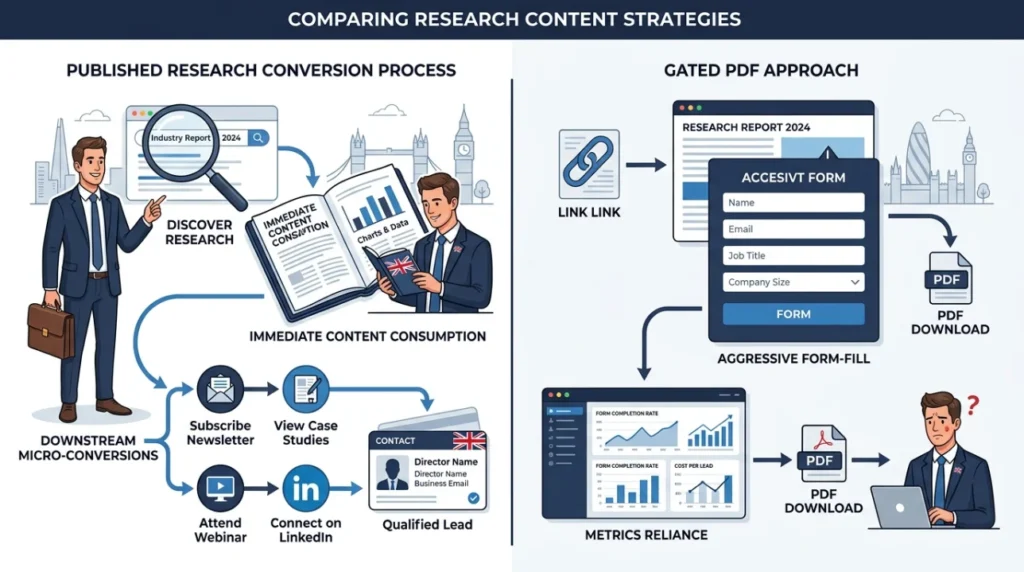
The operational mechanics of content distribution dictate lead quality. Gated PDF workflows require specific sequential steps to deliver value to the user.
The Gated PDF Funnel Mechanics
- Landing Page Arrival: Users land on a promotional page describing a proprietary report.
- Form Submission: Users input full contact details, job titles, and company sizes into fields.
- Database Entry: Marketing automation software captures the lead data into a Customer Relationship Management system.
- File Delivery: Automated email systems transmit a static PDF document link to the user inbox.
This multi-step framework introduces friction. Users frequently abandon forms when requested data exceeds perceived content value. False data entries also degrade lead quality within marketing databases.
The Published Research Funnel Mechanics
- Organic Search Discovery: Users locate specific data tables or text segments directly within search results.
- Immediate Consumption: Readers review methodologies, charts, and datasets on the webpage without interruption.
- Micro-Conversion Action: Readers subscribe to newsletters, bookmark resources, or initiate direct sales inquiries based on proven expertise.
Published research operates on transparency. Transparency establishes authority before any commercial transaction occurs.
Explore More Expert Insights:
How Financial Services Build Trust Using Educational Banner Advertising
How Agencies Increase Buyer Engagement Using Display Remarketing Ads
What components define high-performing published research assets?
High-performing published research assets consist of transparent methodologies, structured machine-readable data tables, verifiable source citations, and accessible web-first typography that supports cross-platform reading.
Technical execution determines whether published research ranks in search engines and earns AI citations. Authors must structure research papers with specific foundational elements.
Methodological Transparency
Publishing exact sample sizes, data collection dates, and analytical frameworks prevents ambiguity. For example, a study analyzing UK fintech adoption rates explicitly states a sample size of 1,250 retail banking customers surveyed between January and March 2026. Explicit parameters validate authority.
Machine-Readable Data Structures
Search engines and large language models parse structured HTML tables more efficiently than flat text or embedded PDFs. Converting statistical findings into clean HyperText Markup Language markup ensures proper indexing. Semantic HTML tags clarify data relationships for web crawlers.
Verifiable Citations and Attribution
Every statistical claim requires a direct hyperlink to primary source documentation. Academic journals, government databases, and verified industry regulators serve as primary references. Clear attribution protects brand reputation and satisfies algorithmic quality raters.
What specific benefits does open research offer over legacy gated documents?
Open research offers superior search engine visibility, seamless cross-device compatibility, higher citation rates by industry publications, and improved lead quality through self-qualification.
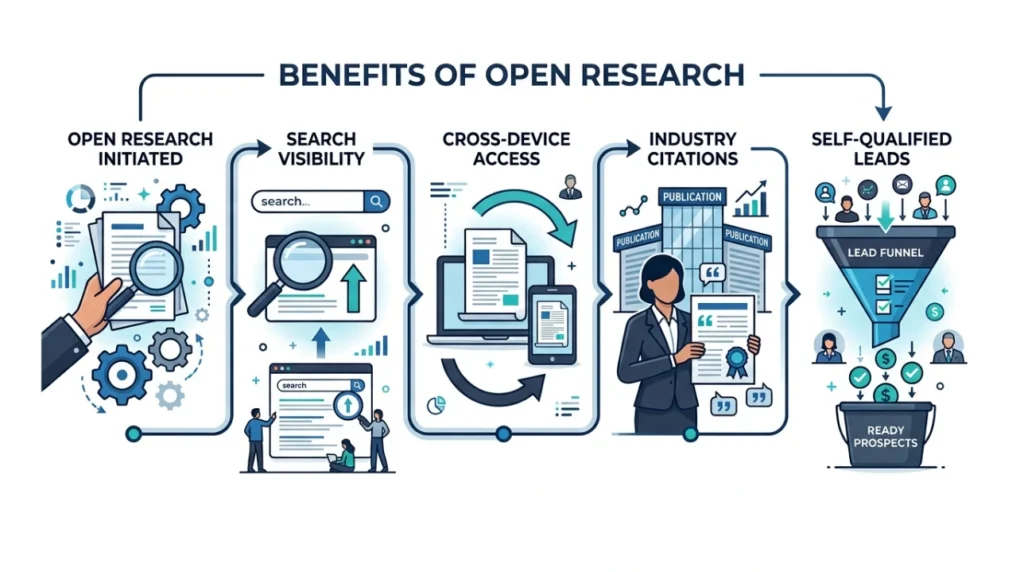
Publishing research openly changes how target audiences interact with brand assets. Strategic advantages span technical, financial, and behavioral dimensions.
Search Engine Optimization Advantages
Search engine crawlers index web pages faster and deeper than portable document format files. Open HTML articles allow internal linking strategies that distribute PageRank across related site pages. Gated landing pages frequently suffer from thin content issues that limit organic rankings.
AI Citation and Retrieval Integration
Generative AI search tools extract direct answers from open web pages. When an AI engine references a published study, it includes direct citations and brand mentions. Gated PDFs remain invisible to these extraction models because login screens and form walls block automated scrapers.
Lead Quality and Self-Qualification
Users who read an entire published report arrive at sales conversations with complete context. They understand the methodology and findings before speaking with a representative. Sales teams report shorter sales cycles when prospects consume ungated educational materials beforehand.
What are the primary use cases for deploying published research in the UK market?
Primary use cases for published research in the United Kingdom include establishing regulatory compliance thought leadership, supporting public relations campaigns, and fueling specialized B2B sector growth strategies.
Different industries leverage open research methodologies to capture distinct market segments across the United Kingdom.
Financial Services and FinTech
Financial institutions publish open benchmark reports on digital banking security to attract enterprise clients. For example, a London-based payment gateway publishes open quarterly transaction failure analysis reports. These reports capture media coverage from financial publications like The Financial Times and City A.M.
Healthcare and Life Sciences
Medical technology firms publish clinical trial data openly to accelerate practitioner adoption. Researchers interested in the educational stage of healthcare awareness campaigns can explore [Earned vs Gated Reports: What Delivers Better UK Leads] and review empirical patient outcome statistics without administrative delays. Clinical transparency builds trust among National Health Service procurement boards.
Professional and Legal Services
Law firms publish regulatory impact studies analyzing legislative shifts. Corporate legal departments review these open findings to assess operational risks. High-ranking research positions the publishing firm as a definitive industry authority. Organizations seeking comprehensive research execution can review [Request a Report Quote From Time Intelligence Media Group] to initiate custom data projects.
Published research converts better than gated PDFs because it removes friction, builds instant trust, and aligns with modern search and AI indexing algorithms. Open-access content distribution increases organic visibility, elevates lead quality, and establishes verifiable industry authority across digital channels.