
Earned reports are public research assets that secure organic media coverage and direct citations, while gated reports require users to submit contact details via a lead capture form before accessing the PDF file.
The modern United Kingdom B2B marketing landscape relies heavily on proprietary data distribution to capture professional interest. Earned reports function as open-access web pages, interactive data dashboards, or downloadable files without form friction. Publishers release these findings to industry journalists, trade associations, and corporate networks to maximize distribution reach. This visibility generates backlinks from high-authority media domains, boosting search engine optimization performance across competitive keyword categories.
Gated reports operate under a transactional exchange model. A marketing team restricts a whitepaper or market research document behind a landing page form. Users input their professional email address, company name, and job title to unlock the file. While this strategy yields a high volume of raw form submissions, the data quality often suffers due to inaccurate entries and low initial purchase intent.
Understanding this distinction shapes how businesses approach lead generation within the British market. Companies evaluating these strategies often review foundational research principles outlined in [Why Published Research Converts Better Than Gated PDFs]. Evaluating performance metrics across both formats reveals distinct operational outcomes for sales pipelines.
How do UK lead generation campaigns execute earned versus gated distribution?
Execution requires distinct operational workflows, where earned strategies focus on digital PR outreach and open web publishing, whereas gated strategies rely on landing page optimization, email automation, and paid traffic acquisition.
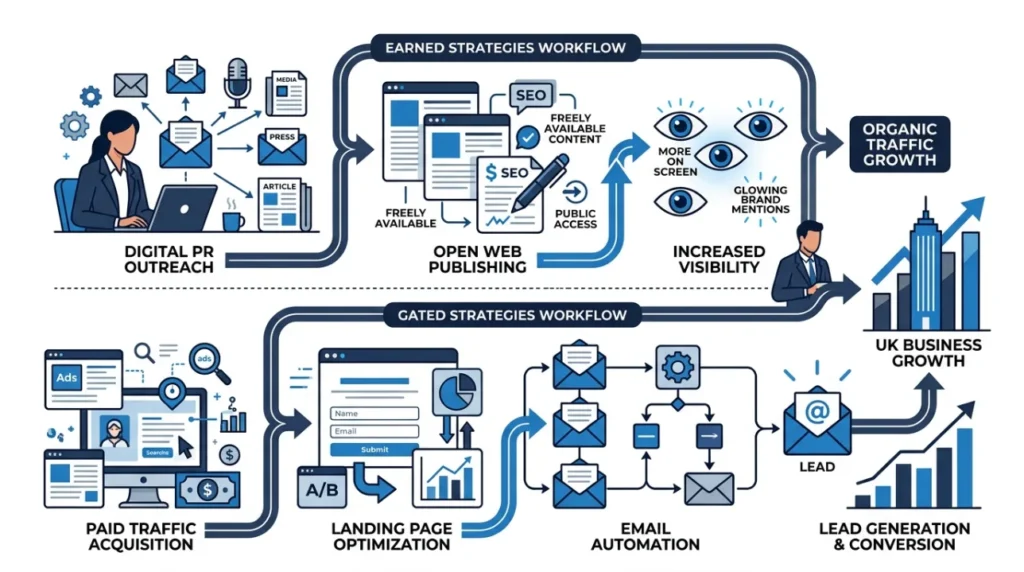
Executing Earned Report Distribution
The earned report workflow starts with primary data collection and statistical analysis. Content teams format the findings into accessible digital articles, interactive charts, or downloadable public documents.
- Data Finalization: Researchers finalize datasets to ensure compliance with UK data protection standards.
- Media Pitching: PR professionals distribute embargoed findings to target journalists across key sectors.
- Open Publishing: The complete report goes live on the corporate website without access barriers.
- Citation Tracking: Brand mentions and backlinks are tracked across digital publications and industry blogs.
Executing Gated Report Distribution
The gated report workflow prioritizes lead capture mechanics and database integration. Marketers package the insights into a polished PDF document and build dedicated infrastructure to collect user data.
- Asset Packaging: Designers format the research into a downloadable PDF asset.
- Landing Page Creation: Conversion rate optimization principles guide the construction of the form submission page.
- Traffic Generation: Paid search and social campaigns direct target accounts to the landing page.
- Nurturing Sequences: Automated email workflows deliver the asset and initiate follow-up contact sequences.
Organizations scaling their lead generation infrastructure frequently integrate these methodologies. Exploring advanced partnership opportunities can streamline campaign execution, such as when teams [Request a Report Quote From Time Intelligence Media Group].
Explore More Expert Insights:
How Investment Firms Build Awareness Using Market Insight Ads
How Finance Brands Improve Conversion Intent Using Retargeting Ads
What are the core components of high-performing B2B research assets?
High-performing research assets require proprietary survey data, transparent methodology sections, professional visual hierarchy, and actionable insights tailored to specific industry verticals.
Proprietary Data and Methodology
Proprietary data serves as the foundation for any credible UK industry report. B2B decision-makers demand verifiable statistics gathered from authentic enterprise sources. A transparent methodology section details sample sizes, geographic distributions across England, Scotland, Wales, and Northern Ireland, and specific data collection timeframes. This transparency eliminates skepticism and establishes brand authority within niche markets.
Visual Formatting and Structure
Visual hierarchy dictates how readers consume complex datasets. Effective reports utilize structured data tables, clear bar charts, and concise executive summaries. Dense paragraphs reduce user engagement, whereas visual data points facilitate rapid comprehension for busy executives. Incorporating clear headings and bulleted insights ensures the content satisfies human readers and search engine algorithms simultaneously.
What specific benefits do earned reports provide for UK brand authority?
Earned reports deliver superior search engine rankings, higher brand trust, broader media amplification, and qualified inbound inquiries from enterprise-level prospects.

Search Engine Optimization and Domain Authority
Earned reports generate natural backlinks from reputable news outlets, academic institutions, and industry associations. Search engines reward these external citations with higher domain authority and improved keyword rankings. Gated PDFs remain invisible to search engine crawlers because the content sits behind a login or form submission barrier. Open-access research pages capture high-volume organic search traffic continuously over multi-year periods.
Brand Trust and Lead Quality
Publishing data openly signals confidence in corporate expertise. Prospective buyers consume the insights without encountering sales friction or aggressive remarketing pixels. This friction-free environment fosters genuine brand affinity. When these readers eventually contact a sales team, their product knowledge is advanced, and their conversion probability exceeds that of cold database leads captured via gated forms.
When should marketers deploy earned versus gated strategies in the UK?
Marketers deploy earned strategies to build long-term brand equity and organic visibility, while deploying gated strategies for short-term sales pipeline generation through targeted account-based marketing.
Use Cases for Earned Reports
Earned distribution models suit organizations targeting broad market awareness, regulatory influence, or public relations milestones. Financial institutions, technology vendors, and management consultancies utilize open research to shape industry discourse. For example, a London-based fintech firm publishing an open-access report on UK payment regulations secures widespread citations in financial media, positioning the firm as an undisputed market leader.
Use Cases for Gated Reports
Gated distribution models function effectively within narrow, high-value account-based marketing campaigns. Niche software providers selling enterprise resource planning systems use gated technical whitepapers to capture verified contact details from named accounts. Sales representatives leverage these direct form submissions to initiate targeted outreach conversations with known decision-makers within specific corporate sectors.