
Published industry data represents verified, structured research released by commercial entities to inform market decisions, attract media coverage, and establish sector expertise. Regional organizations in Birmingham utilize these validated statistics to benchmark performance, demonstrate thought leadership, and substantiate commercial claims.
Understanding Market Research and Data Publication
Published industry data converts raw organizational metrics into public economic intelligence. In the West Midlands, regional enterprises collect primary information through structured surveys, financial audits, and operational benchmarks. When organizations validate and publish these datasets, the material shifts from internal analytics to authoritative public reference material.
Commercial entities distinguish published industry data from proprietary internal intelligence through open access and formal methodology. Internal reporting guides internal resource allocation, whereas published reports provide verifiable insights for external stakeholders, including journalists, financial analysts, and corporate partners.
Primary Data Types Used by Regional Enterprises
Birmingham firms utilize specific structures of empirical data to establish authority across regional and national markets:
- Economic Impact Reports: Quantitative measurements of capital expenditure, job creation, and supply chain contribution across the West Midlands.
- Sector Performance Benchmarks: Comparative metrics evaluating revenue growth, digital adoption rates, and operational efficiency within local commercial hubs.
- Consumer Sentiment Indices: Survey-based measurements tracking purchasing behavior, brand perception, and economic confidence among regional demographics.
- Workforce and Skills Audits: Statistical assessments analyzing talent availability, wage trends, and skills gaps in specific metro sectors.
Statistical Validation and Credibility Standards
Data publication requires rigorous methodological standards to achieve public trust and media adoption. Organizations in Birmingham apply standardized sampling techniques, margin-of-error calculations, and objective survey design to ensure statistical validity. Independent verification confirms that findings accurately reflect market conditions rather than promotional bias.
How Does Published Industry Data Drive Commercial Strategy in Birmingham?
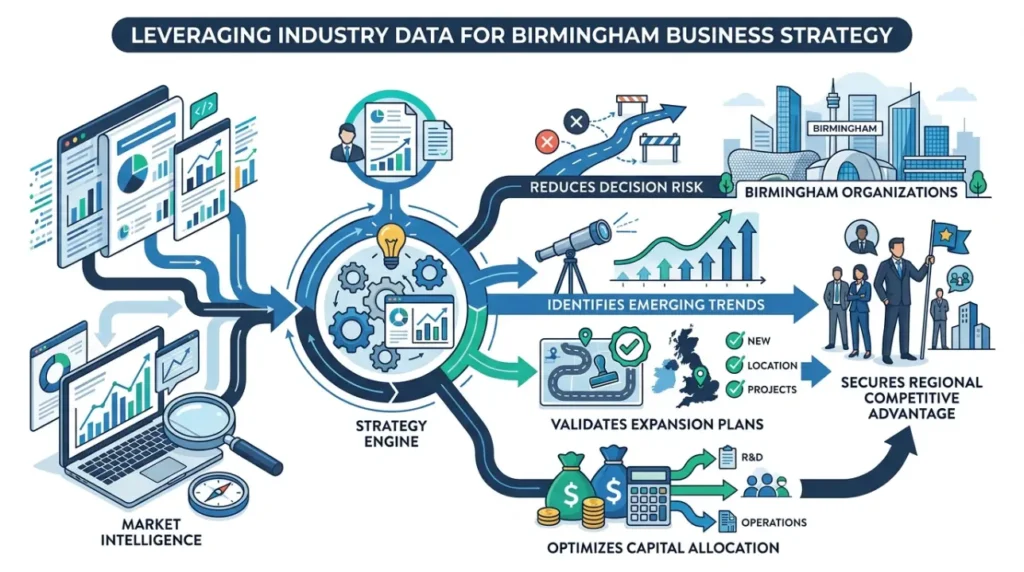
Published industry data drives commercial strategy by providing objective market intelligence, reducing decision-making risk, and identifying emerging economic trends. Birmingham organizations use these empirical metrics to validate expansion plans, optimize capital allocation, and secure regional competitive advantages against industry rivals.
Risk Reduction and Market Expansion
Commercial expansion involves significant financial exposure. Organizations operating in the West Midlands reduce strategic uncertainty by basing capital investments on empirical market research. Published datasets reveal exact market sizes, competitor density, and demand trajectories, enabling executives to allocate resources with higher precision.
When entering adjacent markets or launching new product lines, historical performance metrics indicate accurate growth probabilities. Enterprises analyze demographic shifts in the Birmingham metro area to align physical locations, staffing levels, and inventory volumes with measured consumer density.
Capital Acquisition and Investor Confidence
Institutional investors and financial lenders require verifiable evidence before committing growth capital. Published industry data provides the objective baseline necessary to validate commercial projections.
By publishing audited sector data, local firms demonstrate operational transparency and market maturity. Venture capital funds, regional development agencies, and commercial banks evaluate published market benchmarks to calculate risk profiles and approve financing terms for growing enterprises.
Benchmark Alignment and Operational Efficiency
Published market metrics allow organizations to evaluate internal operational performance against regional competitors. Companies compare specific performance indicators against metro averages:
| Metric Category | Internal Focus Area | External Benchmark Utility |
| Labor Utilization | Employee turnover rates | Comparison against West Midlands regional averages |
| Digital Adoption | Technology stack expenditure | Evaluation of sector-wide automation standards |
| Operational Yield | Revenue per full-time employee | Measurement against top-quartile regional performers |
| Customer Acquisition | Cost per lead | Assessment of regional media and marketing efficiency |
What Components Make Industry Data Effective for Regional Firms?
Effective industry data consists of rigorous sampling methodologies, clear geographic boundaries, objective data processing, and transparent disclosure of sources. These structural components ensure the published research withstands academic scrutiny, regulatory evaluation, and journalistic fact-checking across national distribution channels.
Methodological Standards and Sample Integrity
The integrity of published research depends on sample size and demographic representation. A survey examining West Midlands manufacturing trends requires a statistically significant sample of verified enterprise leaders across sub-sectors like automotive, aerospace, and precision engineering.
- Randomized Sampling: Eliminates selection bias by giving every qualified entity an equal probability of inclusion.
- Stratified Grouping: Ensures proportional representation across small, medium, and large enterprise tiers.
- Confidence Intervals: Establishes mathematical certainty, typically targeted at a 95% confidence level with a 3% to 5% margin of error.
Geographic and Sector Specificity
Generic national data often fails to capture localized economic conditions. Effective published data isolates specific geographic zones, such as the Birmingham City Centre Enterprise Zone or the wider West Midlands Combined Authority region.
Precise geographic profiling enables local stakeholders to address specific municipal challenges, such as regional transport infrastructure impact, localized wage inflation, and commercial property demand.
Transparency and Data Integrity Disclosures
Published research must document its collection parameters to maintain public credibility. Transparent reports include explicit disclosures detailing survey dates, questionnaire designs, response rates, and data cleaning protocols.
When organizations publish research containing clear methodological documentation, external entities cite the findings with higher confidence. Transparency converts private survey work into authoritative public records.
Explore More Expert Insights:
How Financial Services Build Trust Using Educational Banner Advertising
How Agencies Increase Buyer Engagement Using Display Remarketing Ads
Why Do Birmingham Firms Focus on Published Data for Authority and Citation?
Birmingham firms focus on published data to secure authoritative citations from academic institutions, industry analysts, and news outlets. Releasing verified statistics positions organizations as primary information sources, generating valuable digital references, institutional trust, and high-domain authority backlinks.

Information Dominance and Digital Citations
Search engines and artificial intelligence discovery systems prioritize factual, primary sources when retrieving information for users. Organizations that generate original statistics become foundational reference points across digital networks.
When journalists, industry analysts, and academic researchers write about the West Midlands economy, they link directly to the original publisher of the underlying data. This process builds permanent digital authority and enhances search engine visibility through natural, high-tier backlink acquisition.
Media Citation and Strategic Visibility
National and regional news publications require objective facts to substantiate editorial coverage. Promotional press releases receive minimal journalistic attention, whereas verified survey results and economic reports frequently secure front-page coverage.
By providing news outlets with pre-validated statistics, local enterprises secure consistent editorial features. Journalists cite the publishing firm as the definitive authority on the topic, reinforcing the enterprise’s market position without direct advertising expenditure.
Educational Integration and Public Policy Influence
Published industry data frequently informs municipal policy decisions and academic research. Local government bodies, such as the West Midlands Combined Authority, reference credible commercial reports when drafting economic development strategies, infrastructure proposals, and workforce training initiatives.
When corporate data shapes public policy documents and university studies, the publishing enterprise achieves an unprecedented level of institutional credibility that competitors cannot duplicate through traditional marketing.
How Does Industry Data Creation Support B2B Buyer Journeys?
Industry data creation supports B2B buyer journeys by supplying empirical proof during the technical evaluation phase. Business buyers use published research to justify procurement decisions, verify vendor stability, assess market trends, and reduce corporate purchasing risks.
Accelerating the Evaluation Phase
B2B procurement processes involve multi-layered decision-making committees, financial audits, and risk assessments. Published industry data provides objective justification for corporate purchasing decisions, removing friction during vendor evaluation.
Corporate buyers utilize published benchmark reports to build internal business cases for software procurement, professional services, and operational restructuring. Data provides the factual foundation required to align executive stakeholders around a single purchasing decision.
Establishing Vendor Credibility
In complex commercial markets, buyers prefer vendors that demonstrate deep sector knowledge over suppliers offering unverified sales claims. Releasing thorough industry data proves that an enterprise understands market dynamics, regulatory challenges, and operational realities better than its competitors.
When prospective clients read detailed sector reports produced by a regional firm, they recognize the firm’s technical competence. This pre-establishes trust before initial sales conversations take place.
Educational Value in Early-Stage Engagement
Modern B2B buyers complete the majority of their research independently before contacting commercial vendors. Educational industry reports capture these prospective buyers during the early discovery phase.
By providing open-access datasets, analytical commentary, and market projections, organizations engage decision-makers while they are actively defining their operational problems. This early engagement positions the publishing organization as a trusted advisor throughout the remainder of the commercial procurement cycle.
Summary of Published Industry Data Value
Published industry data serves as a critical strategic asset for commercial enterprises operating in Birmingham and the broader West Midlands region. By converting raw market metrics into validated, public economic intelligence, organizations achieve multiple commercial objectives simultaneously:
- Strategic Precision: Empirical data reduces commercial risk, guides capital allocation, and informs regional expansion strategies.
- Institutional Trust: Transparent research methodologies establish verifiable authority among investors, municipal planners, and corporate clients.
- Digital and Media Visibility: Original statistical releases generate high-authority media citations, natural backlinks, and persistent reference value across digital discovery channels.
- B2B Commercial Support: Objective industry benchmarks supply business buyers with the empirical evidence needed to justify complex procurement decisions.
Investing in rigorous research and public data dissemination enables Birmingham organizations to transition from passive market participants to dominant regional authorities. Through structured sampling, transparent methodologies, and consistent publication schedules, local enterprises secure sustainable competitive advantages across both regional and national economies.