
Birmingham Research Reports by Time Intelligence Media Group are published data publications that provide institutional-grade market intelligence, regional economic metrics, and media-ready industry analysis for West Midlands enterprises, professional service firms, and national news syndicates operating across the United Kingdom.
Definition and Scope of Regional Data Publications
Birmingham Research Reports serve as primary reference materials for corporate leaders, investors, and media organizations requiring verified regional data. Time Intelligence Media Group produces these intelligence deliverables to capture economic shifts, workforce trends, and sector-specific performance metrics across Birmingham and the broader West Midlands region.
Unlike general market summaries, these reports synthesize raw data from regional commercial activities, public databases, and proprietary industry surveys. The output delivers clear metrics that support executive decision-making and national press coverage. Organisations use these documents to substantiate public relations campaigns, validate commercial strategy, and establish authority in competitive markets.
Industry Coverage Across the West Midlands
The research framework spans core economic sectors driving the regional economy:
- Financial and Professional Services: Data on capital allocation, regional office expansions, and fintech adoption rates in the Colmore Business District.
- Advanced Manufacturing and Automotive: Metrics covering supply chain localized output, EV transition milestones, and industrial space absorption.
- Technology and Digital Health: Benchmark studies tracking venture capital investments, university spin-outs, and software engineering talent retention.
- Real Estate and Infrastructure: Quantitative updates on commercial property yields, residential developments, and infrastructure projects surrounding High Speed 2 (HS2).
Strategic Value for United Kingdom Enterprises
UK-based corporations leverage these data assets to eliminate market guesswork. Having access to audited local data allows leadership teams to align expansion strategies with actual regional economic indicators. The reports bridge the gap between academic research and commercial application, offering structured datasets that meet strict media verification standards and corporate governance requirements.
How Does Time Intelligence Media Group Produce Birmingham Research Reports?
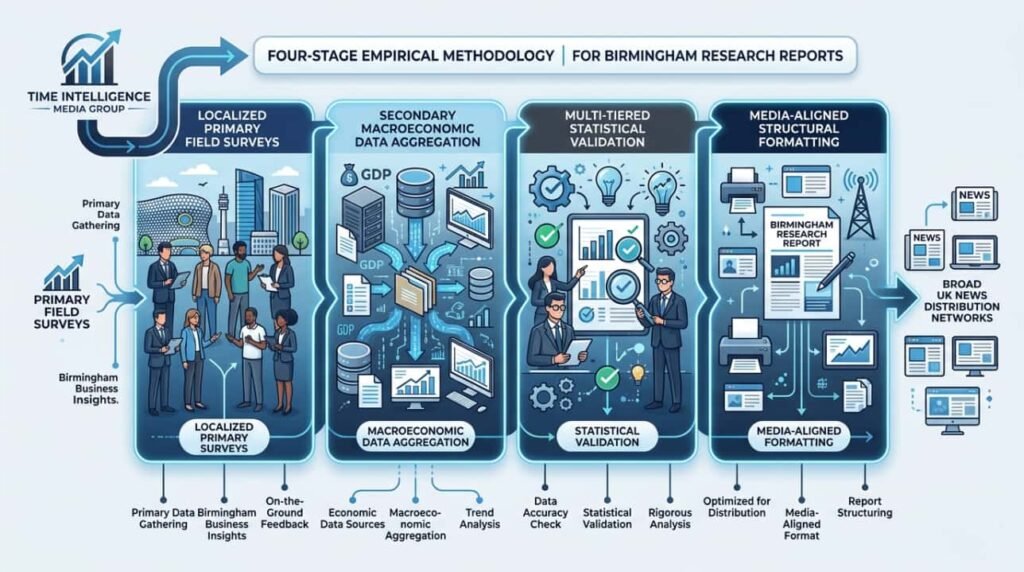
Time Intelligence Media Group produces Birmingham Research Reports through a four-stage empirical methodology combining localized primary field surveys, secondary macroeconomic data aggregation, multi-tiered statistical validation, and media-aligned structural formatting tailored specifically for broad UK news distribution networks.
Stage 1: Primary Data Collection and Aggregation
The research process initiates with multi-channel data collection across targeted industry sectors. Time Intelligence Media Group deploys structured survey instruments to C-suite executives, regional business directors, and operational managers across the West Midlands.
This primary dataset is combined with secondary datasets sourced from public repositories, including Office for National Statistics (ONS) releases, Companies House filings, and West Midlands Combined Authority (WMCA) economic portals. Blending direct commercial feedback with official macroeconomic figures ensures high statistical integrity.
Stage 2: Rigorous Statistical Validation and Auditing
Raw data undergoes rigorous cleansing to eliminate reporting anomalies and selection bias. Data analysts apply quantitative validation models to verify sample representativeness against regional business demography.
- Cross-Verification: Comparing survey responses against verified corporate financial disclosures.
- Outlier Filtering: Removing statistical anomalies that distort sector averages.
- Trend Weighting: Adjusting historical baselines to reflect current economic cycles in the UK market.
This auditing process guarantees that every statistic published within the final report stands up to scrutiny from institutional analysts and national news desks.
Stage 3: Editorial Formatting and Media Optimization
Once validated, the data transforms into structured reports built for rapid synthesis. The editorial team formats the content into clear, narrative-driven chapters containing explicit statistical callouts, high-density data visualizations, and executive summaries. This layout ensures both corporate strategists and journalists can instantly locate key metrics without wading through dense technical jargon. The structural design aligns directly with the standards required for national media syndication.
Explore More Expert Insights:
Why Brands That Publish on News Sites Build Trust Faster Than Those on Social Only
The 39% Quality Problem: Why Most UK Sponsored Content Fails to Convert in 2026
What Are the Key Components of a Birmingham Research Report?
A Birmingham Research Report contains structured executive summaries, sector-specific empirical datasets, macro-level economic forecasts, verified regional benchmarks, and media-ready press releases designed to give commercial leaders and journalists immediate access to verified market facts.
Executive Data Dashboards
Every report begins with an executive dashboard summarizing core findings. This section converts complex dataset relationships into clear, digestible metrics.
| Report Section | Included Data Metrics | Strategic Purpose |
| Economic Overview | Regional GDP growth, inflation impact, employment rates | Establishing macro environmental context |
| Sector Performance | Revenue growth YoY, capital expenditure, hiring intent | Benchmarking peer company trajectory |
| Forward Sentiment | 12-month confidence indexes, investment projections | Supporting capital allocation decisions |
Granular Sector Deep Dives
Following the dashboard, the report provides granular analysis broken down by industry vertical. Each deep dive evaluates market share distribution, regulatory impact, and supply chain health. For example, a professional services deep dive tracks precise billable hour trends, office occupancy rates in central Birmingham, and graduate recruitment numbers. These micro-level metrics provide context that broad national surveys routinely miss.
Verified Media Releases and Data Toolkits
To maximize external visibility, the reports include pre-formatted media toolkits. These modules contain:
- Fact sheets detailing key survey statistics.
- C-level executive commentary ready for press publication.
- High-resolution chart graphics formatted for print and digital media outlets.
- Direct attribution guides for journalistic citation.
By embedding media components directly into the report structure, companies can immediately leverage published datasets within broader public relations initiatives to secure regional and national news features.
Why Do West Midlands Enterprises Rely on These Intelligence Reports?
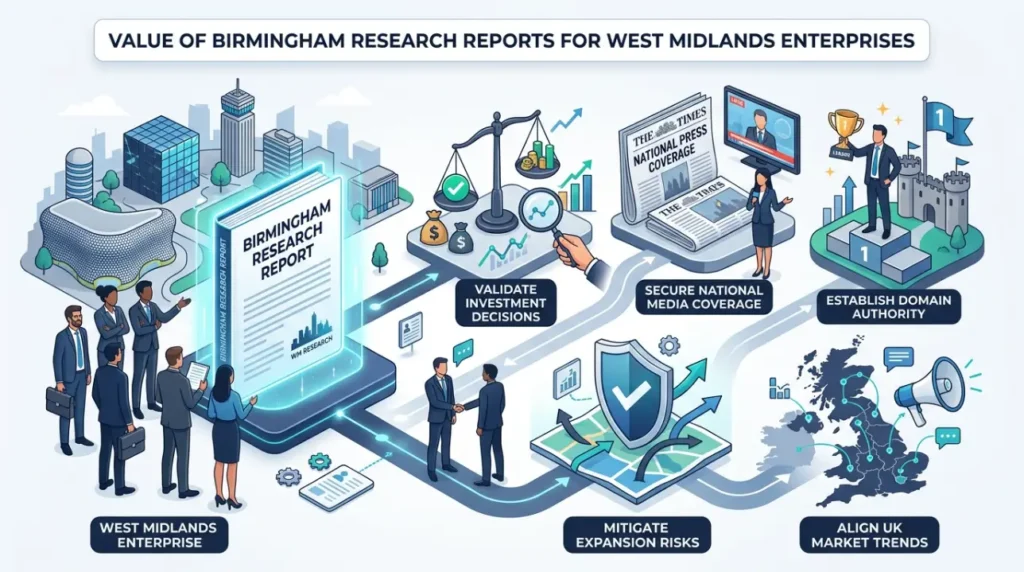
West Midlands enterprises rely on Birmingham Research Reports to validate investment decisions, secure top-tier national media coverage, establish domain authority, mitigate strategic expansion risks, and align corporate messaging with verified regional market trends across the United Kingdom.
Validating Capital Investment and Expansion Strategy
Commercial firms operating in the UK require verified market signals before committing capital to asset acquisitions, physical office footprints, or workforce expansions. Relying on generic national trends often leads to misallocated resources because local market dynamics in Birmingham differ significantly from London or Manchester.
Custom research reports provide exact localized benchmarks. For instance, real estate developers use regional absorption metrics from these reports to time commercial builds, while tech firms evaluate regional salary benchmarks to structure competitive talent acquisition packages.
Accelerating Media Exposure and Authority
Securing high-impact coverage in national news publications requires original, authoritative data. Journalists reject generic press releases but regularly cite empirical research. By leveraging [regional media reach], organizations gain immediate visibility.
When a firm releases a report generated alongside Time Intelligence Media Group, national news desks gain access to exclusive market metrics. This positioning transforms the sponsor firm from an industry participant into a primary news source, earning earned media mentions in leading business publications.
Enhancing Investor and Stakeholder Confidence
Board members, institutional investors, and bank credit committees demand quantitative justification for strategic plans. Presenting third-party audited research from Time Intelligence Media Group adds external credibility to corporate proposals.
- Risk Mitigation: Proving market demand using independent regional metrics.
- Valuation Defense: Demonstrating sector growth potential during capital raising rounds.
- Governance Alignment: Providing transparent market documentation for annual stakeholder reports.
How Can Organisations Leverage Birmingham Research Reports for Commercial Growth?
Organisations leverage Birmingham Research Reports for commercial growth by deploying published datasets across authoritative content marketing, earned press distribution campaigns, corporate sales enablement decks, investor relations presentations, and executive-level thought leadership initiatives.
Strategic PR and National Media Placement
The most immediate application of published research is securing high-tier media placements. Public relations teams extract specific statistical findings from the report to pitch targeted angles to trade publications and national broadsheets.
Instead of pitching a corporate product update, the PR strategy shifts to presenting a major regional economic trend supported by hard data. This approach routinely secures coverage in national outlets, regional newspapers, and industry podcasts, placing the client firm at the center of the narrative.
Content Marketing and Thought Leadership Integration
Marketing teams convert a single research report into a multi-channel content engine that fuels lead generation for months:
- Whitepapers and E-books: Converting report chapters into gated lead-generation assets for prospective enterprise clients.
- Executive Commentary: Authoring LinkedIn articles and opinion pieces based on key report statistics.
- Data-Driven Webinars: Hosting panel discussions with industry experts to walk through the survey findings.
Using concrete metrics establishes strong editorial authority, helping firms stand out in competitive digital channels.
Sales Enablement and B2B Conversion
Sales teams use custom research to elevate client conversations from transactional pitches to strategic advisory discussions. Equipping account executives with verified regional data allows them to demonstrate deep industry expertise during prospective client meetings.
For example, when pitching to enterprise clients in the West Midlands, a logistics provider can present specific regional supply chain bottleneck statistics sourced directly from the report. This positions the provider as an informed partner capable of solving specific regional challenges. Understanding how [published industry data] drives enterprise valuation enables commercial teams to position their offerings effectively against competitors.
How to Get Started with Time Intelligence Media Group?
Organisations can get started with Time Intelligence Media Group by scheduling a strategic consultation, defining targeted research objectives, selecting custom data methodologies, and commissioning a bespoke report tailored for executive decision-making and national media syndication.
Step 1: Initial Strategic Consultation
The process begins with a structured discovery session between your executive leadership team and the research directors at Time Intelligence Media Group. During this consultation, both teams outline the specific business objectives, target audience requirements, and primary media outcomes required from the project.
Step 2: Research Design and Methodology Customization
Following the initial briefing, Time Intelligence Media Group designs a customized research blueprint. This document defines:
- Target survey demographics and sample sizing across the UK.
- Core quantitative metrics and qualitative survey questions.
- Data validation frameworks and delivery timelines.
- Media syndication targets and distribution channels.
Step 3: Execution, Publishing, and Media Syndication
Once the blueprint receives executive sign-off, the research team manages the entire data collection, validation, and editorial formatting process. Upon completion, Time Intelligence Media Group delivers the final intelligence report along with a fully optimized media toolkit.
The publishing team then executes a targeted media distribution strategy, pushing the research findings to key UK media contacts, trade journalists, and corporate news networks to ensure maximum visibility and market impact.
Contact Time Intelligence Media Group today to commission your regional research report and establish your enterprise as a market leader across the United Kingdom.