
Quarterly reports serve as structured data assets that provide journalists with fresh, reliable statistics every 90 days. UK brands use these scheduled data releases to generate consistent media coverage, establish sector authority, and secure repeated placements in national publications.
Quarterly reports transform internal business data into public media assets. Public relations teams in the United Kingdom deploy these documents to establish a predictable communication schedule with journalists. Instead of relying on irregular product announcements, organizations publish regular market insights, consumer behavioral trends, or financial performance metrics.
Establishing Sector Authority Through Regular Data
National outlets such as The Financial Times, The Telegraph, and The Guardian require verified figures to support news stories. When a business consistently provides research every three months, reporters treat that business as an authoritative source. This regular output shifts a brand from a reactive market participant to a proactive industry commentator.
Maintaining a Continuous News Cycle
Securing media coverage requires alignment with editorial calendars. Quarterly publishing cycles match the newsrooms’ editorial rhythms. By releasing data every quarter, brands maintain visibility without fatiguing journalists with low-value press releases.
How Do Quarterly Reports Generate Consistent Media Coverage?
Quarterly reports generate media coverage by providing newsrooms with predictable, exclusive, and verifiable data points. Journalists use these insights to frame broader economic narratives, ensuring the issuing brand receives continuous citations, backlinks, and brand mentions across news channels.
Media outlets operate under strict deadlines and constantly require new data points to validate ongoing stories. Quarterly research reports solve this supply problem for journalists by offering turnkey statistics, chartable graphics, and expert commentary ready for immediate publication.
Creating High-Value Data Assets
Journalists prioritize primary research over opinions. A quarterly report containing survey results from 2,000 UK consumers or analysis of 100,000 retail transactions gives reporters a concrete news hook.
Common high-value report angles include:
- Regional economic index performance across the UK
- Shifts in consumer spending habits month-over-month
- Sector-specific hiring trends and wage growth calculations
- Adoption rates of new operational technologies
Securing Syndication and Editorial Follow-Ups
When a major news wire or trade publication cites a quarterly report, secondary publications syndicate the findings. A single report leads to an initial news launch, follow-up feature stories, trade-press deep dives, and expert commentary requests. UK businesses often direct audiences to educational research like [Insert Link to TOFU Article] to explain the broader industry context behind these quarterly findings.
What Key Components Make a Quarterly Report News-Engine-Ready?
A news-ready quarterly report contains methodology-backed primary data, headline-driven executive summaries, localized UK regional statistics, visual data graphics, and clear commentary from company spokespeople. These elements allow journalists to extract stories quickly without extensive editing.
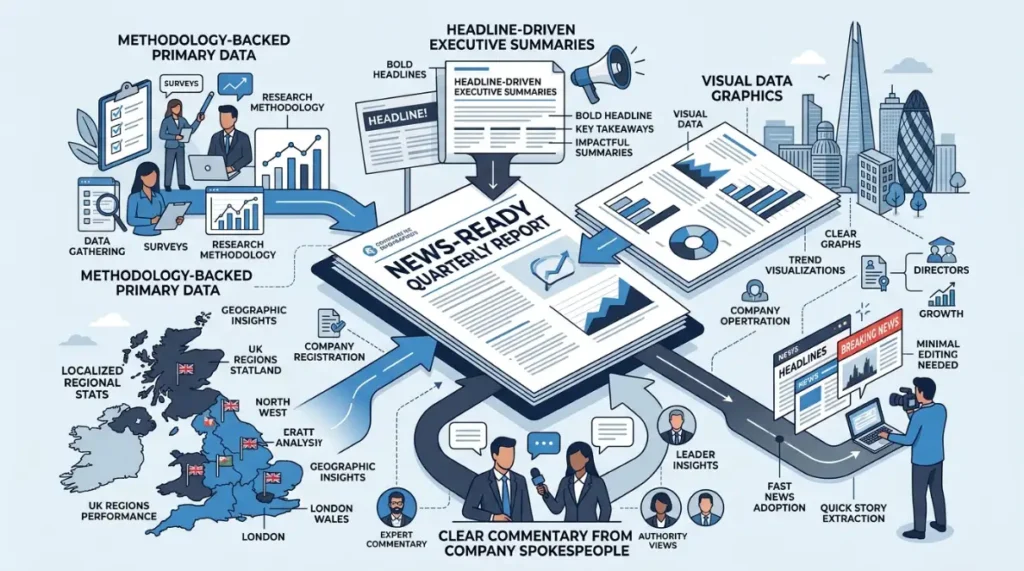
Structuring a quarterly report for media pickup requires strict adherence to newsroom requirements. Reports designed for internal stakeholders rarely succeed as PR assets without specific structural adjustments.
Rigorous Methodology and Data Integrity
National media outlets reject data that lacks methodological transparency. Every report must disclose sample sizes, demographic distributions, data collection dates, and margin-of-error calculations. Reports based on minimum sample sizes of 1,000 to 2,000 UK adults meet standard editorial guidelines for national coverage.
Core Elements of a Press-Optimized Report
Regionalization for Local Media Pickup
National statistics appeal to national news desks, but regional data slices double total media coverage. Dividing UK data sets into specific regions—such as London, the North West, Scotland, and the Midlands—allows local outlets like the Manchester Evening News or Yorkshire Post to run localized headlines using the same master report.
Explore More Expert Insights:
How to Brief a UK Publisher for Sponsored Content That Feels Like Real Journalism
Sponsored Content Across 10 Verticals: UK Engagement Benchmarks 2026
What Process Turns Internal Data into Media-Facing Reports?
The report creation process involves auditing internal datasets, defining media-friendly research themes, conducting external validation surveys, analyzing statistical trends, drafting press-ready summaries, and pitching exclusive data angles to targeted national and trade journalists across the UK.
Transforming raw operational metrics or consumer behavioral trends into press coverage requires a standardized production workflow. This process spans six distinct steps over an eight-week timeline prior to the target release date.
Step-by-Step Production and Distribution Workflow
- Data Auditing and Ideation: Identify unique internal datasets or commission consumer panels focusing on emerging economic trends.
- Survey Design and Execution: Formulate non-leading survey questions that test specific news hypotheses among targeted demographic samples.
- Statistical Analysis: Process raw response data to extract macro-level trends, YoY (Year-over-Year) growth numbers, and anomalous data points.
- Report Authoring: Write the full report alongside condensed press releases, infographics, and executive summaries.
- Targeted Media Pitching: Distribute exclusive report previews under embargo to tier-one UK journalists 72 hours before public release.
- Public Release and Syndication: Publish the full report online, launch press releases across news wires, and distribute key findings across digital channels.
Organizations looking to scale this technical output often evaluate specialized media production solutions, such as [Insert Link to BOFU Article], to manage the end-to-end data gathering, design, and press distribution framework.
What Are the Measurable PR Benefits of Quarterly Publishing?
Quarterly publishing delivers measurable benefits, including domain authority growth through high-tier editorial backlinks, increased brand search volume, established executive thought leadership, elevated share of voice against competitors, and sustainable lead generation over long release cycles.
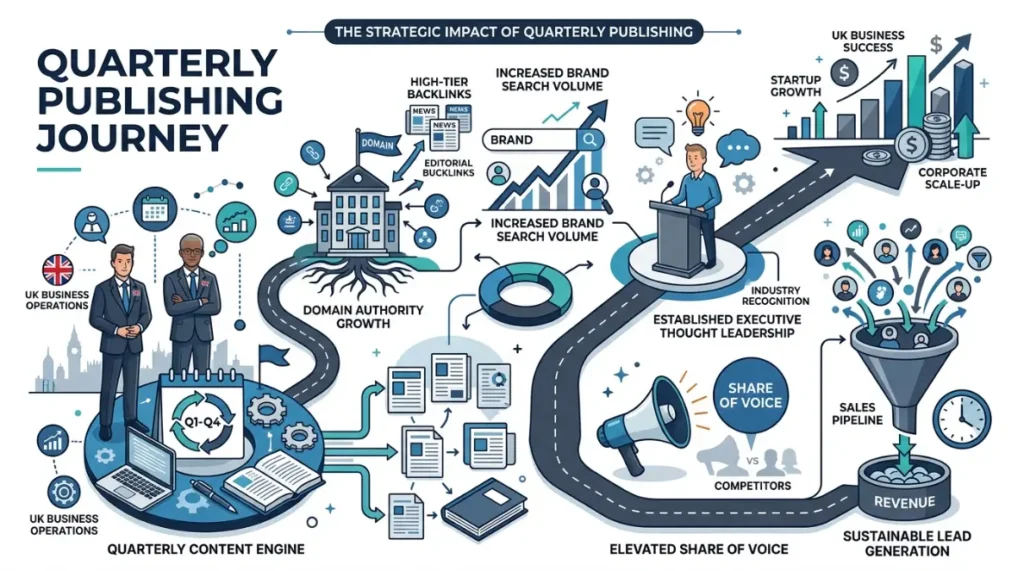
Executing a quarterly research strategy builds compounding marketing value over time. Unlike short-term PR campaigns that yield temporary visibility spikes, regular reporting constructs a permanent library of cited research assets.
Domain Authority and Search Visibility
Editorial mentions in publications like BBC News, Reuters, or CityAM regularly include contextual backlinks to the source report. These high-authority links improve search engine rankings for core commercial keywords. The continuous publish cycle creates fresh, keyword-rich indexable pages that capture long-tail search traffic.
Share of Voice (SoV) Dominance
Publishing data four times per year guarantees a baseline of active press campaigns. This regular activity ensures a company maintains a higher Share of Voice (SoV) than competitors relying solely on sporadic corporate announcements. Over 12 months, this frequency establishes the brand as the default commentary source for industry journalists.
How Are UK Brands Across Different Sectors Using Quarterly Reports?
UK brands across finance, real estate, technology, and recruitment use quarterly reports to analyze market shifts, influence regulatory discussions, present consumer benchmarks, and secure recurring coverage in both specialized B2B trade publications and broad national news outlets.
Different business sectors adapt the quarterly report format to match their specific market dynamics and target audiences.
Financial Services and FinTech
FinTech platforms and financial institutions publish quarterly spending indices, inflation impact reports, and regional investment tracking. For example, Challenger banks release quarterly consumer saving behavior reports that analyze millions of anonymous transaction logs to highlight UK savings trends.
Commercial and Residential Real Estate
Property platforms and estate agencies utilize quarterly rental and housing price trackers. Outlets like Zoopla and Rightmove release quarterly house price indices that national news outlets reference as standard economic barometers.
Technology and B2B SaaS
Software providers publish industry benchmark reports analyzing cybersecurity threat frequencies, cloud adoption rates, or workplace productivity metrics. These data sets position B2B software companies directly in front of enterprise decision-makers reading industry-specific trade publications.
Recruitment and Human Resources
Staffing firms release quarterly employment monitors measuring job vacancy volumes, average salary changes, and skills shortages across UK industries. These statistics provide journalists with immediate insights into the health of the UK labor market.
How Do Quarterly Reports Drive Long-Term SEO and AI Citation?
Quarterly reports build long-term search engine visibility and AI citation by generating authoritative structured data, structured entity relationships, high-tier editorial backlinks, and clear factual citations that large language models and search engines store as trusted reference information.
Modern search engines and artificial intelligence discovery systems prioritize authoritative, structured, and frequently updated sources of primary information.
Supporting Natural Language AI Models
Large Language Models (LLMs) and search engine knowledge graphs extract factual statements from authoritative digital media sources. When national news outlets quote a quarterly report’s statistics, search algorithms index those figures as verified entity data. This citation pattern ensures that when users query AI search engines about sector metrics, the issuing brand is cited as the primary data source.
Building Organic Citation Loops
A published quarterly report continues to gather backlinks long after its initial release date. Researchers, academics, journalists, and industry bloggers regularly cite historical quarterly data to illustrate multi-year trends, generating continuous organic backlinks without requiring additional outreach expenditure.
What Common Pitfalls Cause Quarterly Media Reports to Fail?
Quarterly media reports fail when they rely on biased survey questions, lack statistical significance, include overt product sales messaging, miss editorial deadlines, or present complex datasets without clear, headline-ready insights for busy journalists.
To maximize newsroom adoption, PR and marketing teams must eliminate structural and promotional errors before pitching data to the media.
Pitfalls to Avoid in Quarterly Reporting
- Overt Commercial Pitching: Including product names or promotional claims within the report body leads to immediate rejection by journalists.
- Insufficient Sample Sizes: Surveying small, non-representative panels compromises data credibility and creates legal liabilities.
- Overly Complex Formatting: Hiding key statistics inside dense, multi-page PDF documents without plain-text summaries prevents fast journalist reviews.
- Irregular Release Timelines: Missing quarterly publication windows breaks established coverage patterns with regular newsroom contacts.
- Static Visuals: Failing to provide high-resolution, embeddable data charts reduces pickup across digital-only media outlets.
Eliminating these errors ensures that quarterly reports function as effective, recurring media assets that secure long-term press coverage, elevate market authority, and strengthen brand presence across the UK media landscape.