
A quarterly report in UK public relations is a data-driven publication released every three months. It presents original statistics, industry trends, or economic insights to media outlets to generate consistent press coverage, build sector authority, and secure editorial links.
Core Function of Data-Driven Reports
Quarterly reports transform internal data or proprietary survey findings into structured news stories. UK media outlets require objective information to validate news reporting. By releasing fresh datasets four times a year, organisations provide journalists with verified figures that support seasonal and economic news narratives.
Difference Between Financial and PR Quarterly Reports
Financial quarterly reports fulfill legal obligations for public companies listed on the London Stock Exchange (LSE). PR quarterly reports serve an editorial purpose. These publications focus on broader market trends, consumer behaviour shifts, or employment statistics rather than internal balance sheets.
| Report Type | Primary Audience | Core Content | Main Objective |
| Financial Report | Shareholders, Investors, Regulators | Revenue, EBITDA, profit margins, debt | Regulatory compliance, investor confidence |
| PR Trend Report | Journalists, Editors, Industry Peers | Survey data, market benchmarks, forecasts | Earned media coverage, brand authority |
How Do Quarterly Reports Match the UK Media Cycle?
Quarterly reports match the UK media cycle by providing journalists with reliable, scheduled news angles four times per year. National newsrooms organize editorial calendars around quarterly cycles, creating predictable opportunities for data-backed brand features.
Alignment with Editorial Calendars
National newspapers such as The Times, The Daily Telegraph, and The Guardian, alongside sector trade journals, plan coverage around quarterly financial and economic markers. Releasing data in Q1, Q2, Q3, and Q4 ensures stories coincide with broader media discussions regarding annual targets, seasonal spending, and macroeconomic performance.
The Role of News Hooks in Media Coverage
Journalists reject pitches that lack timely context. A quarterly report creates a distinct news hook. For example, releasing retail spending data at the start of Q4 allows journalists to frame the numbers around upcoming Christmas trading periods, increasing the likelihood of publication.
What Are the Key Components of an Editorial Quarterly Report?
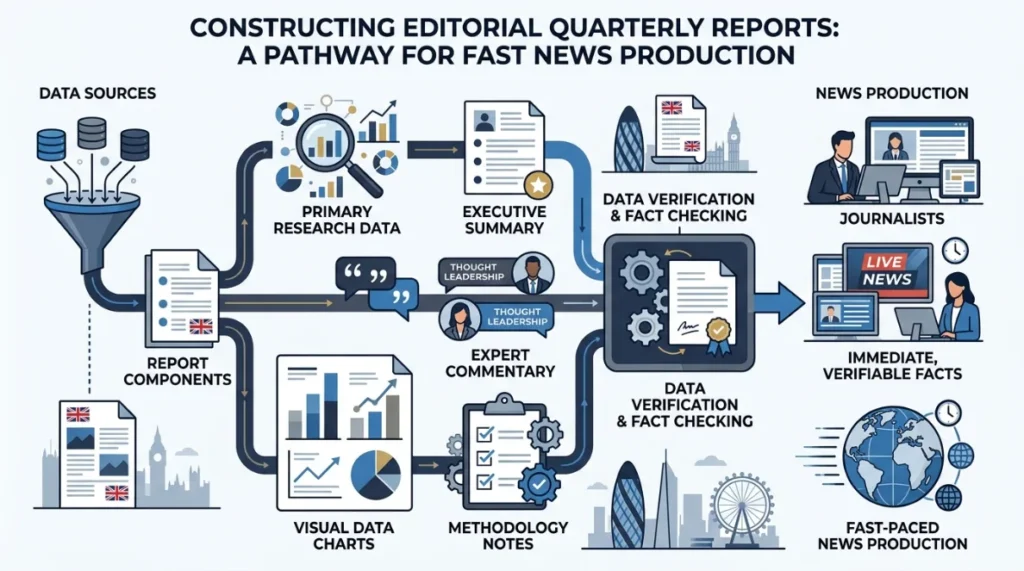
The key components of an editorial quarterly report are primary research data, an executive summary, expert commentary, visual data charts, and clear methodology notes. These elements give journalists immediate, verifiable facts necessary for fast-paced news production.
Primary Research and Data Collection
Primary data forms the foundation of any news report. Methods include consumer polling via market research firms such as YouGov, platform usage analysis, or anonymized customer transaction data. Reports using sample sizes of 2,000 UK adults meet standard national editorial requirements.
Executive Summary and Headline Data
Journalists review news pitches in seconds. An executive summary condenses complex research into three to five statistical bullet points.
- Headline finding showing percentage change (e.g., a 14% increase in remote working adoption in Q2).
- Regional breakdown across UK territories (e.g., Greater London versus the West Midlands).
- Demographic insights covering age brackets or income tiers.
Methodology and Statistical Transparency
National publications verify data sources before publishing. A dedicated methodology section details the sample size, research date range, and collection methods. Transparent data builds editorial trust and prevents coverage rejections based on unverified claims.
Explore More Expert Insights:
How Fintech Companies Acquire Users Using Banner Ads
How Finance Brands Promote Credit Cards Using Display Campaigns
Why Do Journalists Rely on Quarterly Data from Businesses?
Journalists rely on quarterly business data because newsrooms face tight deadlines and shrinking editorial budgets. External data reports provide pre-verified, high-quality statistics that reporters can quote directly to validate economic and industry stories.
Newsroom Resource Constraints
UK newsrooms operate with fewer staff producers than in previous decades. Reporters must produce multiple articles daily. Data-backed quarterly reports function as pre-packaged research, saving journalists hours of primary investigation while maintaining journalistic standards.
Verifiable Data vs. Promotional Claims
PR pitches containing promotional language fail to secure editorial coverage. Quarterly reports succeed because they focus on objective statistics. Media outlets cite data points from industry reports to present factual context to their readership without endorsing a commercial product.
What Types of Data Yield the Highest Media Coverage in the UK?
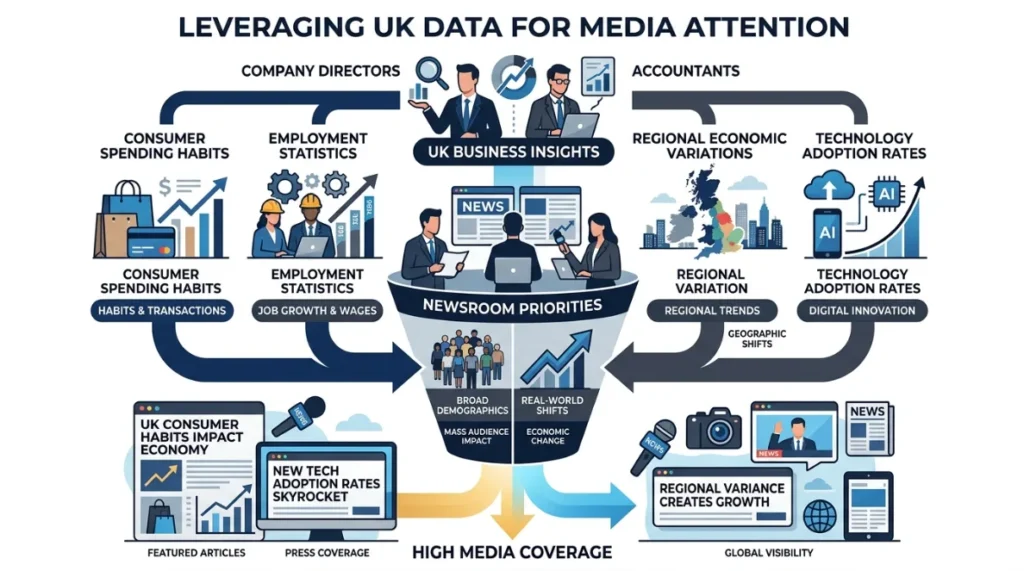
The types of data yielding the highest media coverage in the UK include consumer spending habits, employment statistics, regional economic variations, and technology adoption rates. Newsrooms prioritize data that reflects real-world shifts affecting broad demographics.
Consumer Behaviour and Economic Metrics
Data tracking household expenditure, inflation responses, and purchasing decisions garners consistent coverage across national news outlets. For example, tracking monthly grocery spend shifts provides broad-interest content for consumer affairs desks at broadcast networks like the BBC and ITV.
Regional UK Insights
National editors seek stories with regional angles to engage audiences outside London. Reports containing breakdowns across specific regions—such as Scotland, Wales, the North West, and the South East—allow local outlets like the Manchester Evening News or Yorkshire Post to run localized versions of a national story.
How Does Publishing Quarterly Reports Impact Long-Term Brand Authority?
Publishing quarterly reports impacts long-term brand authority by establishing a company as a definitive source of industry intelligence. Over time, journalists bookmark regular report publishers, leading to inbound media requests, expert commentary features, and sustained organic backlinks.
Securing Editorial Backlinks and Domain Authority
National news sites cite the original publisher when referencing quarterly statistics. These citations include high-value editorial backlinks. Acquiring links from high-authority news domains enhances search engine visibility, driving organic traffic to core digital assets. Understanding [how quarterly reports keep UK brands in the news] enables organizations to turn periodic research into a predictable engine for organic search growth.
Becoming a Reference Point for Industry Benchmarks
Consistent quarterly publishing creates a historical archive of data. Analysts, academic institutions, and industry peers quote these benchmarks over time. This continuous citation cycle solidifies an organization’s position as a primary sector voice. Executing this effectively requires a structured strategy for [quarterly report publishing], ensuring every release meets strict media standards and reaches key editorial decision-makers.
What Steps Are Required to Produce a Media-Ready Quarterly Report?
The steps to produce a media-ready quarterly report involve defining research objectives, gathering data, structuring editorial findings, drafting news releases, and executing targeted PR distribution to relevant media desks.
Step 1: Defining Key Hypotheses and Angle
Before collecting data, establish clear hypotheses that align with current UK news narratives. Identify what shifts are occurring in the market and frame questions that will yield definitive statistical answers.
Step 2: Data Collection and Fieldwork
Execute data collection through customer databases or third-party polling panels. Ensure sample sizes meet statistical significance criteria for UK national media coverage.
Step 3: Report Drafting and Design
Transform raw data into a structured PDF or digital hub. Use visual charts, callout quotes, and clear section breaks to make information easily scannable for reporters.
Step 4: Media Outreach and Embargo Management
Distribute the report to target journalists under embargo 48 to 72 hours prior to the official launch date. Pre-pitching allows reporters time to analyze the figures, conduct follow-up interviews, and schedule publication for the release day.
How Do UK Companies Measure the PR Success of a Quarterly Report?
UK companies measure the PR success of a quarterly report through quantitative metrics like earned media placements, editorial link count, domain authority increases, referral traffic, and secondary coverage quotes across trade publications.
Media Coverage Quality Metrics
Evaluating success requires looking beyond volume. High-value outcomes include placements in top-tier national news outlets, inclusion of key statistics in story headlines, and direct quotes from internal spokespeople.
Search Engine and Referral Impact
Digital impact is measured using analytics platforms. Key metrics include:
- Referral Traffic: Direct website visitors clicking through links embedded in news coverage.
- Backlink Profile Growth: New referring domains acquired directly from report citations.
- Keyword Rankings: Improved rankings for industry terms driven by increased domain authority.
Summary of Quarterly Report Benefits for UK News Cycle Relevance
Quarterly reports provide a structured framework for securing repeatable media exposure in the UK. By publishing objective, data-backed insights four times per year, organizations solve newsroom resource challenges while establishing industry authority. Aligning internal data collection with the national editorial calendar ensures consistent visibility across print, digital, and broadcast news media.