
UK journalists evaluate report credibility by examining data provenance, sample sizes, methodology transparency, and author independence. Newsroom editors reject unverified statistics, small survey samples, promotional bias, and reports lacking clear contact details for academic or technical data source verification.
National newsrooms, regional publications, and trade outlets in the United Kingdom process hundreds of press releases daily. Editorial teams apply strict verification standards to filter out promotional surveys and artificial statistics.
Data Sourcing and Sample Requirements
Journalists analyze raw numbers before reading narrative conclusions. Representative sampling forms the baseline of credibility in UK media.
- Sample Size: Consumer surveys require a minimum of 2,000 UK adults using weighted demographic sampling to reflect national age, region, and gender balances.
- Methodological Transparency: Methodologies must explicitly state data collection dates, target demographics, margin of error, and surveying methods (e.g., online panels or phone interviews).
- Source Authority: Data drawn from official bodies like the Office for National Statistics (ONS), government departments, or accredited research organizations carries immediate editorial trust.
Independence and Commercial Neutrality
UK media outlets operate under strict editorial codes, including the Independent Press Standards Organisation (IPSO) principles and Ofcom guidelines. Reports designed purely to promote a product face immediate rejection. Credible reports separate commercial sponsors from factual outcomes, presenting objective conclusions regardless of corporate interest.
What Methodology Standards Do UK Newsrooms Require for Data-Driven Reports?
UK newsrooms require methodology standards that include representative sampling, verified statistical margins of error, transparent survey questions, and explicit documentation of data collection methods. Editors reject reports hiding raw datasets, non-weighted panels, or leading survey questions.
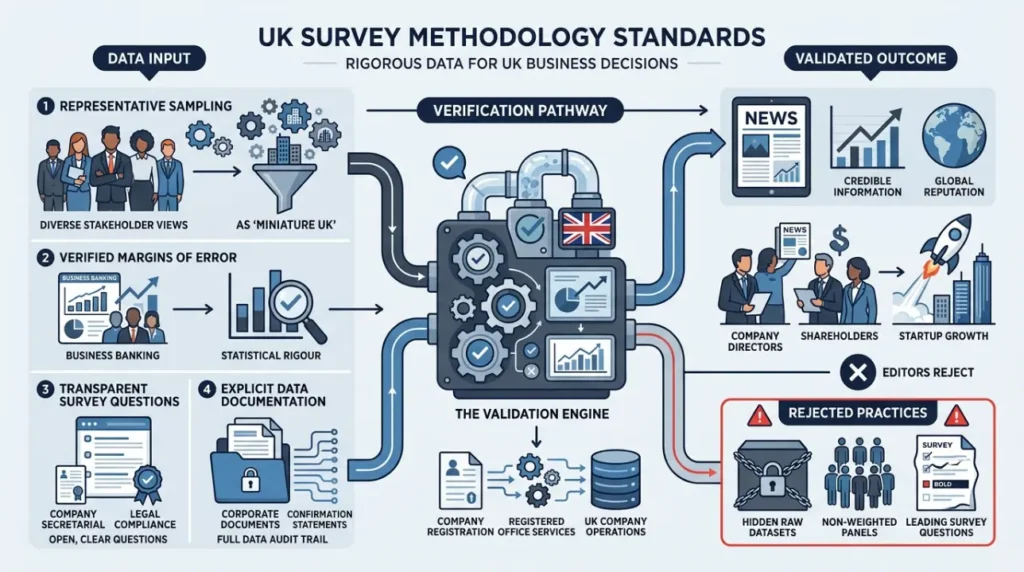
To pass editorial review, research reports must include a formal methodology appendix. Newsrooms use this section to determine if the findings meet academic and journalistic standards.
Statistical Precision and Sample Integrity
Statistical validity depends on sample composition. A survey of 100 business executives cannot represent the entire UK enterprise sector. Newsrooms check for specific statistical parameters:
- Demographic Weighting: Survey panels must align with Census statistics for regional distribution across England, Scotland, Wales, and Northern Ireland.
- Margin of Error: Reports must specify confidence intervals, typically aiming for a 95% confidence level with a margin of error under 3%.
- Question Neutrality: Survey questions must avoid leading phrasing. Journalists frequently request full questionnaires to verify that options provided to respondents were balanced.
For broader context on baseline research criteria, review the guide on [Insert Link to TOFU Article].
Peer Verification and Raw Data Access
Providing open access to raw datasets allows reporters to run independent cross-tabulations. Offering downloadable CSV files or direct contact details for the lead statistician speeds up the editorial verification process.
Explore More Expert Insights:
Headlines for Sponsored Articles: 9 Formulas That Drive UK News Reader Clicks
Sponsored Content Calendar Planning: A 12-Month UK Framework for B2B Brands
What Key Components Must Be Included in a Report to Build Media Trust?
A credible report must include an executive summary, clear data visualizations, a detailed methodology section, expert commentary, independent peer reviews, and accessible author contacts. Excluding raw data, methodology disclosures, or contact information signals poor credibility to UK reporters.
Structuring a report correctly allows journalists to find crucial facts quickly during fast-moving news cycles.
| Report Component | Required Standards | Purpose for UK Journalists |
| Executive Summary | Concise key findings presented with concrete numbers. | Allows reporters to scan core findings in under 30 seconds. |
| Methodology Section | Explicit details on sample size, dates, and weighting. | Provides proof of statistical rigor and IPSO compliance. |
| Data Visualizations | High-resolution, unedited charts with labelled axes. | Direct assets for digital newsroom publication. |
| Neutral Expert Quotes | Quotes from non-commercial analysts or academics. | Offers immediate third-party validation for news stories. |
| Data Tables | Fully itemized cross-tabulations by region and age. | Gives journalists unique angles for localized coverage. |
Designing Clear Data Visualizations
Charts and graphs must present numbers without optical distortion. Truncated y-axes, missing legend labels, and misleading scale variations undermine trust. Reporters require clear, high-resolution vector or PNG images with explicit source attributions directly underneath the visual.
Integrating Qualified Commentary
Including commentary from independent experts—such as university professors, registered industry analysts, or former public officials—adds authority. Quotes must interpret the implications of the data rather than sell a commercial product or service.
How Does Third-Party Data Verification Improve Media Acceptance Rates?
Third-party data verification improves media acceptance rates by eliminating perceived corporate bias and providing independent validation. UK journalists accept verified data faster because independent auditing bodies, academic partnerships, and recognized polling agencies confirm the statistical accuracy of the research.
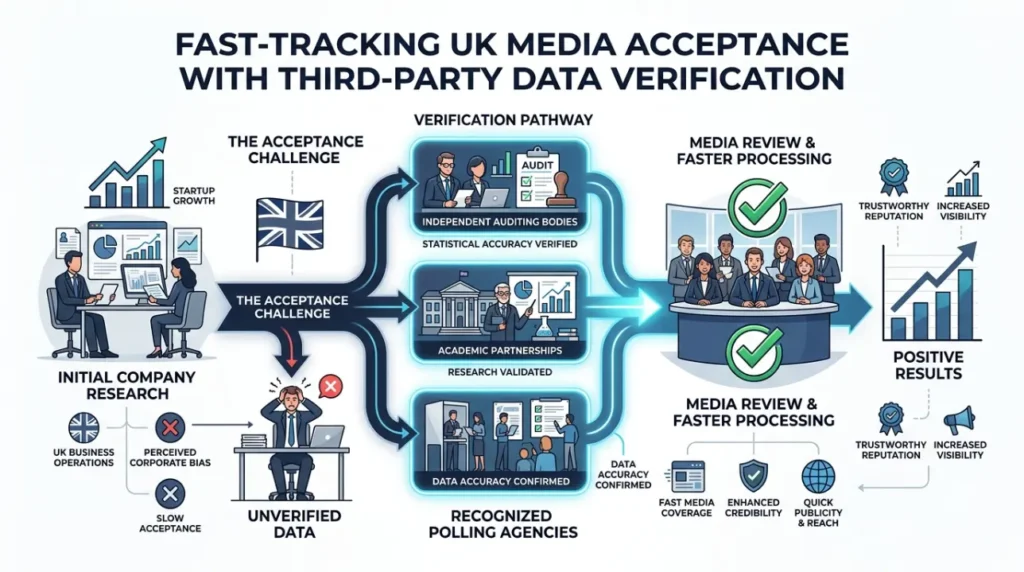
When brands commission research, journalists naturally suspect bias. Third-party auditing removes this commercial friction.
Partnering with Accredited Polling Agencies
Working with members of the Market Research Society (MRS) or the British Polling Council (BPC) guarantees adherence to professional codes of conduct. These accreditations confirm that research follows strict ethical guidelines and recognized statistical frameworks.
Academic and Analytical Collaboration
Co-authoring reports with academic institutions or established economic consultancies increases media pick-up. Academic co-authors apply rigorous peer-review standards, ensuring data withstands scrutiny from specialist trade reporters and national science editors alike.
Organizations preparing high-level research can refine their outreach strategy using professional media audits, such as those available through a [Insert Link to BOFU Article].
What Common Errors Cause UK Journalists to Reject Research Reports?
UK journalists reject research reports due to small sample sizes, leading survey questions, commercial bias, unverified claims, missing methodology details, and outdated data. Reports that fail to provide transparent source attribution or raw data are routinely discarded.
Avoiding standard editorial red flags preserves long-term credibility with national and trade journalists.
Over-interpreting Minor Differences
Data claims must show statistical significance. Reporting a 2% variance between two demographic groups as a “major national trend” represents a fundamental misuse of statistics. UK reporters identify these discrepancies immediately and reject the entire report.
Conflating Correlation with Causation
Asserting a definitive causal link based purely on correlational survey data is a primary reason for rejection. Reports must state facts clearly without introducing unsubstantiated cause-and-effect claims.
How Can Organizations Structure Case Studies to Earn UK National Coverage?
Organizations structure credible case studies by placing verified data metrics, real-world operational outcomes, and named human sources at the center of the narrative. UK national media outlets reject anonymous claims, vague percentage increases, and unverified ROI metrics.
Case studies provide human context to abstract statistical reports. However, journalists require strict verification before publishing corporate case studies.
Required Elements for Media-Grade Case Studies
- Named Participants: National newspapers require named individuals, job titles, and locations. Anonymous testimonials rarely pass editorial checks.
- Hard Baseline Data: Case studies must present clear “before and after” metrics (e.g., “reduced operational expenditure by £140,000 over 12 months” rather than “improved efficiency”).
- Third-Party Verification: Financial or operational improvements require independent verification via public records, audited accounts, or customer sign-offs.
By maintaining strict statistical integrity, transparent methodologies, and independent validation, organizations produce research reports that consistently earn coverage in top-tier UK newsrooms.