
A startup research report is a structured document containing primary data, industry analysis, market sizing, and financial projections. Founders submit these reports to institutional investors, angel syndicates, and venture capital firms to validate commercial viability during fundraising rounds.
Startup research reports convert broad business ideas into verifiable economic metrics. Investors require evidence to confirm market demand before deploying capital. Research reports aggregate sector data to reduce risk profiles.
Primary Functions of Funding Reports
Research reports serve four distinct functions in early-stage financing:
- Market Validation: Establishing Total Addressable Market (TAM), Serviceable Addressable Market (SAM), and Serviceable Obtainable Market (SOM) with third-party sources.
- Risk Reduction: Identifying regulatory hurdles, competitive pressures, and supply chain vulnerabilities.
- Valuation Support: Providing financial benchmarks and unit economics to justify investment valuations.
- Due Diligence Acceleration: Presenting audited data points to shorten investor review timelines.
Why do UK investors require data-backed reports before investing?
UK investors require data-backed reports to meet fiduciary obligations, comply with Financial Conduct Authority regulations, and verify valuation models. Third-party research eliminates founder bias, providing clear metrics on market capture, customer acquisition costs, and competitive landscapes.
The UK investment ecosystem operates under strict regulatory frameworks. Institutional investors manage capital on behalf of private funds, pension schemes, and high-net-worth individuals. Fiduciary duty obligates fund managers to document due diligence processes before writing checks.
Mitigating Information Asymmetry
Founders possess deep operational knowledge of their products. Investors possess capital but lack detailed insights into niche market operations. This imbalance creates information asymmetry. Research reports resolve this imbalance by standardising market information into verifiable data sets.
Financial Conduct Authority Compliance
UK venture capital funds and angel networks operate under FCA guidelines regarding risk assessment. Investment committees must archive independent research confirming market sizing assumptions. Reports compiled with audited methodologies ensure fund managers maintain regulatory compliance.
How do research reports accelerate the UK venture capital due diligence process?
Research reports accelerate due diligence by consolidating technical validation, market sizing, and competitor analysis into a pre-verified format. This allows investment analysts to audit assumptions immediately, reducing the average diligence period from 16 weeks to 6 weeks.
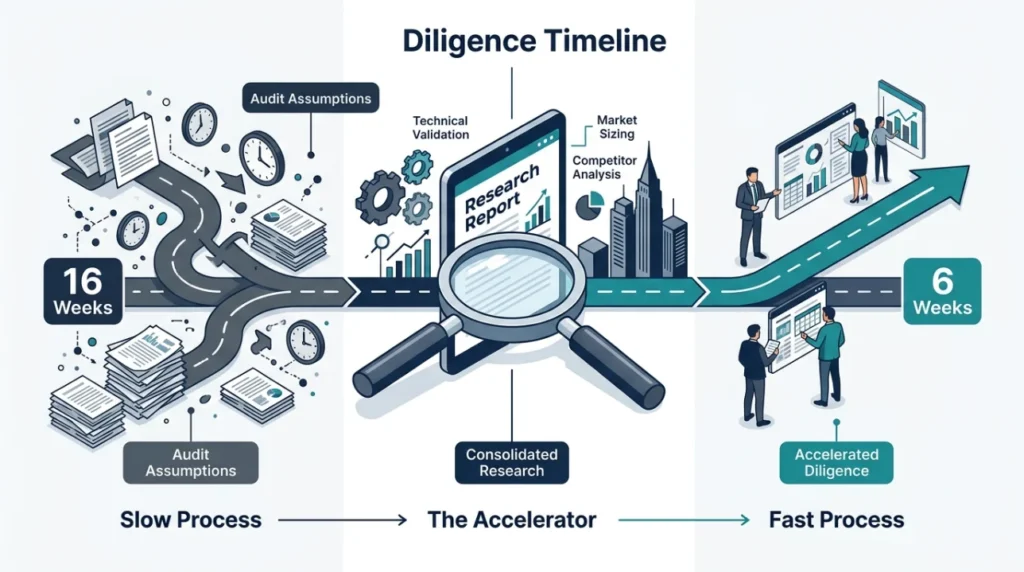
Due diligence requires investment teams to test every claim made in a pitch deck. Unverified pitch decks cause delays while analysts independently verify customer acquisition metrics, regulatory risks, and TAM figures.
Streamlining Analyst Review Steps
Venture capital analysts follow standard audit protocols during due diligence:
- Top-Down Sizing Verification: Analysts cross-reference internal projections with independent sector reports.
- Competitor Mapping: Reports map direct and indirect competitors, eliminating manual market mapping by the fund.
- Unit Economics Auditing: Independent data validates figures for Customer Lifetime Value (LTV) and Customer Acquisition Cost (CAC).
- Regulatory Risk Analysis: Research outlines UK compliance standards, such as GDPR, consumer duty, and ESG reporting rules.
When founders present a pre-compiled research report, investment analysts verify existing sources rather than building market analyses from scratch.
What core components must a fundraising research report contain?
A fundraising research report must contain top-down and bottom-up market sizing, competitor benchmarking, regulatory analysis, unit economics data, customer survey findings, and a 5-year TAM growth forecast supported by verifiable statistical references.
High-converting research reports avoid opinion-based narratives. Every claim requires factual documentation and accurate data points.
Essential Document Architecture
- Executive Summary: A 2-page overview of key market metrics, growth rates, and structural advantages.
- Market Opportunity Analysis: Detailed calculations of TAM, SAM, and SOM.
- Competitive Intelligence Matrix: Quantitative comparisons of pricing, market share, feature velocity, and retention rates across competitors like Revolut, Wise, and Monzo.
- Regulatory and Compliance Framework: Analysis of UK regulatory standards, tax incentives such as SEIS and EIS, and trade policies.
- Primary Research Data: Qualitative survey results from a minimum of 200 target buyers or 15 enterprise decision-makers.
- Financial Benchmarking: Industry averages for churn rate, gross margin, payback period, and net retention rate.
How does market sizing research validate a startup valuation?
Market sizing research validates startup valuations by providing bottom-up proof of achievable revenue within target sectors. Investors multiply realistic market share capture rates against SAM metrics to determine if expected financial returns match fund-return requirements.
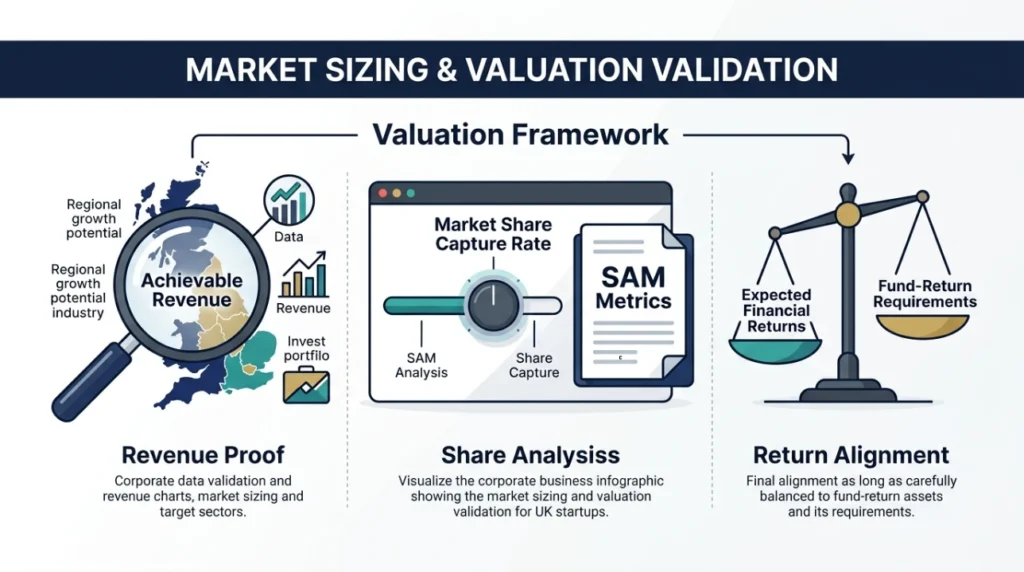
Early-stage valuations rely heavily on potential outcomes rather than historical revenues. A pre-seed startup seeking a £5 million valuation must demonstrate a path to £100 million in enterprise value within 7 to 10 years.
Mathematical Sizing Models
Research reports apply two primary methodologies to justify valuations:
Top-Down Sizing
Top-down models utilize macro-economic statistics from sector databases to establish overall expenditure. For example, a UK healthtech startup identifies the total NHS software expenditure of £3.1 billion annually.
Bottom-Up Sizing
Bottom-up models calculate realistic revenue limits using specific operational metrics.
$$\text{SAM} = \text{Total Target Accounts in UK} \times \text{Average Annual Contract Value}$$
If the UK contains 4,500 target mid-market firms, and the average annual contract value is £20,000, the Serviceable Addressable Market equals £90 million. Investors compare requested valuation multiples against this £90 million ceiling to confirm if investment returns fit venture models.
Explore More Expert Insights:
How Financial Services Build Trust Using Educational Banner Advertising
How Agencies Increase Buyer Engagement Using Display Remarketing Ads
When should early-stage founders produce a research report?
Founders must produce a research report 3 to 6 months before initiating formal investor meetings. Early preparation ensures data availability during initial pitch sessions, term sheet negotiations, and technical due diligence reviews.
Timing determines the impact of market research on fundraising velocity. Producing research mid-raise creates operational delays that stall deal momentum.
The Fundraising Timeline Integration
- Months 6–4 Before Raise: Conduct primary customer research, gather industry data sets, and compile market sizing models.
- Months 3–2 Before Raise: Draft the research report, verify source citations, and align pitch deck metrics with report data.
- Month 1 Before Raise: Distribute reports to advisory boards, existing angel investors, and friendly funds for initial review.
- Active Raise Phase: Attach the research report to data rooms alongside financial models, pitch decks, and cap tables.
What role do research reports play in securing SEIS and EIS investments?
Research reports support SEIS and EIS investments by demonstrating commercial viability and qualifying risk profiles for HMRC advance assurance applications. Clear sector analysis proves the business involves genuine risk and aims for long-term growth.
The Seed Enterprise Investment Scheme (SEIS) and Enterprise Investment Scheme (EIS) offer substantial tax relief to UK investors. However, HM Revenue and Customs (HMRC) requires proof that the startup operates as a risk-bearing, growth-oriented enterprise rather than a tax shelter.
Fulfilling the Risk to Capital Condition
HMRC evaluates advance assurance applications against the “Risk to Capital” condition. This condition requires two core elements:
- The company has a plan to grow and develop its trade in the long term.
- There is a significant risk that investors will lose more capital than they gain.
Research reports document market volatility, capital expenditure requirements, and competitive barriers. This documentation serves as explicit evidence when submitting tax relief applications to HMRC.
How do research reports help UK startups stand out in competitive funding markets?
Research reports differentiate startups by shifting investor conversations from qualitative speculation to quantitative facts. Data-driven pitches achieve higher pass-through rates from initial contact to term sheet delivery.
UK venture capital funds evaluate thousands of deal opportunities annually but invest in under 1% of applicants. Pitch decks containing vague statements like “multi-billion pound market opportunity” face immediate rejection.
Quantitative vs. Qualitative Pitching
| Pitch Deck Approach | Pitch Deck + Research Report Approach |
| Claims market demand exists without local data. | Quantifies demand via survey data from 250 UK buyers. |
| Assumes 5% market capture rate without justification. | Calculates capture rate based on competitor displacement capacity. |
| Uses generic global market sizing figures. | Isolates UK-specific SAM and regulatory variables. |
| Relies heavily on visual design and founder storytelling. | Combines founder vision with audited industry metrics. |
How can startups leverage research reports to attract media coverage during a raise?
Startups leverage research reports for media coverage by transforming propriety data into pitchable industry statistics. Journalists publish reports containing original data, driving inbound investor interest and brand authority.
Securing media coverage during a funding round builds credibility with angel syndicates and institutional investors. However, tech and business editors reject plain product announcements or pre-funding pitches. Media outlets require original data trends, economic insights, and sector benchmarks.
Data Monetisation via Press Coverage
To secure editorial coverage during or ahead of a round, startups package proprietary insights from their reports into standalone press assets. Aligning internal data with external distribution strategies ensures reports reach investment-focused journalists. Founders often study how [startup research reaches UK investor media](Insert Link to MOFU Article) to structure press-ready data releases.
Key Editorial Angles
- Sector Benchmarking: Releasing benchmarks for UK software adoption rates or operational costs.
- Macroeconomic Trends: Detailing how supply chain changes impact regional manufacturing margins.
- Consumer Behaviour Metrics: Sharing shift statistics regarding UK consumer purchasing habits.
Journalists cite the startup as the source of the research, generating high-authority backlinks and press clippings. Investment analysts review these publications during deal sourcing, which directly increases inbound investor inquiries.
How do institutional investors evaluate the quality of a startup research report?
Institutional investors evaluate report quality by auditing primary research methods, verifying statistical sample sizes, cross-referencing external data sources, and analyzing bottom-up financial assumptions.
Low-quality reports rely on opinion pieces, outdated industry blogs, or unverified secondary aggregators. Institutional investors reject reports that lack methodology documentation.
Quality Audit Criteria
- Sample Size and Significance: B2B research requires interviews with relevant industry executives. B2C research requires statistically significant sample sizes with a 95% confidence level.
- Data Recency: All industry statistics must be less than 12 months old to reflect current macroeconomic conditions.
- Methodology Transparency: Every chart and table must state its precise data gathering methodology, including collection dates, sample demographics, and analytical tools.
- Source Hierarchy: Investors prioritize primary sources (governmental databases, peer-reviewed journals, direct customer surveys) over secondary market summaries.
What is the total cost and ROI of producing a fundraising research report?
Producing a professional startup research report costs between £5,000 and £25,000, depending on research depth and sample requirements. The return on investment manifests through higher equity valuations, faster fundraising closes, and reduced equity dilution.
Cost Breakdown
- Secondary Market Data Subscriptions: Accessing premium sector databases costs £1,500 to £5,000.
- Primary Survey Execution: Incentivizing enterprise survey participants costs £2,000 to £8,000.
- Data Analysis and Modeling: Hiring specialized sector analysts costs £2,500 to £10,000.
Return on Investment Metrics
- Reduced Dilution: A startup raising £1 million at a £4 million pre-money valuation gives up 20% equity. By validating a £5 million pre-money valuation through research data, the founder retains 2% more equity—saving £100,000 in equity value.
- Shortened Deal Cycles: Securing funding 8 weeks faster saves tens of thousands in operational burn rate while preserving management focus.
- Higher Term Sheet Volume: Multiple term sheets create competitive tension, allowing founders to negotiate investor-friendly liquidation preferences and board rights.
Founders seeking structured preparation often utilize professional [startup research reports](Insert Link to BOFU Article) to streamline document compilation and secure funding efficiently.
Summary of Strategic Value
A startup research report bridges the gap between vision and financial investment. By providing pre-verified data, bottom-up market sizing, and regulatory insights, founders remove friction from the venture capital due diligence process. In the UK market, where regulatory compliance and fiduciary duty drive investment decisions, data-backed reports serve as essential infrastructure for successful capital raises.