
London Research Reports by Time Intelligence Media Group are data-driven editorial studies commissioned by UK organisations to generate national news coverage, establish executive thought leadership, and capture high-intent commercial leads through proprietary market intelligence, survey data, and industry statistics.
Strategic Purpose and Media Authority
Time Intelligence Media Group designs published studies specifically for the United Kingdom market. Modern newsrooms require verified statistical backing before citing corporate sources. Research reports convert abstract brand positioning into concrete, citation-ready data points.
When a brand publishes proprietary findings, it shifts its market status from a commercial vendor to a primary news source. National newspapers, trade publications, and broadcast channels cite these findings, creating permanent editorial backlinks and high-level media exposure.
Primary Audience and Regional Relevance
These reports target business-to-business (B2B) decision-makers, consumer brands, and agency partners operating within the United Kingdom. The focus remains heavily on UK-specific demographics, economic trends, and consumer sentiment.
By grounding methodology in UK sampling frameworks, the reports deliver actionable insights that align directly with national editorial agendas and corporate strategy. Decision-makers use these statistics to justify procurement choices, benchmark internal performance, and evaluate market threats.
How Does Time Intelligence Media Group Create Published Market Research?
Time Intelligence Media Group creates published market research through a four-stage process: hypothesis design, representative UK demographic sampling, newsroom-grade statistical analysis, and media-optimised editorial production tailored to secure national press coverage and corporate citations.
Hypothesis Formulation and Survey Design
The production sequence begins by identifying gaps in current industry data. Time Intelligence Media Group collaborates with client teams to draft core research hypotheses. These hypotheses align with upcoming policy changes, seasonal news cycles, or emerging economic trends.
Survey questions are engineered to eliminate response bias while guaranteeing headline-worthy statistical outcomes. Every question undergoes editorial review to ensure it meets the strict standards set by national news desks.
Sampling, Methodology, and Data Collection
Data collection relies on robust, representative panels across the United Kingdom. Sampling models mirror national statistics for age, region, socioeconomic group, and employment status.
- Sample Size: Standard consumer studies survey 2,000 UK adults to ensure statistical significance.
- B2B Sampling: Executive studies target 250 to 500 verified C-suite decision-makers across specific UK sectors, such as financial services, technology, and retail.
- Compliance: Data collection protocols strictly adhere to Market Research Society (MRS) codes of conduct and UK General Data Protection Regulation (GDPR) standards.
Editorial Production and Media Packaging
Raw survey outputs undergo quantitative analysis to surface statistically significant correlations. Editors transform these findings into publication-ready reports.
Final assets include raw data tables, executive summaries, graphic data visualisations, and press release syndication packages. To understand how initial research investments build audience trust, explore London brand research.
Explore More Expert Insights:
Why Brands That Publish on News Sites Build Trust Faster Than Those on Social Only
The 39% Quality Problem: Why Most UK Sponsored Content Fails to Convert in 2026
What Are the Core Components of a Published London Research Report?
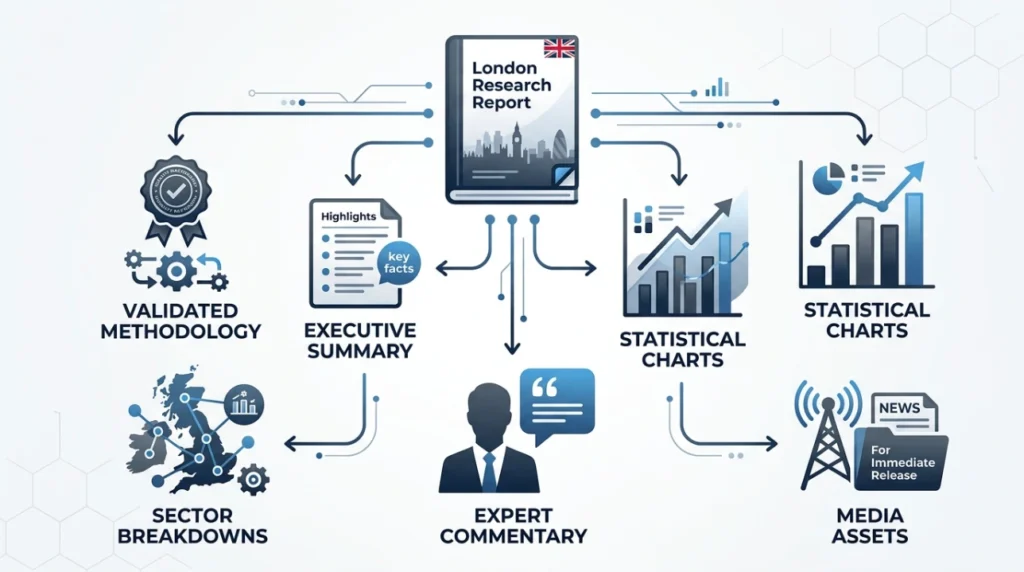
The core components of a Published London Research Report include a validated methodology statement, executive summaries, statistical charts, sector breakdowns, expert editorial commentary, and media-ready press distribution assets designed for national journalist pickup.
Essential Structural Elements
Every report follows a structured layout designed for rapid data extraction by journalists and executives:
- Executive Summary: A concise 2-page overview highlighting the headline statistical findings.
- Methodology Statement: Clear documentation of sample sizes, field dates, weighting, and research vendor credentials.
- Thematic Chapters: Data grouped into 3 to 5 logical sub-topics exploring distinct aspects of the central hypothesis.
- Visual Assets: High-resolution charts, infographics, and callout statistics ready for digital and print syndication.
Comparative Asset Overview
Different research assets serve distinct stages of the media and sales funnel:
| Asset Type | Primary Purpose | Primary Target Audience | Key Deliverables |
| Consumer Insights Report | Mass media coverage and brand awareness | National news desks, consumer publications | 2,000-person survey, press release, infographics |
| B2B Sector Report | Executive thought leadership and lead generation | C-Suite buyers, trade media, industry analysts | 250+ executive survey, deep-dive whitepaper, PDF asset |
| Index / Benchmark Study | Annual authority and long-term search equity | Industry stakeholders, policy makers, investors | Longitudinal data sets, ranking tables, annual launch event asset |
Why Do UK Brands Invest in Published Market Research?
UK brands invest in published market research to gain national media coverage, build domain authority through high-tier backlinks, establish category leadership, and equip sales teams with proprietary, unassailable data that closes high-value corporate deals.
Securing National Media Coverage
Editorial desks reject overt promotional pitches. Journalists demand objective data to substantiate news stories.
A published research report provides the exact factual backbone media outlets require. UK brands commissioning research systematically secure coverage in tier-one outlets including The Times, The Financial Times, The Daily Telegraph, BBC News, and City A.M.
Search Engine Optimization and AI Citation
High-tier media coverage generates organic, highly authoritative backlink profiles. When national outlets cite research findings, they link directly to the source report on the brand’s domain.
- Domain Authority Growth: Earned editorial backlinks accelerate search engine rankings across all target commercial keywords.
- AI Engine Citation: Generative search engines index factual data points. Publishing unique statistics guarantees brand inclusion within AI-generated search summaries and industry overviews.
- Referral Traffic: Direct clicks from national news articles route qualified, high-intent traffic straight to the primary research asset.
Sales Enablement and Commercial Conversion
Commercial teams use published research to validate client pain points during sales conversations. Proprietary data provides objective proof that a vendor understands macro-level industry shifts.
To see how these assets move from editorial distribution to lead conversion, examine UK national media research.
How Do London Research Reports Drive B2B and B2C Growth?
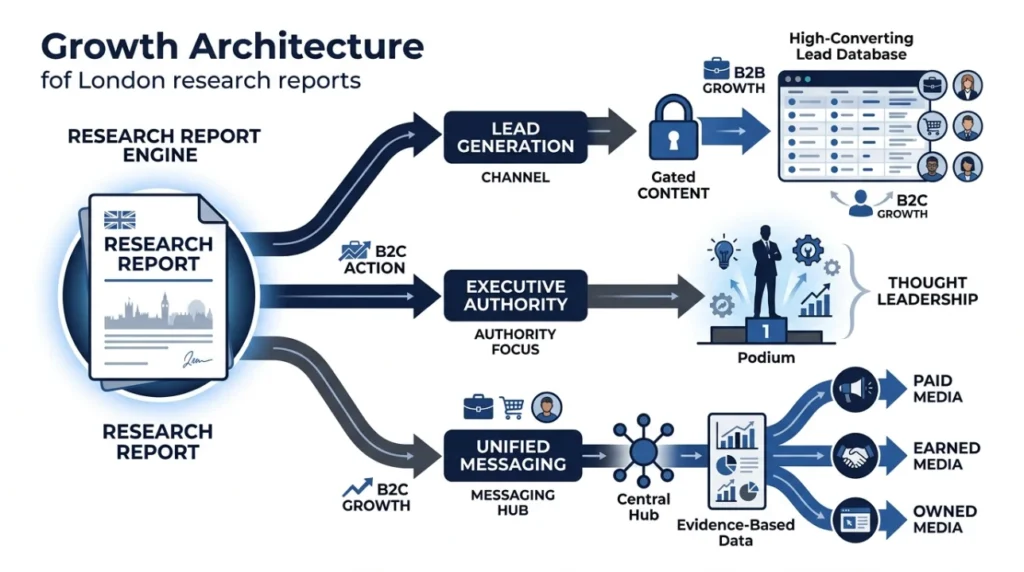
London research reports drive B2B and B2C growth by acting as high-converting gated lead magnets, providing authority for executive thought leadership campaigns, and supplying evidence-based messaging across all paid, earned, and owned marketing channels.
Gated Assets and Direct Lead Generation
Publishing an authoritative report creates a high-value digital asset. Brands place full report downloads behind simple registration forms to capture user data.
Prospects willingly exchange business contact details, company size, and job titles to access proprietary industry benchmarks. This process delivers highly qualified B2B leads directly to internal business development pipelines.
Integrated Marketing Campaign Fuel
A single research report yields assets across the entire marketing ecosystem:
- Social Media Content: Individual statistics convert into standalone visual graphics, poll questions, and short-form video scripts.
- Executive Thought Leadership: C-suite leaders publish LinkedIn articles and opinion pieces built entirely on report findings.
- Email Nurture Sequences: Multi-week email campaigns deliver sequential chapter highlights to mid-funnel sales prospects.
- Performance Advertising: Paid campaigns featuring direct statistics achieve significantly higher click-through rates than generic product promotions.
How Does Time Intelligence Media Group Guarantee Media Coverage?
Time Intelligence Media Group guarantees media coverage by pairing experienced newsroom journalists with precise statistical methodologies, designing research specifically around active UK news agendas, and distributing assets directly to established national media contacts.
Journalist-Led Survey Design
Standard corporate surveys fail in newsrooms because they ask commercially biased questions. Time Intelligence Media Group employs former national media journalists who understand editorial decision-making.
Surveys are constructed to uncover genuine market shifts, unexpected consumer behaviors, or stark economic realities. This editorial orientation ensures the resulting data naturally aligns with standard UK news values.
Targeted Distribution to UK Media Desks
Syndication bypasses generic wire services in favor of direct journalist outreach. Media relations specialists pitch specific data sets directly to relevant beat reporters, news editors, and national columnists.
- Exclusive Pitching: Securing national tier-one exclusives before general release.
- Embargoed Distribution: Providing advance report copies to target trade journalists to ensure launch-day coverage.
- Broad Syndication: Distributing region-specific statistical slices to localized UK news desks.
When Should a Brand Commission a Research Report?
A brand should commission a research report 8 to 12 weeks before major product launches, key industry conferences, annual budgeting cycles, or strategic rebranding initiatives to ensure data collection, editorial production, and media outreach align perfectly.
Strategic Timing Triggers
Research production should coincide with specific commercial milestones:
- Major Product / Service Launches: Establish a market problem using published data weeks before introducing the commercial solution.
- Annual Budgeting Cycles: Publish sector benchmark data when prospective clients evaluate next-year software or service budgets (typically Q3 and Q4 in the UK).
- Industry Flagship Events: Launch proprietary findings ahead of major UK trade shows to secure keynote speaking slots and event media coverage.
- Policy or Regulatory Changes: Issue reactive or proactive data studies when new UK legislation impacts industry operations.
How Can Your Organization Commission a London Research Report Today?
Your organization can commission a London research report by partnering with Time Intelligence Media Group to scope target demographics, establish core research objectives, execute nationally representative field research, and launch an integrated national PR and lead-generation campaign.
Immediate Next Steps
Securing national authority through published data requires a structured launch framework. Time Intelligence Media Group handles every phase of the research lifecycle, from initial survey architecture to national press syndication.
- Schedule a Strategy Session: Review your target audience, industry vertical, and primary commercial objectives with our senior editorial team.
- Define the Research Scope: Determine appropriate sample parameters, whether targeting a 2,000-person general UK consumer panel or a niche executive cohort.
- Approve Survey Architecture: Finalize journalist-approved question sets designed to deliver guaranteed headline statistics.
- Execute and Capitalize: Receive full editorial design assets, raw data tables, and an executed national media relations campaign.
Contact Time Intelligence Media Group today to commission your published market study and secure your brand’s position as a cited UK industry authority.