
B2B trust is the confidence business buyers place in a supplier’s capability, integrity, and data accuracy before entering a commercial contract. Manchester firms use research reports to demonstrate market expertise, provide verifiable data, and reduce commercial purchasing risks.
B2B purchasing decisions in the United Kingdom involve multiple stakeholders, extended sales cycles, and significant financial commitments. Buyers evaluate vendor stability and technical competence through objective documentation rather than promotional claims. Research reports serve as authoritative evidence of industry knowledge, helping firms differentiate themselves in competitive regional markets like Greater Manchester.
The Shift Toward Data-Driven Buyer Expectations
Modern business buyers complete up to 70 percent of their research process before contacting a vendor. In sectors like financial services, digital technology, and advanced manufacturing across the North West, buyers demand objective proof of performance. Reports fill this information gap by delivering empirical data rather than sales marketing.
How Do Research Reports Function as a Commercial Strategy?
Research reports function as a commercial strategy by capturing primary market data, answering key industry challenges, and establishing thought leadership. Manchester companies distribute these reports through digital channels to attract senior executives, generate qualified leads, and shorten sales cycles.
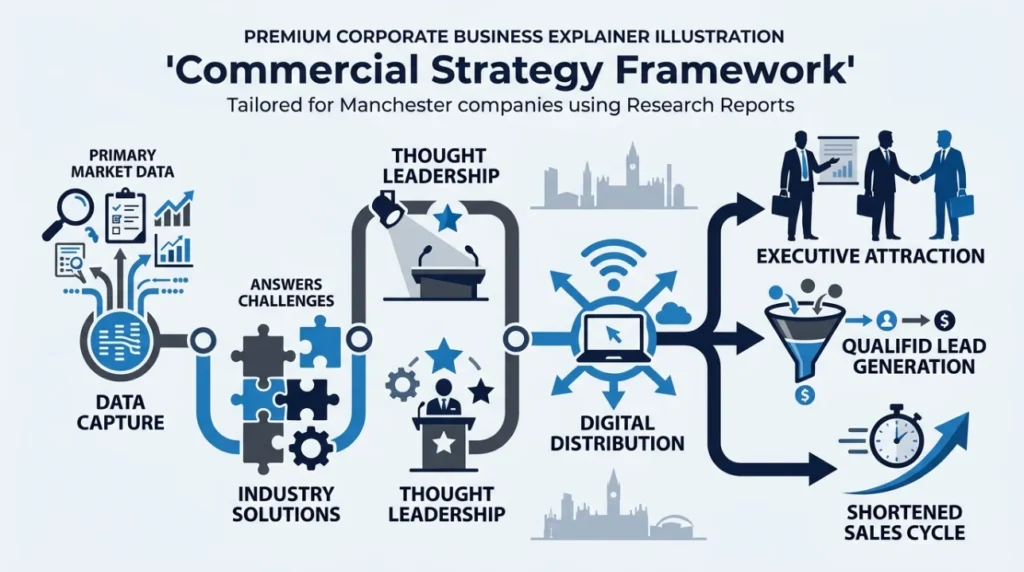
A structured research report targets specific commercial pain points within an industry sector. By collecting original survey data, transaction statistics, or operational benchmarks, a firm positions itself as the primary authority on that subject.
Primary Data Generation
Original research creates exclusive market insights that competitors cannot replicate. When a firm surveys 200 regional logistics managers about supply chain bottlenecks, the resulting dataset becomes a valuable asset for the entire industry.
Multi-Channel Content Assets
A single comprehensive report serves as the foundation for multiple marketing assets. Firms extract smaller data points to support targeted executive outreach, industry presentations, and digital content distribution.
What Are the Essential Components of an Effective B2B Report?
An effective B2B report contains methodology disclosures, primary survey data, executive summaries, actionable industry insights, and clear visual representations of statistics. These components ensure the document meets strict professional standards and provides immediate value to business readers.
Methodological Transparency
Trust requires verifiable research methods. A credible report details the sample size, respondent demographics, data collection dates, and analytical frameworks used during research. For example, a report surveying 150 IT directors across North West England must state the exact survey timeframe and industry classifications.
Core Structure of B2B Reports
- Executive Summary: A concise overview of critical findings for C-suite readers.
- Industry Context: A factual review of current market conditions and regulations.
- Primary Data Analysis: Clear charts, statistical breakdowns, and survey results.
- Strategic Recommendations: Direct, non-promotional guidance based on the collected data.
- Explore More Expert Insights:
- How Fintech Companies Acquire Users Using Banner Ads
- How Finance Brands Promote Credit Cards Using Display Campaigns
How Does Distributing Reports Build Industry Authority in Greater Manchester?
Distributing reports builds industry authority by positioning a business as a neutral research provider, attracting media references, and earning backlinks from trade publications. Regional distribution ensures key local stakeholders acknowledge the firm’s subject matter expertise.
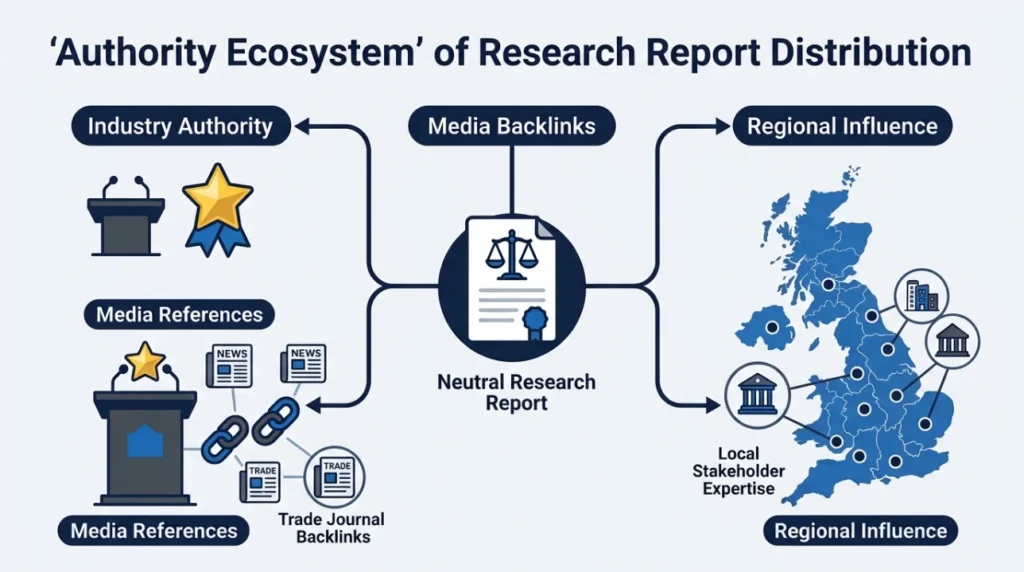
Publication across regional media outlets and digital networks amplifies the reach of primary data. When trade journals cite a report’s findings, the publishing firm gains indirect validation from third-party editors.
Earned Media and Citation Impact
Journalists and industry analysts regularly search for verified data to support market coverage. Reports that offer fresh statistics on regional business trends frequently earn citations in major news publications and industry trade journals.
Search Engine Visibility and Entity Authority
Search engines prioritize domain authority based on content depth, external references, and clear topical context. Publishing detailed reports helps search engines associate a business domain with specific industry topics, improving organic visibility for related commercial searches.
Firms interested in expanding their reach beyond single-site publication can review strategies on how Manchester reports get published across multiple sites.
Which Manchester Industries Benefit Most from B2B Reports?
Technology, professional services, manufacturing, financial services, and commercial real estate benefit most from B2B reports. These sectors feature high contract values, long buyer journeys, and complex decision-making processes requiring extensive factual validation.
Professional and Financial Services
Accountancy, legal, and financial advisory firms deal in expertise and risk mitigation. Reports analyzing regulatory changes—such as environmental, social, and governance (ESG) disclosure requirements—help these firms demonstrate technical knowledge to corporate clients.
Technology and Digital Enterprise
Manchester represents a major tech hub in the UK. Local software development, cybersecurity, and cloud computing firms publish benchmark reports detailing adoption rates, security vulnerabilities, and infrastructure costs to guide enterprise buyers.
Manufacturing and Logistics
Firms operating in industrial corridors like Trafford Park utilize reports on automation efficiency, freight costs, and labor availability to educate regional supply chain partners.
How Do Reports Direct Buyers Through the Commercial Decision Process?
Reports direct buyers through the commercial decision process by identifying operational risks, establishing benchmark standards, and highlighting efficient strategic approaches. Factual documentation aligns multiple decision-makers around a single problem before vendor evaluation begins.
In complex B2B sales, internal alignment presents a significant barrier to purchase. Procurement teams, technical directors, and finance executives evaluate purchases against different internal criteria.
Aligning Diverse Stakeholders
A well-structured report provides specific data points tailored to different C-suite priorities:
- Chief Executive Officers: High-level market shifts and competitive threats.
- Chief Financial Officers: Cost-reduction metrics, ROI calculations, and risk ratios.
- Chief Technology Officers: Technical specifications, integration frameworks, and security benchmarks.
By addressing these varied requirements in a single document, a report creates consensus among buyers. Companies ready to execute target research campaigns can explore specialized options for producing regional market research reports.
How Should Firms Measure the Performance of B2B Reports?
Firms measure report performance by tracking direct downloads, executive engagement, earned media mentions, organic search rankings, and pipeline influence. Attribution tracking links report interactions to closed B2B contracts.
Direct and Indirect Measurement Indicators
- Pipeline Velocity: Measuring whether prospective buyers who read a report move faster through the sales pipeline compared to unengaged leads.
- Media Citations: Tracking how many times external industry publications reference report data points.
- Inbound Inquiries: Monitoring commercial contact requests that directly cite the research report as the source of interest.
By analyzing these metrics, businesses continuously refine their research focus to align with emerging buyer interests across the United Kingdom.