
Third-party research is independent data, analysis, or evaluation conducted by an unbiased external organization. It builds UK buyer trust fast by providing objective validation, reducing perceived purchase risk, verifying vendor product claims, and eliminating self-serving brand bias during procurement evaluations.
Buying decisions in the United Kingdom B2B sector depend heavily on risk mitigation. Modern commercial buyers routinely dismiss vendor-generated marketing materials as biased or exaggerated. Third-party research operates as an independent filter. It evaluates solutions through objective methodology, standardized benchmarking, and empirical evidence.
Defining Independent Research Entities
Independent research entities include market analyst firms, academic institutions, and specialized trade media organizations. These entities do not hold a financial stake in the commercial performance of the products they evaluate. They gather raw data directly from active market participants, industry practitioners, and enterprise users.
The Mechanism of Risk Reduction
UK enterprise buyers face strict governance standards, budget scrutiny, and internal procurement oversight. Investing in unverified technology or services carries professional and financial risk. Independent research offers non-partisan evidence that procurement teams use to justify expenditure to executive boards and finance directors.
How Does Independent Research Accelerate the UK B2B Buying Process?
Independent research accelerates the UK B2B buying process by streamlining vendor evaluation, providing standardized competitive benchmarks, shortening contract review timelines, and establishing immediate credibility among multi-departmental decision-makers who require verifiable operational proof before signing commercial agreements.
B2B sales cycles in the UK average between 6 and 12 months. Much of this time is spent validating vendor claims, negotiating terms, and securing buy-in from internal stakeholders. Independent data replaces subjective claims with verified operational figures, reducing friction at every stage of the funnel.
Streamlining Stakeholder Alignment
Modern enterprise purchases involve multiple internal decision-makers, including chief information officers, procurement heads, and line-of-business managers. Each stakeholder evaluates solutions through a distinct professional lens.
- Finance teams demand verified return on investment figures and total cost of ownership models.
- Information security officers require independent technical compliance audits.
- Operational leads need validated usability benchmarks and productivity metrics.
Independent research provides a single source of truth that satisfies these diverse requirements simultaneously, preventing stalled deals caused by internal disagreement.
Replacing Vendor Claims with Verified Benchmarks
Vendors routinely claim superior performance, faster deployment times, and higher customer satisfaction. UK buyers treat these assertions with healthy skepticism. When a buyer reads that why 7 in 10 UK buyers trust third-party research reports, they recognize that third-party validation carries significantly higher weight than proprietary whitepapers.
What Are the Key Components of Credible Third-Party Research?
The key components of credible third-party research include transparent data collection methodologies, statistically significant sample sizes, rigorous analytical frameworks, peer-reviewed methodology, independent sponsorship disclosures, and direct input from verified UK business professionals operating within relevant commercial sectors.
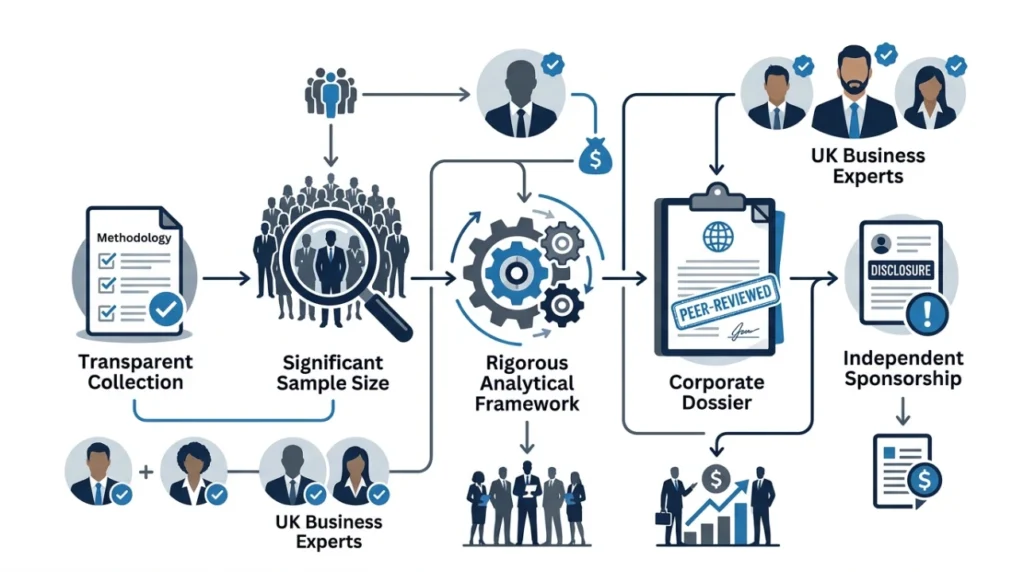
Not all research carries equal weight in the UK marketplace. Credibility depends entirely on the transparency and integrity of the underlying research methodology.
Methodological Transparency and Sample Integrity
High-trust research explicitly outlines its data collection parameters. It discloses the total number of survey respondents, job titles, industry verticals, and geographic distributions. A study analyzing UK enterprise cybersecurity must evaluate verified UK chief information security officers rather than non-specific global IT workers.
Sector-Specific Market Context
Generic global data often fails to resonate with UK procurement managers facing specific local conditions. Credible research accounts for UK regulatory frameworks such as the UK General Data Protection Regulation, Financial Conduct Authority guidelines, and local supply chain dynamics. Data grounded in local market realities provides actionable insights that buyers can apply immediately.
Explore More Expert Insights:
How to Brief a UK Publisher for Sponsored Content That Feels Like Real Journalism
Sponsored Content Across 10 Verticals: UK Engagement Benchmarks 2026
Why Is Independent Research Essential for Middle-of-Funnel Evaluation?
Independent research is essential for middle-of-funnel evaluation because buyers are actively comparing specific solution categories, evaluating alternative vendors, assessing deployment risks, and seeking objective comparative criteria to narrow down their shortlist before committing to final vendor demonstrations.
At the middle-of-funnel stage, buyers transition from defining their problem to evaluating potential solutions. They no longer require basic educational content; they need actionable comparative analysis.
Facilitating Objective Solution Comparisons
During solution evaluation, buyers analyze competing architectures, deployment models, and feature sets. Vendor comparison matrices generated by third-party research firms evaluate competing products under identical test conditions. This approach highlights genuine technical differentiators while filtering out marketing rhetoric.
Validating Commercial Impact
Middle-of-funnel buyers must build an internal business case for software or service adoption. Independent financial impact studies quantify the precise financial, operational, and time-to-value metrics achieved by existing implementations.
Buyers use these verified figures directly within their internal justification documents to secure capital allocation.
How Do UK Businesses Use Third-Party Data to Validate Vendors?
UK businesses use third-party data to validate vendors by benchmarking performance metrics, verifying security compliance standards, evaluating customer retention rates, analyzing real-world deployment outcomes, and cross-referencing vendor value claims against industry standards before making binding purchasing commitments.
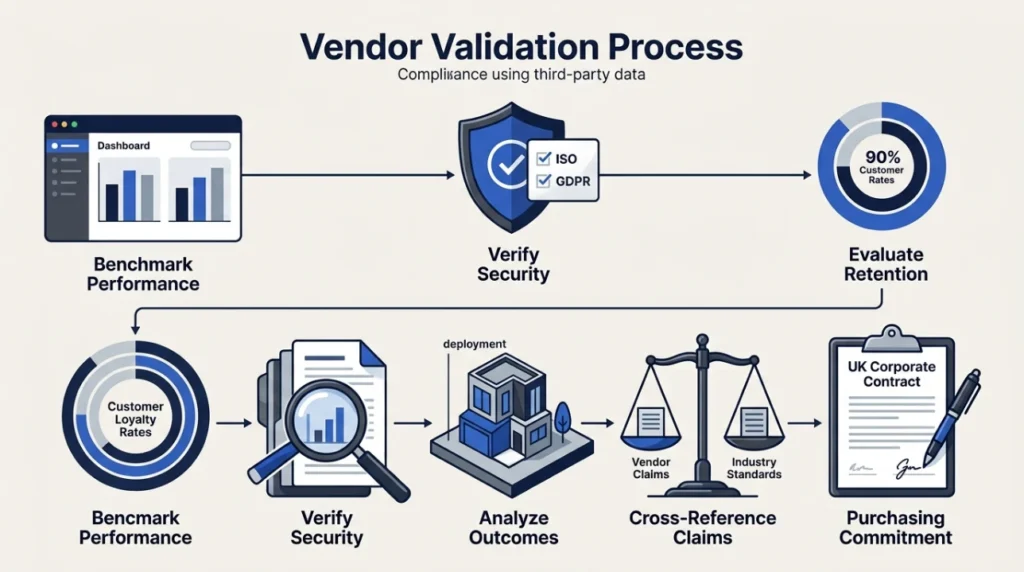
Procurement teams follow systematic processes to evaluate potential suppliers. Independent research feeds directly into each phase of this evaluation framework.
Shortlisting Qualified Vendors
Procurement teams examine market landscape reports to identify viable market players. Vendors featured in independent research reports achieve instant inclusion on vendor shortlists, whereas unverified vendors are often excluded during initial screening.
Conducting Due Diligence and Risk Assessment
During formal vendor evaluation, buyers cross-reference vendor promises against third-party satisfaction surveys and operational performance reviews. Buyers evaluate key risk indicators:
- System Reliability: Independent downtime and latency monitoring data.
- Implementation Success Rates: Third-party data tracking project completion within budget and scope.
- Vendor Financial Stability: Analyst assessments of vendor market share growth and ongoing viability.
Accessing specialized research solutions such as third-party research reports by time intelligence media group allows procurement specialists to evaluate verified vendor performance data before formal contract negotiations begin.
What Is the Operational Impact of Research-Led Content on Sales Velocity?
The operational impact of research-led content on sales velocity includes significantly shorter deal cycles, higher contract win rates, lower buyer hesitation, reduced request-for-proposal evaluation times, and increased average deal sizes driven by clear executive confidence in verified business outcomes.
Integrating third-party research into sales processes directly impacts commercial metrics. It converts complex, high-friction sales engagements into streamlined procurement approvals.
Reducing Request for Proposal Friction
Request for Proposal processes consume substantial time and resources for both buyers and sellers. When vendors anchor their RFP responses in independent third-party research, procurement committees process evaluations significantly faster. Independent data reduces the need for repetitive clarification meetings and extended technical audits.
Increasing Executive Confidence and Contract Value
Higher trust directly correlates with larger deal sizes. When executive boards review purchasing proposals backed by independent analyst data, they approve larger initial deployments rather than insisting on limited, low-value pilot programs. Independent research provides the strategic assurance necessary for enterprise-wide rollouts.