

Financial services research in the UK market is the systematic collection, analysis, and dissemination of economic and monetary data. It establishes institutional credibility, informs public policy, ensures regulatory compliance, and provides validated data to journalists, investors, and consumers.
Core definition and purpose
Financial services research involves structured quantitative and qualitative investigation into market trends, consumer banking behavior, investment flows, and macroeconomic shifts. Institutions publish this research to demonstrate expertise and provide baseline data for commercial and regulatory decisions across the United Kingdom.
Primary data types in British finance
British financial research relies on distinct data categories to ensure accuracy and statistical validity:
- Transactional Data: Anonymised payment records, credit utilization rates, and savings balance trends.
- Attitudinal Data: Consumer sentiment surveys regarding inflation, interest rates, and mortgage affordability.
- Institutional Data: Balance sheet analysis, capital adequacy metrics, and corporate credit ratings.
Key regulatory bodies and standards
Research published within the UK financial sector must adhere to strict guidelines established by statutory authorities:
| Regulator / Body | Acronym | Primary Oversight Area |
| Financial Conduct Authority | FCA | Consumer protection and financial market integrity |
| Prudential Regulation Authority | PRA | Prudential regulation of banks, building societies, and insurers |
| Advertising Standards Authority | ASA | Truthfulness and evidentiary support in financial promotions |
| Information Commissioner’s Office | ICO | Data privacy and compliance under UK GDPR |
How does research build authority for UK financial institutions?
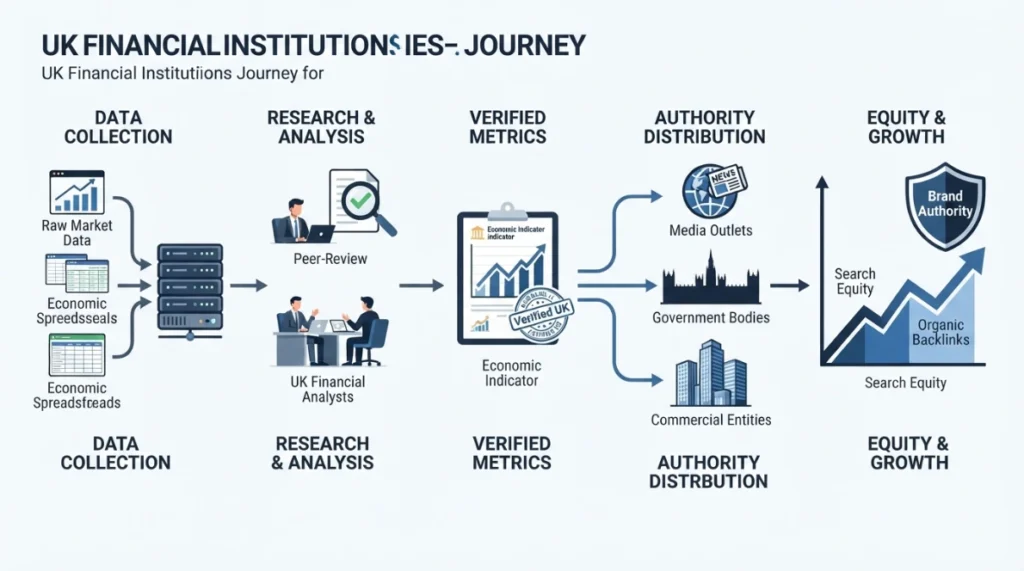
Research builds authority for UK financial institutions by transforming raw market data into peer-reviewed economic indicators. Media outlets, government bodies, and commercial entities cite these published metrics, which establishes verified expertise, improves brand search equity, and drives organic backlinks.
Information asymmetry and market trust
Financial markets depend on transparent information. When an institution produces rigorous research, it resolves information asymmetry for consumers and businesses. By publishing verified statistics regarding inflation impacts or small business lending, an organization transitions from a service vendor to an authoritative source of market intelligence.
The mechanics of media citations
Journalists at UK news organizations rely on primary data sources to validate editorial coverage. When a financial entity releases a dataset, news outlets cite the publishing organization as the primary source.
These editorial citations build search engine authority through high-quality contextual references and establish domain expertise within digital ecosystems.
Impact on organic search and AI discovery
Modern search engines and artificial intelligence models index entity relationships. Publishing structured, data-rich research helps algorithms recognize an institution as a primary authority on specific topics, such as mortgage rate trends or wealth management strategies. This recognition improves overall search visibility and ensures inclusion in AI-generated summaries.
What are the key components of authoritative financial research?
Authoritative financial research requires a representative UK sample size, transparent methodology, rigorous compliance with data protection laws, and peer-validated statistical analysis. These elements ensure the resulting data withstands scrutiny from regulators, journalists, and institutional market participants.
Sample size and demographic representation
To reflect the United Kingdom population accurately, quantitative research requires statistically sound sampling. Standard sample sizes include:
- Nationally Representative Consumer Surveys: Minimum sample of 2,000 UK adults, balanced by age, region, income, and gender according to Office for National Statistics (ONS) census parameters.
- SME Business Studies: Minimum sample of 500 UK business owners or financial decision-makers, segmented by company turnover and sector.
- Institutional Investor Studies: Targeted samples of 50 to 200 fund managers, chief investment officers, or risk directors.
Transparent methodology
Methodological transparency requires clear documentation of data collection protocols. Reports must specify sampling dates, field techniques, weighting procedures, and margin-of-error calculations. Reports lacking methodological disclosure fail compliance reviews and rarely secure media references.
Compliance with UK GDPR and data ethics
All primary data collection in the UK must conform to the Data Protection Act 2018 and UK GDPR regulations. Data gathering protocols require explicit consent, total anonymisation of personally identifiable information (PII), and secure data storage infrastructure.
Explore More Expert Insights:
How Cloud Kitchens Boost Demand Using Display Campaigns
How Food Businesses Improve Visibility Using Banner Ads
How is financial research structured for maximum citation?
Financial research is structured for maximum citation by placing key statistical findings at the beginning of the report, using clear schema markup, providing downloadable raw data, and formatting summaries into concise, factual statements that journalists and analysts can quote directly.
Structural hierarchy for data density
Authoritative reports follow an inverted pyramid structure to facilitate quick extraction of key data points:
- Executive Summary: Concise summary containing primary metrics, percentage changes, and core findings.
- Key Findings: Bulleted list of specific, numerical insights categorized by market segment.
- Methodology Section: Detailed breakdown of sample size, field dates, and analytical frameworks.
- Full Data Tables: Complete tabular data categorized by demographic and regional variables.
Digital formatting and data markup
To ensure search engines and news crawlers index published research accurately, technical documents must incorporate structured data formats:
Fact-dense writing protocols
Citable research avoids subjective commentary and vague qualifiers. Reports must present findings using precise numerical metrics:
- Correct: “UK household savings rates decreased by 1.4% in Q2 2026, reaching an average of £4,250 per household.”
- Incorrect: “UK households are saving significantly less money this year due to tough economic conditions.”
What steps are involved in executing a financial research campaign in the UK?
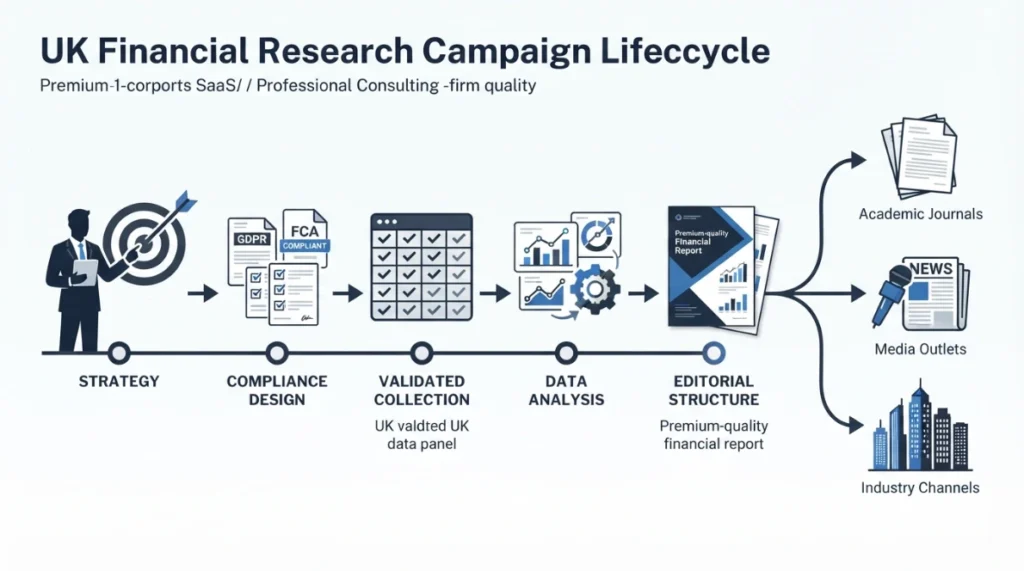
Executing a financial research campaign involves defining core objectives, designing compliant survey instruments, collecting data from validated panels, executing statistical analysis, structuring the final editorial report, and distributing findings to target academic, media, and industry channels.
Step-by-Step Campaign Architecture
1.Define Research Objectives:Align with market data gaps.
Identify specific economic questions or data gaps within the UK financial landscape. Define primary research questions, target audiences, and required statistical precision before designing data collection instruments.
2.Develop Survey Instruments:Ensure FCA and ASA compliance.
Draft neutral, non-leading questions that adhere to research ethics guidelines. Ensure all questions collect objective data points suitable for quantitative statistical modeling and regulatory review.
3.Execute Fieldwork and Data Collection:Sample nationally representative populations.
Deploy survey instruments to verified UK research panels or extract anonymized transactional datasets from internal databases. Monitor demographic quotas continuously to guarantee sample validity.
4.Execute Statistical Analysis and Verification:Apply econometric modeling.
Process raw data using statistical software package models. Apply demographic weighting, compute margin of error metrics, and verify all percentage shifts against baseline historical benchmarks.
5.Publish and Distribute Findings:Format for media and AI extraction.
Compile analysis into accessible digital formats containing structured tables, executive summaries, and clear citation guidelines for journalists, policy makers, and market analysts.
What are the main use cases for financial research in the United Kingdom?
The main use cases for financial research in the United Kingdom include supporting corporate public relations, informing government policy submissions, guiding institutional product development, providing sales enablement material for business-to-business firms, and establishing thought leadership in competitive sectors.
Corporate PR and media distribution
Financial institutions use research to earn coverage across national broadsheets like The Financial Times, The Times, and The Daily Telegraph, as well as trade publications like Mortgage Strategy and Property Week. These citations build broad public awareness and secure valuable backlink equity. Understanding [how financial research gets distributed across UK news] helps organizations structure their datasets to match editorial requirements and increase pickup rates across national newsrooms.
Policy submissions and regulatory engagement
Government departments, including HM Treasury and parliamentary select committees, regularly request evidence-based submissions during policy consultations. Financial research provides the quantitative proof required to influence legislative frameworks, regulatory policy development, and industry white papers.
Product development and market positioning
Quantitative research identifies underserved customer segments, price sensitivity thresholds, and emerging financial habits. Institutions use these insights to design relevant mortgage products, savings accounts, or investment platforms matched to verified market demand.
For organizations seeking to produce high-impact, compliant studies, partnering with specialists in [financial research reports] ensures that data collection, statistical validation, and report structuring meet the rigorous standards required by British media and regulatory bodies.
B2B sales enablement and commercial growth
Business-to-business financial service providers use detailed industry research to frame commercial conversations with prospective clients. Highlighting specific sector pain points backed by primary data validates value propositions and reduces sales cycle friction.
Summary of Financial Research Impact
Establishing authority within the UK financial market requires a commitment to data integrity, compliance, and methodical distribution. Institutions that publish representative, transparent, and structured research consistently position themselves as trusted experts, earning long-term dividends in search equity, regulatory standing, and market reputation.



