SaaS industry reports by Time Intelligence Media Group are data-driven research publications designed to establish market authority, secure high-tier media coverage, and generate qualified B2B leads. These reports provide verified sector metrics, benchmark analysis, and actionable software growth insights.
Core Definition and Institutional Purpose
Time Intelligence Media Group produces specialised B2B research documentation tailored for software-as-a-service providers operating within competitive digital markets. These industry reports transform raw platform data, customer usage trends, and market metrics into published media assets.
SaaS businesses use these structured intelligence assets to achieve precise strategic growth targets:
- Earn authority backlinks from top-tier news outlets and trade journals.
- Educate prospective buyers during complex enterprise procurement cycles.
- Establish category leadership in specific vertical markets.
- Provide account-based marketing teams with high-intent sales collateral.
Unlike standard corporate content marketing assets, an industry report relies strictly on rigorous statistical methodology, real-world sampling sizes, and objective market data. Time Intelligence Media Group formats each report to meet the exact editorial standards required by mainstream media journalists, financial analysts, and corporate decision-makers.
Entity Relationships in B2B Research Publishing
The production of an authoritative industry report connects several core digital and commercial entities:
These structural relationships ensure that raw user data converts directly into external brand equity and verifiable search engine citations.
How does Time Intelligence Media Group produce SaaS industry reports?
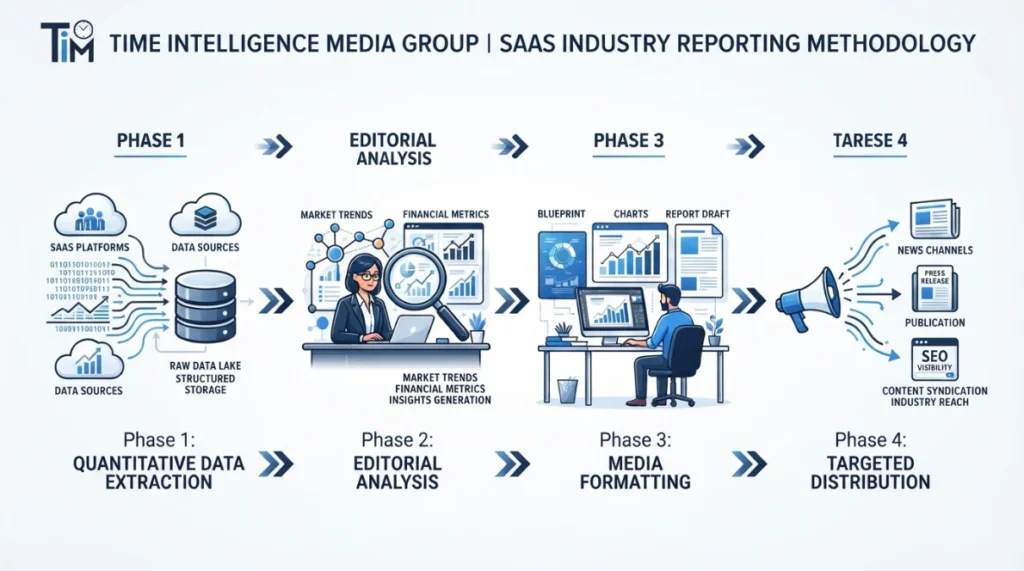
Time Intelligence Media Group produces SaaS industry reports through a strict four-phase methodology: quantitative data extraction, editorial analysis, media formatting, and targeted distribution. This structured workflow ensures every report meets rigorous journalistic standards and yields maximum search engine visibility.
Phase 1: Data Architecture and Telemetry Analysis
The research process begins by identifying high-value data points hidden within proprietary software systems. Time Intelligence Media Group collaborates directly with internal product teams to extract anonymised telemetry data, transaction volumes, and user usage patterns.
Key data fields extracted for report synthesis include:
- Average Revenue Per User (ARPU) fluctuations across specific UK regions.
- Customer Acquisition Cost (CAC) trends across B2B software verticals.
- Annual Recurring Revenue (ARR) growth metrics categorized by company valuation.
- Platform adoption rates within specific commercial sectors such as finance, logistics, and healthcare.
By relying on real-time operational data rather than simple opinion surveys, the resulting publication achieves higher statistical validity and editorial trust.
Phase 2: Editorial Synthesis and UK Media Alignment
Once raw metrics are cleansed and validated, senior analysts at Time Intelligence Media Group synthesize the findings into clear market narratives. The team structures the research specifically around topics actively covered by national media, technology journalists, and institutional investors.
During this stage, writers frame data around core macroeconomic themes:
- Market Efficiency Metrics: Demonstrating how modern software tooling reduces operational expenditure.
- Regional Growth Patterns: Mapping software spending shifts across key business hubs such as London, Manchester, and Edinburgh.
- Compliance and Security Benchmarks: Evaluating how UK enterprises adapt to evolving regulatory frameworks.
This alignment ensures the report provides immediate editorial value to external newsrooms seeking verified statistical data.
Phase 3: SEO Structuring and Semantic Optimisation
To ensure long-term organic performance, every section of the report undergoes structural search engine optimisation. Analysts embed primary entity terms, technical definitions, and clear data tables into the content architecture.
Search engine crawlers and AI answer engines index these structured data points directly, enabling the primary brand to claim critical information positions across relevant search engine results pages.
What core components make a SaaS industry report successful?
A successful SaaS industry report contains three essential components: proprietary quantitative data, structured editorial analysis, and publication-ready media graphics. Together, these elements deliver immediate technical credibility, drive high-volume media citations, and maintain long-term search engine visibility for the brand.
Component 1: Verified Proprietary Data Sets
A commercial research asset relies entirely on the uniqueness and accuracy of its underlying dataset. Media outlets and enterprise procurement leaders ignore generic predictions and recycled third-party stats.
Time Intelligence Media Group structures reports using specific internal metrics:
- Sample Size Disclosures: Stating exact user base figures, such as 500,000 anonymised UK user accounts.
- Timeframe Boundaries: Defining exact observational windows, such as Q1 2025 through Q4 2025.
- Vertical Focus: Isolating specific market segments, such as Fintech SaaS, Healthtech SaaS, or Enterprise Resource Planning platforms.
Establishing clear statistical parameters prevents editorial pushback from major publications and validates the overall research asset.
Component 2: Structural Data Layouts and Citation Tables
Search engine crawlers, large language models, and journalists require easily scannable data formats. Time Intelligence Media Group structures core report findings into clean, explicit numerical tables.
| Metric Evaluated | Enterprise Average (UK) | Mid-Market Average (UK) | YoY Growth (%) |
| Annual Churn Rate | 5.2% | 8.7% | -1.3% |
| Net Revenue Retention (NRR) | 114% | 102% | +3.1% |
| Average Deal Length | 24 Months | 12 Months | +15.0% |
| Software Spend Per Employee | £1,240 | £850 | +8.4% |
This tabular formatting allows search engines to extract clean snippets directly, increasing the likelihood of earning zero-position featured snippets and direct AI citations.
Component 3: Press-Ready Visual Assets
Journalists operate under strict daily deadlines and rarely have time to create custom graphic assets to accompany their stories. Time Intelligence Media Group designs custom charts, data maps, and infographic summaries formatted specifically for digital news publication.
By providing downloadable, high-resolution visual assets alongside the written report, SaaS brands significantly increase their rate of earned media coverage and secure high-value editorial link attribution.
Why do UK media outlets cite SaaS industry reports?
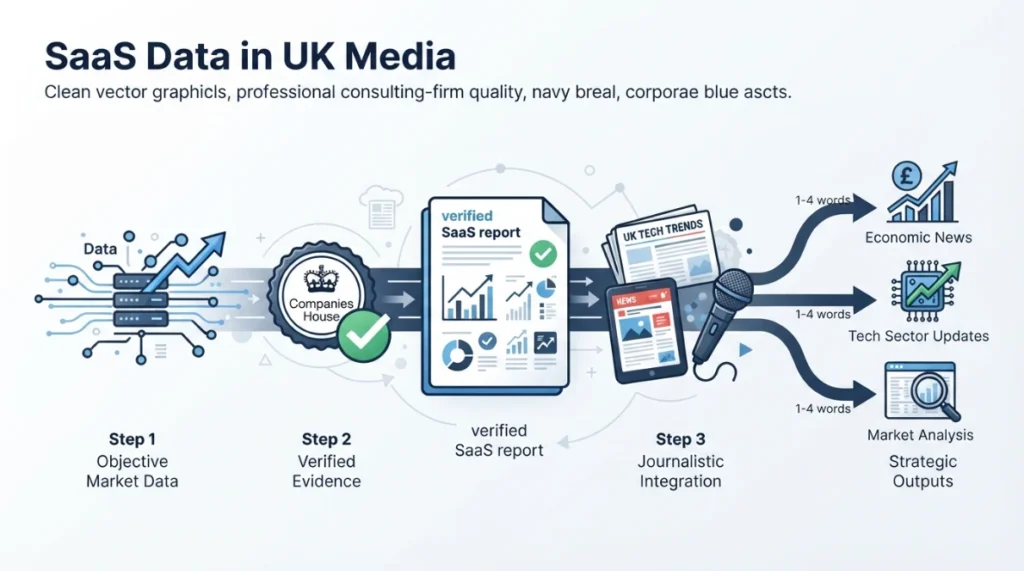
UK media outlets cite SaaS industry reports because they provide objective, real-time market data that journalists cannot gather independently. High-quality reports give newsrooms verified statistical evidence to support economic news stories, technology sector updates, and broader market analyses.
The Editorial Demand for Third-Party Data
Modern digital newsrooms face relentless pressure to publish factual stories quickly. Mainstream news channels like the BBC, The Times, and Financial Times require independent, external proof before running stories about economic trends, technology adoption, or corporate performance.
SaaS industry reports fill this critical operational gap by supplying ready-to-use research:
When a SaaS firm publishes verified statistical research, journalists use those data points to validate their reporting. The publishing brand is cited directly as the original data owner.
To understand how software brands format these research assets specifically to maximize press exposure, review our detailed guide on [saas media reporting strategies].
Primary Attributes That Earn Editorial Links
Journalists evaluate incoming corporate research assets against strict institutional standards before inclusion in a news story.
Reports produced by Time Intelligence Media Group consistently earn media pickups because they include:
- Methodological Transparency: Clearly explaining how the data was gathered, cleaned, and analyzed.
- Commercial Neutrality: Focusing strictly on empirical findings rather than aggressive product promotion.
- Timely Market Relevance: Addressing current UK business challenges, such as inflation pressures, labor market shifts, or regulatory changes.
- Geographic Specificity: Providing clear regional data isolations for specific markets across the United Kingdom.
Meeting these editorial requirements turns a standard corporate whitepaper into an authoritative research publication capable of earning top-tier organic backlinks.
How do SaaS industry reports drive pipeline for BOFU prospects?
SaaS industry reports drive bottom-of-the-funnel pipeline by proving domain expertise, accelerating enterprise vendor evaluations, and providing high-intent sales collateral. Enterprise buyers review these reports to validate a vendor’s market authority and technical capabilities before signing high-value contracts.
Validating Authority During Procurement
Enterprise software sales cycles in the UK regularly exceed 6 to 12 months, involving multiple executive decision-makers, security teams, and procurement specialists. At the Bottom-of-the-Funnel (BOFU) stage, buyers seek proof that a software provider possesses deep expertise in their specific sector.
A published industry report serves as concrete evidence of market leadership. When buyers see that a software vendor regularly publishes sector-wide benchmarks, their perception of risk drops significantly.
Key ways industry reports convert late-stage prospects include:
- Benchmarking Capabilities: Allowing prospects to compare their operational metrics directly against industry peers.
- ROI Verification: Demonstrating clear, data-backed financial returns achieved by similar organisations across the UK.
- Risk Reduction: Confirming the software vendor understands compliance, data security, and market regulations.
Supporting Account-Based Marketing (ABM) Workflows
Sales development representatives (SDRs) and account executives (AEs) use custom research reports to re-engage stalled pipeline opportunities and target high-value enterprise accounts.
Rather than sending standard sales follow-ups, account managers share specific sections of a report tailored directly to the prospective buyer’s operational footprint:
- “Page 14 outlines specific cost-reduction benchmarks achieved by UK logistics providers this quarter.”
- “Section 3 details the exact cybersecurity standards adopted by 80% of mid-market UK financial firms.”
This contextual approach positions the sales team as trusted advisors rather than aggressive software vendors.
To learn more about the strategic benefits of launching research assets to support your broader marketing engine, read our foundational guide on [data driven industry reports].
Explore More Expert Insights:
Real Estate Market Reports by Time Intelligence Media Group
Retail Research Reports From Time Intelligence Media Group 2026
What are the key use cases for SaaS industry reports?
The key use cases for SaaS industry reports include earning high-authority backlinks, supporting enterprise sales cycles, boosting organic search visibility, and establishing thought leadership. SaaS companies deploy these reports across multiple channels to maximize ROI and strengthen their market positioning.
Use Case 1: High-Impact Link Building and SEO Authority
Earning high-tier organic backlinks remains one of the most challenging aspects of modern search engine optimization. Standard blog posts, service pages, and promotional landing pages rarely earn natural links from authoritative publications.
Industry reports function as permanent linkable assets. Other websites, bloggers, industry analysts, and academic researchers cite the report’s underlying statistical data points over time, creating a continuous stream of organic, high-authority backlinks.
Specific types of domains that regularly link to SaaS reports include:
- National news websites and digital media outlets.
- Specialised B2B trade publications and technology journals.
- Industry associations and regulatory advisory bodies.
- University research departments and business schools.
This continuous influx of contextual backlinks builds overall domain authority, elevating organic search positions across all commercial product pages.
Use Case 2: Organic Search and AI Answer Optimization
Modern search engine engines and generative AI answer engines prioritize structured, factual, and verified data over generic marketing content.
Time Intelligence Media Group structures every industry report using clear entity associations, explicit numerical metrics, and direct definitions. This structural precision ensures that AI engines extract the brand’s proprietary data when answering complex market queries.
By owning the primary data source, the publishing company guarantees long-term visibility within evolving search interfaces.
Use Case 3: Investor Relations and Strategic Valuation
For venture-backed and growth-stage SaaS providers across the UK, publishing authoritative market research directly impacts corporate valuation.
Investors and financial buyers look for companies that command their market categories. Consistently issuing high-quality industry intelligence proves that a SaaS brand possesses unique market insights, deep customer access, and institutional authority—attributes that directly support higher valuation multiples during funding rounds or acquisition events.
How can your company launch a SaaS industry report with Time Intelligence Media Group?
Your company can launch a SaaS industry report with Time Intelligence Media Group by scheduling a strategy consultation, auditing your available proprietary data, and defining your media distribution goals. Time Intelligence Media Group manages the entire production lifecycle from data extraction to press placement.
The Media Production and Delivery Roadmap
Partnering with Time Intelligence Media Group allows your internal teams to publish enterprise-grade research without redirecting core engineering or marketing resources away from daily operations.
The complete campaign workflow follows a structured sequence:
- Initial Strategy Consultation: Defining project objectives, target UK media outlets, and key commercial KPIs.
- Data Extraction Audit: Identifying viable telemetry data, user metrics, and transaction logs within your software environment.
- Data Processing and Analysis: Cleansing, anonymizing, and analyzing datasets to reveal statistically significant trends.
- Editorial Production: Drafting journalistic prose, designing publication-grade data visualizations, and formatting content for optimal SEO crawlability.
- Distribution and Media Outreach: Executing a targeted PR campaign targeting journalists, trade publications, and commercial decision-makers across the United Kingdom.
Achieve Category Leadership Through Proprietary Research
Publishing an industry report transforms your software brand from a market participant into an authoritative industry leader. By turning proprietary platform metrics into a high-visibility media asset, your brand earns permanent search authority, secures top-tier press mentions, and builds pipeline for enterprise sales cycles.
Contact Time Intelligence Media Group today to schedule your research strategy session, audit your platform data assets, and deploy a custom SaaS industry report tailored to your commercial growth goals.