
A search-optimised research report in 2026 is a data-driven digital publication structured for search engine indexing and artificial intelligence retrieval. It delivers verified primary data, direct answers, and clear semantic entity relationships to secure top organic rankings.
Search engines and AI discovery engines prioritize original, empirical data over aggregated opinions. In 2026, search algorithms evaluate content using Information Gain scores. This metric measures the volume of unique, non-duplicative information a document introduces to the search index. A research report achieves high Information Gain by publishing original survey findings, industry benchmarks, or proprietary data sets.
AI-driven retrieval systems rely on structured semantic data. A research report must present facts using clear entity-attribute-value triples. For example, instead of stating that a trend grew significantly, a report explicitly states that remote workforce adoption in the United Kingdom increased by 14 percent in 2025. This structural clarity allows large language models and search bots to extract, index, and cite the data accurately.
Google prioritizes Experience, Expertise, Authoritativeness, and Trustworthiness (E-E-A-T) for research content. Author identification, transparent methodology, accessible raw data, and clear peer-review credentials establish this trust. A search-optimised report combines high Information Gain with rigorous technical metadata to ensure search engine crawlers index the document efficiently.
What is the process for making a research report rank?
The process requires five sequential steps: primary data collection, entity-focused keyword mapping, structured HTML markup implementation, citation network building, and continuous data updates. This approach ensures search crawlers and AI systems index and value the report.
Step 1: Collect primary data and establish methodology
Original research begins with data collection via verified surveys, proprietary software metrics, or public database analysis. Search algorithms favor sample sizes exceeding 1,000 respondents in specific regions like the United Kingdom to ensure statistical relevance. The methodology section must disclose sample demographics, collection timeframes, and margins of error to establish baseline authority.
Step 2: Implement entity-based SEO architecture
Keyword research in 2026 targets semantic entities rather than isolated search terms. Search systems organize knowledge around recognized concepts, organizations, and industry standards. Content creators must map primary entities to secondary contextual attributes throughout the text. Implementing structured schema markup, specifically Report and Dataset schemas via JSON-LD, explicitly tells search engines what the document contains.
Step 3: Publish with accessible web formatting
PDF formats limit search visibility because search crawlers index web pages more efficiently than static documents. Publishing research as interactive HTML pages improves crawlability, page speed, and reader engagement metrics. Including visual data representations, such as labeled charts and concise data tables, increases dwell time and encourages natural backlinks. Optimising internal site structure, including using [report structure strategies], ensures search bots navigate and index the content efficiently.
What components must a ranking research report include?
A ranking research report must include an executive summary with direct answers, interactive data visualisations, downloadable raw data files, explicit methodology documentation, machine-readable schema markup, and complete author background credentials to verify domain authority.
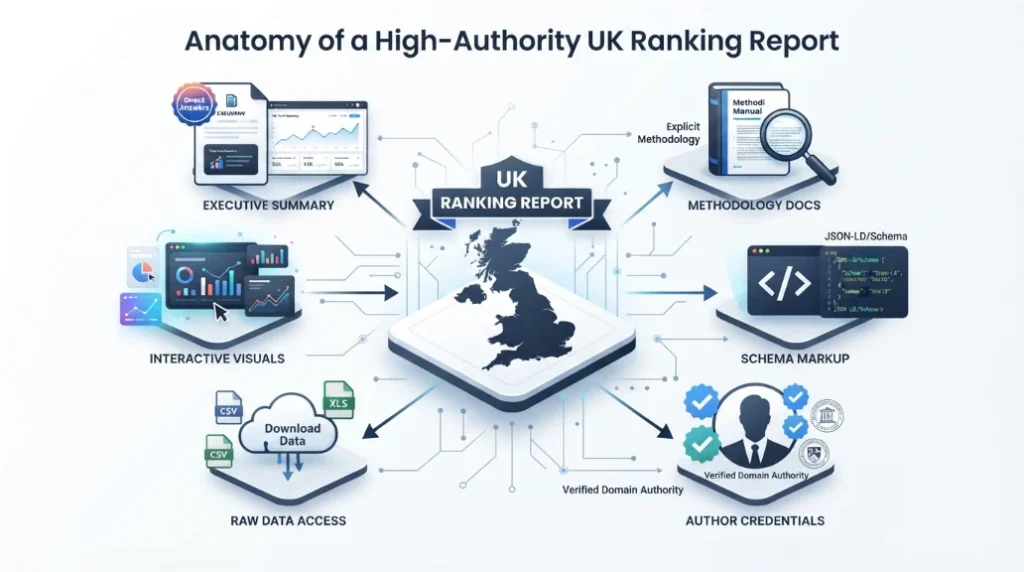
Executive summary with direct answers
The executive summary must appear at the top of the report. It provides concise, factual answers to core industry questions. Search engines extract these summaries for featured snippets and AI overviews. Each summary point must deliver an explicit fact using precise numerical values.
Visual data assets and structured tables
Data tables and charts convert complex statistics into readable formats for both humans and search crawlers. Every visual element requires descriptive ALT text containing primary semantic entities. HTML tables must use clear header rows (<th>) and structured cells (<td>) to allow automated scrapers and search bots to parse data points accurately.
Author credentials and methodology section
Establishing authority requires explicit author bio sections detailing professional backgrounds, relevant degrees, and past publications. The methodology section must clarify the exact research process. Transparency reduces bounce rates and signals content quality to manual quality evaluators and automated quality algorithms alike.
What are the benefits of ranking a research report high on Google?
Ranking a research report high on Google generates organic backlinks from high-authority media, establishes brand domain authority, drives targeted decision-maker traffic, accelerates AI platform citations, and creates long-term evergreen organic search visibility.
High-authority backlink acquisition
Journalists, academics, and industry analysts constantly search for reliable data to support their writing. A top-ranking research report acts as an authority hub. Media outlets, such as The Guardian, BBC, or specialized trade publications, reference the data and link directly to the source report, increasing the domain’s overall authority score.
AI engine visibility and citations
Modern search experiences incorporate conversational AI systems that pull information from top-indexed pages. Reports structured with clear factual statements earn frequent citations in AI-generated answers. This visibility drives brand awareness among users who rely on AI summaries for rapid industry research.
Qualified lead generation and authority
Decision-makers search for empirical data to justify business choices. High-ranking reports attract executives, strategists, and managers actively seeking solutions. Securing visibility for competitive industry research builds trust immediately, simplifying future conversion efforts through targeted assets like [specialized research reports].
What are the main use cases for SEO-optimised research reports?
The main use cases include establishing industry benchmarks, supporting corporate public relations campaigns, acquiring competitive SEO backlinks, demonstrating thought leadership, and providing data for B2B buyer decision-making processes.
Industry benchmark reports
Organizations publish annual benchmark reports to track performance standards across a sector. For example, a financial technology firm publishes a UK business payment trends report showing that 62 percent of small enterprises adopted automated invoicing in 2025. Industry professionals reference this benchmark continuously throughout the year, sustaining search traffic.
Academic and policy research distribution
Non-profit organizations, educational institutions, and policy think tanks use search-optimised reports to distribute critical findings to the public and government officials. Structuring white papers and policy briefs with web-first SEO principles ensures key stakeholders locate vital statistical evidence during policy debates.
Market intelligence and competitive analysis
B2B companies release market intelligence reports to map emerging technology shifts, consumer behavior changes, and economic outlooks. By ranking for terms related to market growth and sector forecasts, companies capture high-intent traffic from investors, analysts, and enterprise buyers evaluating market entry strategies.
How do AI overview search engines evaluate research data?
AI overview search engines evaluate research data by verifying statistical consistency across independent web sources, assessing the document’s information density, reading structured schema attributes, and confirming author entity authority.
AI systems utilize retrieval-augmented generation (RAG) to source context for user queries. During the retrieval phase, the algorithm scans indexed web pages for unique data points that match the query’s intent. Pages with high information density—containing specific dates, percentages, and original metrics—score higher in the retrieval hierarchy than generic opinion pieces.
Fact verification algorithms compare extracted numbers against established knowledge graphs. If a report contains logical contradictions or unverified statistics, the system lowers its confidence score. Providing raw data downloads in accessible formats like CSV or JSON helps automated agents process, verify, and cite the underlying data accurately.
Semantic entity mapping ensures the AI correctly attributes the research findings to the proper domain and author. Utilizing explicit entity relationships in the text allows AI models to summarize the report accurately without generating hallucinated facts or misattributing credit to third-party aggregators.
What technical SEO factors impact research report performance?
Technical SEO factors impacting performance include core web vitals speed optimization, mobile-first responsive rendering, secure HTTPS protocols, clean URL architecture, XML sitemap inclusion, and correct canonical tag implementation.
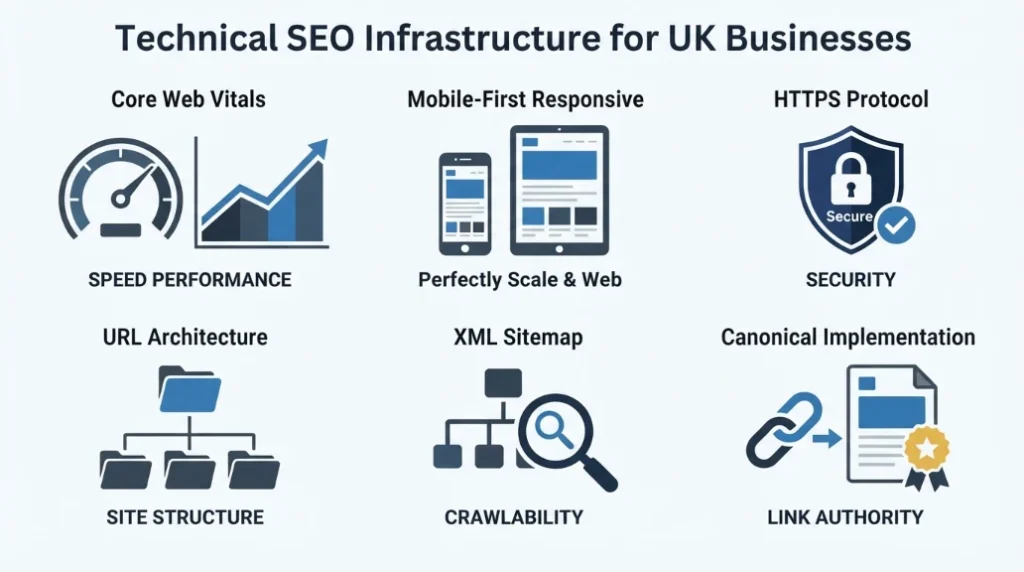
Core Web Vitals and load performance
Research reports containing heavy data visualizations, interactive charts, and large tables often suffer from slow page load times. Optimising JavaScript execution, serving images in modern formats like WebP, and implementing lazy loading for non-critical assets ensures the page passes Core Web Vitals assessments. Fast-loading pages reduce user drop-off and retain search engine positioning.
URL structure and canonicalization
A clean URL structure communicates topic hierarchy clearly to search engine crawlers. URLs should remain short and descriptive, using hyphens to separate words. Implementing canonical tags prevents duplicate content issues when reports exist across multiple formats, such as HTML web pages, print-friendly versions, and downloadable summaries.
Schema markup implementation
Schema markup provides explicit structural context directly to search engine crawlers. Implementing the standard JSON-LD script for research documents verifies the headline, author, publication date, publisher, and main entity of the report:
Explore More Expert Insights:
How Cloud Kitchens Boost Demand Using Display Campaigns
How Food Businesses Improve Visibility Using Banner Ads
How does internal linking improve report visibility?
Internal linking improves report visibility by distributing page authority across site architecture, establishing semantic topic clusters, guiding search engine crawlers to newly published data, and keeping users engaged with related educational resources.
Search engine crawlers rely on internal hyperlinks to discover pages and understand the contextual relationship between different documents on a website. Linking from high-authority hub pages to newly released research reports accelerates indexation. It signals to search engines that the linked report holds significant structural importance within the website’s topic hierarchy.
Creating topic clusters around a primary research report strengthens overall domain authority. A central research report serves as the core pillar page, surrounded by supporting articles that address specific subtopics, methodological details, or industry applications. Linking these supporting documents back to the main research report builds a cohesive network of topical relevance.
Anchor text selection must remain specific and semantically relevant to the target page. Using exact or partial-match entity descriptors in the hyperlinked text provides crawlers with immediate context regarding the linked page’s content. Consistent, logical internal linking structures optimize both search engine indexation efficiency and user navigation pathways.