

Real estate reports reach UK investors through digital syndication, targeted financial media networks, direct email distribution, and institutional investor databases. These channels ensure high-value market data arrives directly to private equity firms, real estate investment trusts, and individual property investors.
The distribution of real estate market data in the United Kingdom relies on multi-channel strategies. Property analysts, research firms, and media organisations compile raw transactional data, yield metrics, and macroeconomic indicators into structured intelligence formats. Once published, these reports enter specific channels tailored to investor archetypes, including retail landlords, high-net-worth individuals, and institutional fund managers.
Digital syndication platforms push reports to financial news terminals, property portals, and specialized industry publications. At the same time, proprietary database distribution targets verified investor networks. Understanding this flow allows research publishers to maximise reach while enabling investors to access timely market intelligence.
Digital Syndication and Financial Media Networks
Digital syndication routes property market research through established financial feeds and news platforms. Automated feeds supply data directly to terminals used by institutional asset managers. High-traffic property portals also host research hubs, making quarterly market updates accessible to private landlords and localized property developers.
Direct Database Delivery and Specialized Distribution
Direct delivery relies on opt-in investor databases and corporate email lists. Research firms segment these lists by asset class, investment threshold, and geographic preference. An investor focused on commercial property in London receives tailored reports, while a residential buy-to-let investor in the West Midlands gets regional capital growth data.
Why Is Target Audience Segmentation Critical for UK Property Reports?
Target audience segmentation ensures that property reports match the specific criteria, risk profiles, and capital requirements of distinct investor groups. Proper segmentation prevents information overload, improves engagement rates, and ensures that financial data reaches decision-makers with relevant capital.

The United Kingdom real estate landscape consists of diverse investor profiles, each requiring distinct data points. A generic market summary fails to provide actionable insights for specialised decision-making. Effective report distribution depends on segmenting the broader audience into precise categories based on investment strategy, regulatory requirements, and portfolio scale.
Institutional Investors vs. Private Landlords
Institutional investors, such as pension funds and REITs, require granular metrics. They focus on internal rates of return, environmental, social, and governance compliance, and long-term lease structures. In contrast, private landlords prioritize local yield percentages, tenant demand indices, and immediate capital growth potential.
- Institutional Focus: Core yields, debt financing costs, portfolio diversification, multi-million-pound assets.
- Private Investor Focus: Mortgage rates, regional rental growth, localized tenant demand, tax regulation impact.
To understand the foundational concepts behind property market analysis and how raw data translates into actionable insights, review [Insert Link to TOFU Article].
Regional and Sector-Specific Targeting
Investors often specialize in specific asset classes or geographic regions. Distribution strategies segment audiences into niche categories to maximize relevancy:
- Commercial Property Investors: Require data on office occupancy rates, industrial logistics demand, and retail yields.
- Residential Developers: Need metrics on planning permission approvals, construction cost indices, and regional housing starts.
- Regional Specialists: Require hyper-local data on specific markets, such as prime central London, the Northern Powerhouse hubs of Manchester and Leeds, or Scottish commercial centers.
What Key Components Make a Real Estate Report Actionable for Investors?
An actionable real estate report contains verified transactional data, macroeconomic contextual analysis, regional yield breakdowns, and forward-looking market projections. Clear data visualisations, precise yield calculations, and regulatory updates enable UK investors to execute informed asset allocation strategies.
Investors evaluate reports based on data accuracy, methodology, and practical utility. A report must move beyond basic statistics to explain the underlying market drivers and economic factors shaping real estate performance across the United Kingdom.
Core Metrics and Transactional Data
Reports must present verified data derived from official registers, transaction records, and corporate filings. Critical metrics include:
- Capital Values: Price per square foot or meter across specific sub-markets.
- Rental Growth Rates: Annual percentage changes in residential and commercial rent.
- Yield Benchmarks: Prime versus secondary yield spreads across commercial sectors.
- Transaction Volumes: Total capital deployed within specific quarters.
Macroeconomic and Regulatory Context
Real estate performance links directly to broader UK economic indicators. Reports must integrate contextual data including the Bank of England base rate, UK inflation figures, employment trends, and shifting planning regulations. Contextualising data helps investors anticipate interest rate sensitivity, tenant default risks, and shifting construction expenses.
How Do Media and Distribution Channels Accelerate Report Reach?
Media and distribution channels accelerate reach by leveraging established audience networks, search engine visibility, targeted PR, and multi-format content adaptation. These strategies place real estate reports directly into the daily workflows of active UK property investors.
Publishing a high-quality report is only the first phase; effective dissemination requires dynamic media strategies. Content distribution frameworks adapt raw research data into accessible formats distributed across multiple digital touchpoints.
Multi-Format Content Adaptation
Investors consume information through varied media formats depending on their time constraints and preferences. Maximising reach requires breaking down comprehensive reports into modular content assets:
- Executive Summaries: Short PDF briefs highlighting top-line statistics for busy executives.
- Data Visualisations: Charts, maps, and infographics designed for immediate digital consumption.
- Audio and Video Summaries: Brief commentary videos and podcast segments discussing key research findings.
Strategic PR and Digital Syndication
Securing coverage in national financial news outlets, trade publications, and specialized property platforms amplifies credibility and reach. Financial PR campaigns pitch report insights to journalists, positioning the publishing entity as a primary source of market truth. Concurrently, digital optimization ensures the report ranks prominently when investors search for UK property market research.
Modern publishers often work alongside specialized media networks, such as [Insert Link to BOFU Article], to streamline distribution directly into verified corporate investor ecosystems.
How Do UK Investors Utilize Real Estate Market Intelligence for Asset Allocation?
UK investors utilize real estate market intelligence to assess portfolio risk, identify high-yield regional markets, execute timely acquisitions, and benchmark asset performance. Data-driven reports validate investment thesis models and support capital raising efforts from institutional funding partners.
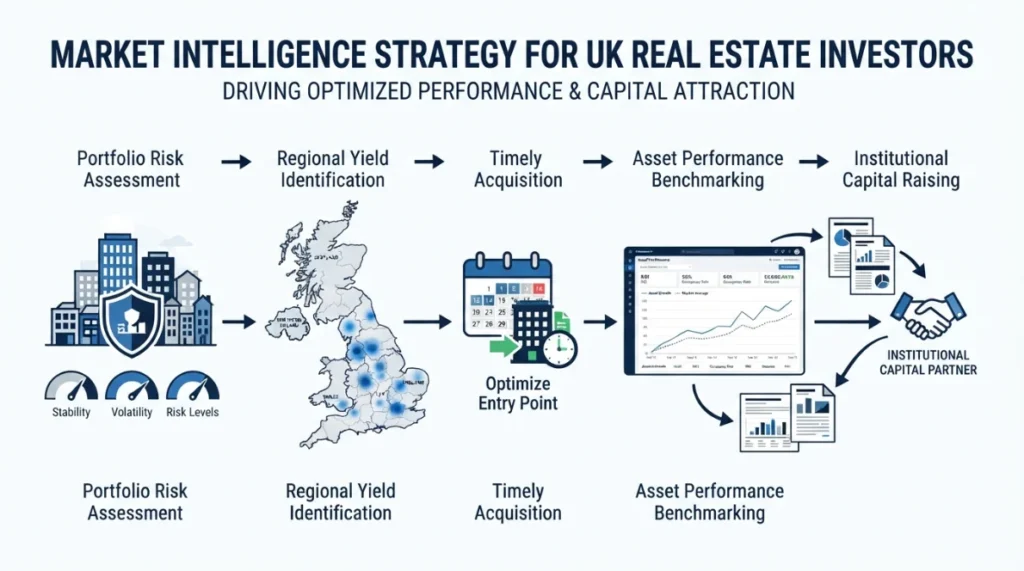
Investment decisions require objective risk management frameworks. Real estate market intelligence provides the empirical basis for strategic asset allocation, capital deployment timing, and portfolio rebalancing.
Capital Deployment and Timing
Market reports assist investors in identifying cyclical entry and exit points. By tracking yield movements and rental growth projections, asset managers determine when a regional market reaches peak valuation or when an undervalued sector offers upside potential.
For example, tracking logistics yield compression in the Midlands allows industrial funds to allocate capital before broader market re-pricings occur.
Risk Mitigation and Portfolio Stress-Testing
Investors analyze macroeconomic scenarios within research reports to stress-test their portfolios against rising interest rates, shifting vacancy rates, or regulatory changes.
Using verified intelligence reduces exposure to volatile asset classes and ensures long-term capital preservation across UK property portfolios.
What Role Does Data Verification Play in Investor Trust and Engagement?
Data verification builds investor trust by ensuring that sample sizes, methodologies, and source materials are accurate, transparent, and auditable. Independent verification prevents data distortion, protects institutional reputations, and drives sustained investor engagement with research publications.
Institutional capital demands rigorous data integrity. Reports containing unverified statistics or biased sample sizes damage publisher credibility and lead to flawed investment strategies. High engagement rates depend on establishing long-term data trust.
Explore More Expert Insights:
How Food Chains Increase Purchase Consideration Using Display Ads
How Restaurants Build Trust Using Review-Based Banner Campaigns
Transparent Research Methodology
Actionable reports clearly state their underlying methodologies, including data collection techniques, sample sizes, and calculation frameworks. Transparent methodology allows institutional analysts to replicate calculations and verify findings independently.
- Data Source Transparency: Citing Land Registry figures, official government statistics, and verified private exchange data.
- Sample Size Disclosure: Clearly stating the volume of transactions analyzed within a given dataset.
- Standardised Metrics: Utilizing recognized industry benchmarks for gross and net yield calculations.
Neutrality and Analytical Independence
Investors distinguish between objective market research and promotional marketing material. Neutral analysis acknowledges both market opportunities and downside risks. Presenting balanced economic realities builds long-term authority, ensuring investors consistently rely on the publication for future decision-making.



