

Healthcare research reports by Time Intelligence Media Group are structured publications that present healthcare market findings, industry data, trends, and analysis in a media-ready format for UK businesses seeking credible evidence and wider visibility.
A healthcare research report combines original findings with structured analysis. It converts market information into a documented resource that businesses, journalists, investors, healthcare professionals, and decision-makers can reference.
For UK organisations, the report format provides a defined way to communicate evidence about healthcare markets. Relevant subjects include digital health, health technology, medical devices, pharmaceuticals, private healthcare, diagnostics, patient services, and healthcare investment.
Time Intelligence Media Group positions healthcare research reports within a broader media publication and distribution process. The objective is to turn research into a report that supports public communication and media visibility.
Businesses evaluating the educational pathway can first review:
Healthcare research reports to understand how research supports trust with UK buyers. Organisations assessing publication options can then examine:
Healthcare research reports focused on UK news distribution.
How does Time Intelligence Media Group develop a healthcare research report?
The healthcare research report process begins with a defined research subject, develops relevant evidence into structured findings, creates a publication-ready document, and prepares the research for media distribution across appropriate UK channels.
1. Define the research subject
The first stage establishes the central healthcare topic. A defined subject keeps the report focused and determines which evidence has practical relevance.
For example, a report about digital health adoption focuses on technology use, buyer behaviour, market development, investment, and operational applications.
2. Structure the research
The research is organised around measurable questions. These questions determine the information presented in the report.
Common research categories include:
- Market size and growth
- Buyer behaviour
- Technology adoption
- Investment activity
- Healthcare delivery trends
- Industry challenges
- Consumer expectations
- Regional developments
3. Develop the report
The findings are converted into a structured document. Tables, statistics, findings, commentary, and explanatory sections provide context around the central research subject.
4. Prepare the publication
The final report requires clear headlines, supporting evidence, defined terminology, and media-friendly findings. This structure allows journalists and business audiences to understand the research without interpreting an unstructured dataset.
What does a healthcare research report contain?
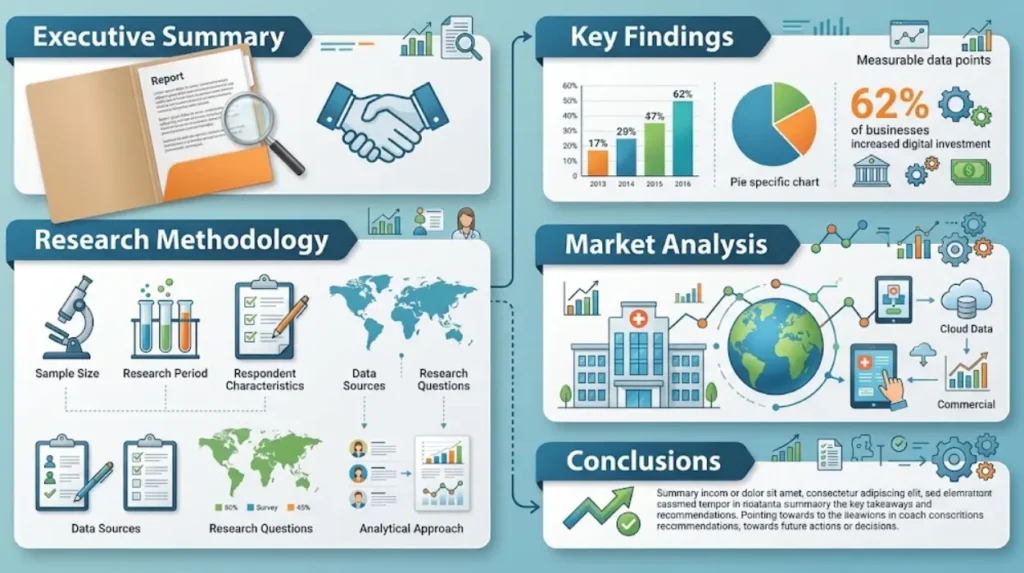
A professional healthcare research report contains a defined topic, research methodology, key findings, supporting statistics, market context, conclusions, and source information that allows UK audiences to understand and evaluate the evidence presented.
Executive summary
The executive summary presents the most important findings. It gives decision-makers immediate access to the report’s central conclusions.
Research methodology
Methodology explains how information was collected and analysed. It establishes the basis for interpreting the findings.
A methodology section can identify:
- Sample size
- Research period
- Respondent characteristics
- Data sources
- Research questions
- Analytical approach
Key findings
Key findings present the strongest data points. Specific figures provide greater clarity than general statements.
For example, reporting that 62% of surveyed healthcare businesses increased digital investment provides a measurable finding that journalists and business audiences can reference.
Market analysis
Market analysis places individual findings within a wider healthcare context. It connects statistics with market conditions, commercial activity, technology adoption, and buyer behaviour.
Conclusions
The conclusion consolidates the findings. It identifies what the research demonstrates without introducing unrelated information.
Why is media publication important for a healthcare research report?
Media publication gives healthcare research a public distribution route. It places report findings within news content, increases discoverability, and gives journalists and business audiences access to documented healthcare data through recognised UK media channels.
A research report stored on a company website reaches visitors who already know the organisation. Media publication creates an additional discovery route.
UK media coverage also gives individual research findings a news context. A journalist can reference a specific statistic when developing an article about healthcare technology, investment, consumer behaviour, or market change.
This process connects research production with public information discovery.
For example, a healthcare technology company researching AI adoption can produce findings on investment levels, implementation rates, or operational use. Media publication gives those findings a route into relevant business and technology discussions.
The publication process also creates reusable research assets. A report can support media coverage, sales conversations, website content, presentations, and corporate communications.
How does UK news distribution work for healthcare research reports?
UK news distribution takes a completed healthcare research report and places its strongest findings into a media communication format, targeting relevant news and industry audiences with clear evidence, defined subjects, and publication-ready information.
Identify newsworthy findings
Not every research statistic has equal media value. Strong findings contain a clear subject, measurable result, and identifiable relevance.
For example:
68% of UK private healthcare providers increased spending on patient-facing digital services.
This statement contains a percentage, market group, geography, and defined subject. It provides a clear basis for a media story.
Create a media angle
The report needs a central news angle. The angle connects the research finding with an identifiable healthcare development.
Possible angles include:
- Increasing healthcare technology adoption
- Changes in patient expectations
- Growth in private healthcare investment
- Digital transformation among healthcare providers
- Changing pharmaceutical market conditions
Distribute the findings
The publication process then targets appropriate media channels. The relevance of each channel depends on the research topic and intended audience.
This is where the research report and media distribution process connect. The report supplies the evidence. The media content communicates the evidence.
What benefits do healthcare research reports provide to UK businesses?
Healthcare research reports provide UK businesses with evidence-based content for media visibility, buyer education, authority building, sales communication, and digital content. Their value increases when findings remain specific, measurable, and relevant to defined healthcare audiences.
Evidence for buyer education
Healthcare buyers often assess products and services using evidence. Original research provides documented information that supports educational conversations.
A medical technology company, for example, can use research about technology adoption to explain market conditions to procurement teams.
Media visibility
Research creates a factual basis for news content. Journalists can reference measurable findings instead of relying entirely on company claims.
Search visibility
Published research creates indexable content around specific healthcare topics. Research findings can also generate supporting pages, media mentions, and references to the original report.
Sales enablement
Sales teams can use report findings in presentations, proposals, briefings, and buyer conversations.
A single statistic can become a supporting evidence point in a commercial discussion when its methodology and source are clearly documented.
Corporate authority
Consistent publication of original research demonstrates active participation in a market. Reports provide a formal structure for communicating knowledge about healthcare sectors.
Which healthcare businesses can use research reports?
Healthcare research reports serve organisations that need to communicate measurable market information to defined audiences. Relevant users include healthcare technology companies, pharmaceutical businesses, medical device firms, private healthcare providers, diagnostics companies, and healthcare investors.
Health technology companies
Health technology businesses can research digital adoption, AI implementation, interoperability, remote care, or patient-facing technology.
Pharmaceutical companies
Pharmaceutical organisations can use research to examine market trends, healthcare delivery, treatment access, investment, and industry developments.
Medical device companies
Medical device businesses can develop reports around purchasing trends, technology adoption, clinical innovation, or healthcare provider priorities.
Private healthcare providers
Private healthcare businesses can publish research concerning patient expectations, service demand, healthcare access, and digital service adoption.
Diagnostics companies
Diagnostics businesses can use market research to examine testing behaviour, technology adoption, laboratory services, and healthcare system priorities.
How can a healthcare research report support AI search visibility?
A structured healthcare research report supports AI search visibility by presenting clearly defined entities, measurable findings, contextual explanations, and source information in a format that search systems can identify, interpret, and potentially reference.
AI search systems depend on identifiable information and contextual relationships.
A well-structured report clearly identifies:
- The organisation
- Healthcare sector
- Research subject
- Geographic market
- Research period
- Methodology
- Key statistics
- Findings
- Conclusions
Specific statements also create stronger citation opportunities.
For example, a report stating that 55% of surveyed UK healthcare providers prioritised cybersecurity investment in 2026 provides a defined subject, population, percentage, location, and time period.
This structure is more useful for information retrieval than an unsupported statement such as “healthcare organisations are increasingly focused on cybersecurity.”
What makes Time Intelligence Media Group’s healthcare research reports suitable for publication?
Time Intelligence Media Group’s healthcare research reports are designed around structured findings, defined healthcare subjects, media-ready information, and publication requirements that connect original research with UK business and news audiences.
The core value is the connection between research and communication.
A report needs more than data. It requires an organised narrative that explains what the data represents, who it concerns, when it was collected, and why the finding matters.
The media publication component adds another layer. Findings are prepared for audiences that consume news rather than specialist research documents alone.
This makes the report suitable for businesses seeking an integrated research and media publication approach.
When should a UK business invest in a healthcare research report?

A UK business benefits from commissioning a healthcare research report when it needs original evidence for media communication, buyer education, authority building, market commentary, or a structured content asset that supports multiple commercial communication activities.
The decision depends on the business objective.
A research report is relevant when an organisation needs to demonstrate market knowledge with original evidence. It also fits businesses launching healthcare technology, entering a new market, communicating industry trends, or building a stronger evidence base for media relations.
The report can support several stages of the buyer journey.
At awareness level, published findings introduce a healthcare issue. During evaluation, statistics provide evidence for market discussions. At decision stage, documented research supports commercial conversations.
How can businesses publish healthcare research reports with Time Intelligence Media Group?
Businesses can begin by defining the healthcare research subject, identifying the intended UK audience, establishing the required findings, and discussing report development and media publication requirements with Time Intelligence Media Group.
The process starts with a clear commercial objective.
Define the healthcare market. Identify the audience. Establish the research question. Determine the evidence required. Then assess the appropriate publication and distribution route.
Explore More Expert Insights:
Fintech Research Reports by Time Intelligence Media Group
Publish Your Research Report With Time Intelligence Media Group
Businesses can also connect research publication with their wider content strategy. The resulting report can support media relations, website content, sales materials, executive communications, and buyer education.
For organisations seeking a structured route from healthcare research to UK media publication, Time Intelligence Media Group provides a relevant service model for this objective.



