

Healthcare research reports provide structured evidence about markets, patient behaviour, clinical developments, technologies, services, and industry trends. For UK buyers, these reports support informed decisions by presenting data, methodology, sources, findings, and conclusions in a documented format.
What is a healthcare research report?
A healthcare research report is a structured document that presents evidence about a healthcare topic using defined research methods, verified data, documented sources, and analytical findings to help organisations understand market conditions, buyer behaviour, technologies, services, risks, and emerging developments.
Healthcare research reports convert research findings into an organised information resource. They differ from promotional brochures because their primary function is to communicate evidence and analysis.
A report can examine a specific healthcare market, technology, service category, patient segment, treatment area, or business issue. Its structure depends on the research question and intended audience.
What information does a healthcare research report contain?
Common components include:
- Research objectives
- Methodology
- Market data
- Survey findings
- Industry statistics
- Expert research
- Buyer behaviour data
- Competitive information
- Key findings
- Conclusions
- References
- Data sources
For example, a report examining digital health adoption in the UK can analyse provider usage, patient preferences, technology investment, regulatory developments, and purchasing priorities.
The quality of these components affects how buyers interpret the report.
Why does research evidence influence trust among UK healthcare buyers?
Research evidence strengthens buyer trust because it gives decision-makers documented information they can examine, compare, verify, and apply. Clear methodology, transparent sources, relevant statistics, and consistent findings reduce uncertainty during healthcare purchasing and evaluation processes.
Healthcare purchasing involves multiple decision factors. Buyers assess clinical relevance, operational requirements, financial implications, regulatory considerations, supplier capabilities, and market evidence.
A research report gives these buyers a defined evidence base.
Trust develops when information is transparent. A buyer can examine where data originated, how research was conducted, and how conclusions were reached.
How does transparency affect report credibility?
Transparency makes research easier to evaluate. A credible report identifies its research scope, sample characteristics, collection methods, analytical approach, and information sources.
For example, a survey of 1,000 UK healthcare professionals provides stronger context when the report identifies respondent roles, organisation types, geographic coverage, and research dates.
Without this information, statistics lack sufficient context.
Why does source attribution matter?
Source attribution allows buyers to distinguish original findings from external information. A report that cites government statistics, regulatory publications, academic research, surveys, and industry datasets creates a traceable evidence structure.
Relevant UK sources can include NHS information, Office for National Statistics data, Care Quality Commission publications, academic studies, and recognised industry datasets.
How does report methodology build credibility?
Methodology builds credibility by explaining exactly how research data was collected, assessed, analysed, and presented. A defined methodology allows UK buyers to understand the evidence base, identify its scope, evaluate relevance, and interpret findings accurately.
Methodology describes the research process. It establishes the conditions under which findings were produced.
A quantitative healthcare report can use surveys, statistical datasets, transaction records, market measurements, or structured questionnaires. A qualitative report can use interviews, focus groups, case studies, or expert assessments.
What should a healthcare research methodology explain?
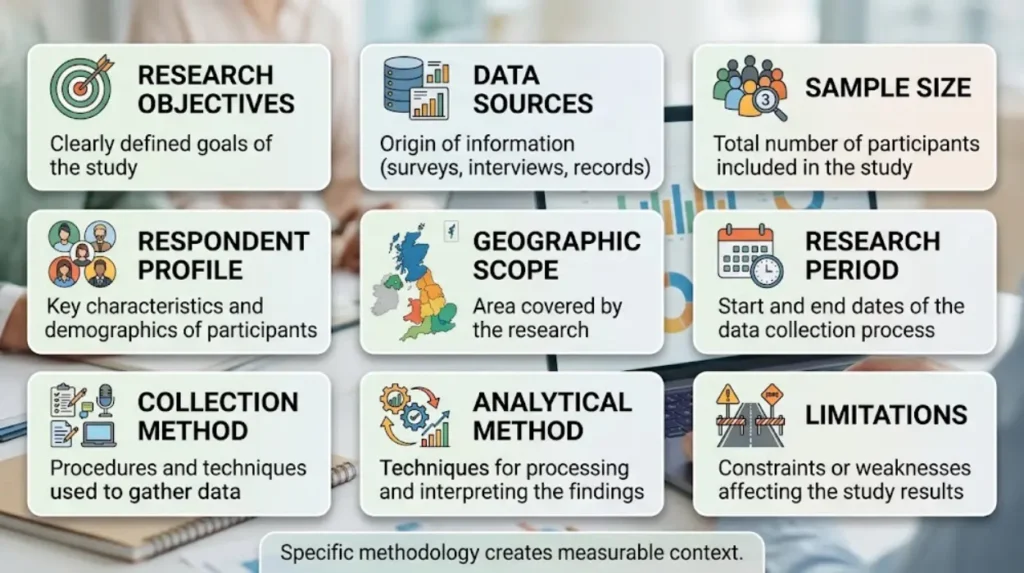
A useful methodology section identifies:
- Research objectives
- Data sources
- Sample size
- Respondent profile
- Geographic scope
- Research period
- Collection method
- Analytical method
- Limitations
For example, a UK buyer researching healthcare software can assess a report differently when it covers 750 procurement professionals across England, Scotland, Wales, and Northern Ireland compared with a report based on an unspecified respondent group.
Specific methodology creates measurable context.
How does data quality affect buyer trust?
Data quality affects buyer trust because accurate, relevant, current, and appropriately sourced information gives decision-makers a reliable foundation for evaluating healthcare markets, products, services, risks, and purchasing priorities across the United Kingdom.
Data quality has several dimensions. Accuracy concerns whether information correctly represents the measured subject. Relevance concerns whether the data answers the research question. Timeliness concerns whether the information reflects current market conditions.
Consistency also matters. Definitions and measurement methods need to remain stable throughout the report.
Which data characteristics matter most?
Important characteristics include:
- Accuracy
- Recency
- Relevance
- Completeness
- Consistency
- Traceability
- Comparability
For example, a report comparing NHS technology adoption across 2023, 2024, and 2025 needs consistent definitions for adoption, implementation, and active usage.
Poorly defined metrics reduce the usefulness of comparisons.
How do statistics help healthcare buyers evaluate research?
Statistics help healthcare buyers identify measurable patterns in markets, behaviours, demand, adoption, spending, and preferences. Percentages, sample sizes, growth rates, averages, and regional comparisons transform broad statements into specific evidence that supports structured evaluation.
Specific statistics provide measurable context. They also allow buyers to compare findings across periods, locations, organisation types, and buyer groups.
A statement such as “healthcare technology adoption increased” provides limited information. A finding showing adoption rising from 42% to 58% provides a measurable change.
Why are percentages and sample sizes important?
Percentages describe proportions. Sample sizes show the number of observations behind those proportions.
For example, a finding that 64% of respondents prioritise cybersecurity becomes more informative when the report states that 640 of 1,000 respondents selected that priority.
This distinction matters because percentages without sample context can create misleading impressions.
How do independent findings support trust?
Independent findings support trust when research conclusions originate from documented data rather than unsupported promotional claims. Buyers gain stronger evidence when findings are separated from commercial messaging and presented with clear sources, research methods, statistical context, and limitations.
Independence concerns how evidence is collected, analysed, and presented. Buyers examine whether findings reflect research results or marketing objectives.
A report that presents positive and negative findings provides greater analytical context. For example, research on a healthcare platform can identify high satisfaction with usability alongside concerns about integration costs.
Why are limitations important?
Limitations define the boundaries of research. They prevent buyers from applying findings outside their appropriate context.
A UK healthcare survey covering private providers does not automatically represent NHS organisations. A study involving 500 respondents does not automatically represent every healthcare professional in the UK.
Explicit limitations make conclusions more precise.
How do healthcare research reports support different UK buyer groups?
Healthcare research reports support different UK buyer groups by providing evidence relevant to procurement, strategy, investment, operations, technology adoption, market development, and service planning. Each group uses research findings to answer specific questions about demand, risk, performance, and opportunity.
Healthcare buyers include procurement teams, NHS organisations, private healthcare providers, pharmaceutical businesses, medical technology companies, insurers, investors, consultants, and healthcare service organisations.
Each group evaluates different evidence.
How do procurement teams use research reports?
Procurement teams use research to understand supplier markets, purchasing priorities, pricing factors, technology adoption, service expectations, and buyer requirements.
For example, a procurement team evaluating patient engagement software can use market research to assess adoption rates, feature priorities, integration requirements, and purchasing criteria.
How do healthcare executives use research?
Executives use reports to evaluate strategic conditions. They examine market growth, customer behaviour, competitive activity, operational trends, and emerging technologies.
A report can provide evidence for strategic planning without replacing internal financial, clinical, or operational assessments.
How do investors use healthcare research?
Investors examine market size, growth rates, adoption patterns, competitive structures, regulatory conditions, and customer demand.
Research reports provide market evidence that contributes to wider due diligence.
How does report presentation influence perceived credibility?
Report presentation influences perceived credibility because structured tables, clearly labelled charts, defined terminology, consistent references, and organised findings make evidence easier to inspect. Buyers interpret well-documented information more efficiently than fragmented or poorly structured research material.
Presentation does not replace research quality. It determines how easily buyers can understand the evidence.
Charts need descriptive titles. Tables need defined units. Percentages need denominators where relevant. Sources need clear attribution.
Which report elements improve information clarity?
Useful elements include:
- Executive summaries
- Research methodology sections
- Data tables
- Source notes
- Defined terminology
- Regional breakdowns
- Buyer segmentation
- Key findings
- References
- Limitations
For example, a regional analysis separating England, Scotland, Wales, and Northern Ireland gives UK buyers more precise context than a single national figure.
How does consistency across a research report build trust?
Consistency builds trust when terminology, measurements, sources, dates, geographic definitions, and analytical methods remain aligned throughout the report. Consistent presentation enables buyers to compare findings without repeatedly adjusting their interpretation of the underlying research evidence.
Inconsistent terminology creates uncertainty.
If a report uses “digital health adoption” to describe registered users in one section and active users in another, the comparison becomes unreliable.
Consistent definitions solve this problem.
Why are definitions important?
Definitions establish what each measurement represents. Terms such as healthcare buyer, adoption, market size, patient, provider, and technology user require clear meanings within research.
For example, “UK healthcare provider” needs a defined scope if the research includes NHS trusts, private hospitals, GP practices, care providers, or all categories.
How can healthcare research reports support evidence-based decision-making?
Healthcare research reports support evidence-based decision-making by combining structured data, documented research methods, market analysis, and clearly stated findings. Buyers use this evidence to assess conditions, compare options, identify priorities, and understand relevant healthcare market developments.
Evidence-based decision-making separates measurable information from assumptions.
A buyer can use research findings alongside internal data, financial analysis, clinical evidence, regulatory requirements, and supplier assessments.
Research therefore becomes one component within a broader decision process.
What decisions can research inform?
Healthcare research can inform decisions involving:
- Market entry
- Product development
- Service design
- Procurement
- Technology investment
- Customer segmentation
- Pricing research
- Expansion planning
- Competitive analysis
- Strategic planning
For example, a medical technology company entering a new UK market can examine buyer priorities, adoption barriers, regional demand, and competitive conditions before developing its market strategy.
Why does research relevance matter to UK buyers?
Research relevance matters because buyers need evidence that directly relates to their market, geography, organisation type, purchasing problem, and decision timeframe. A report with precise UK context provides greater practical value than broadly applicable but geographically disconnected research.
UK healthcare markets have specific institutional, regulatory, economic, and procurement characteristics.
A report focused on the United Kingdom can address these conditions directly. Regional detail also matters because healthcare structures and market conditions differ across the four nations.
What makes healthcare research relevant?
Relevant research has:
- A defined UK scope
- Current research dates
- Appropriate buyer segments
- Healthcare-specific terminology
- Applicable market measurements
- Transparent sources
- Clearly defined objectives
For readers progressing from general healthcare research education into publication and distribution considerations, healthcare research reports provide the next stage of understanding.
How can buyers evaluate the credibility of a healthcare research report?
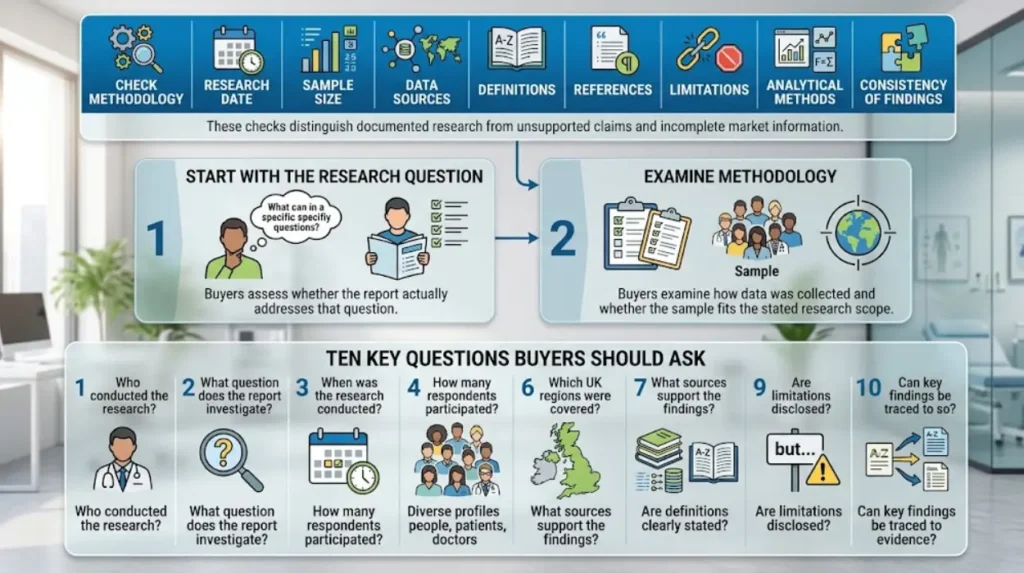
Buyers can evaluate credibility by checking the methodology, research date, sample size, data sources, definitions, references, limitations, analytical methods, and consistency of findings. These checks help buyers distinguish documented research from unsupported claims and incomplete market information.
A practical evaluation process begins with the research question. Buyers then assess whether the report actually addresses that question.
The methodology comes next. Buyers examine how data was collected and whether the sample fits the stated research scope.
What questions should buyers ask?
Buyers can ask:
- Who conducted the research?
- What question does the report investigate?
- When was the research conducted?
- How many respondents participated?
- Who were the respondents?
- Which UK regions were covered?
- What sources support the findings?
- Are definitions clearly stated?
- Are limitations disclosed?
- Can key findings be traced to evidence?
These questions create a structured method for assessing healthcare research credibility.
Explore More Expert Insights:
Why UK Fintech Brands Need Original Research Reports
What Is a Media-Published Research Report in 2026?
What is the overall role of healthcare research reports in buyer trust?
Healthcare research reports build buyer trust by combining transparent methodology, credible sources, relevant UK data, measurable findings, consistent terminology, and clearly defined limitations. These elements give buyers evidence they can inspect, interpret, compare, and apply within informed decision processes.
Trust in healthcare research does not depend on presentation alone. It develops through evidence quality and transparency.
A credible report establishes what was researched, how it was researched, what the data shows, and where the findings apply. It also distinguishes research evidence from interpretation.
For UK buyers, geographic relevance adds another layer of value. Research that reflects UK healthcare structures, buyer groups, market conditions, and regulatory context provides clearer decision-making information.
The strongest healthcare research reports therefore function as documented evidence resources. They help buyers understand markets before evaluating products, services, suppliers, investments, or strategic opportunities.
When research is transparent, measurable, relevant, and traceable, it provides a stronger foundation for informed healthcare decisions.



