
A healthcare research report presents structured evidence about a healthcare topic using defined research methods, data, analysis, and conclusions. UK news publishers assess these reports for accuracy, relevance, originality, public interest, and editorial suitability before publication.
A healthcare research report is a formal document based on evidence collected through surveys, interviews, datasets, clinical research, market research, or secondary sources. It converts research findings into measurable insights.
Common healthcare research subjects include:
- Patient behaviour
- Healthcare spending
- Digital health adoption
- Pharmaceutical markets
- Medical technology
- NHS services
- Health insurance
- Private healthcare
- Patient experience
- Healthcare workforce trends
For example, a report analysing 2,000 UK consumers’ use of digital GP services provides a defined dataset, a clear population, and measurable findings.
News publishers use research reports as source material when the findings contain a clear news angle. A report with original UK statistics has stronger editorial relevance than a document containing only general commentary.
Understanding healthcare research reports also helps organisations recognise why credible evidence supports buyer trust and media visibility.
How does a healthcare research report become newsworthy?
A healthcare research report becomes newsworthy when its findings present original, timely, relevant, and measurable information that connects with UK audiences. Strong reports identify a clear change, behaviour, statistic, market development, or healthcare issue supported by verifiable evidence.
Newsworthiness depends on the relationship between research findings and public interest.
What makes research findings newsworthy?
Several characteristics strengthen editorial relevance:
- Originality — The research provides new data.
- Timeliness — The findings relate to a current healthcare issue.
- Scale — The research includes a meaningful sample or dataset.
- UK relevance — Findings directly relate to British consumers, businesses, healthcare professionals, or institutions.
- Clarity — The central finding is easy to understand.
- Evidence — Claims have identifiable supporting data.
- Comparison — Results demonstrate measurable differences.
For example, a survey showing that 42% of UK patients prefer online appointment booking creates a specific statistic. A report stating that patients increasingly use digital healthcare provides a broader observation without the same numerical precision.
This distinction affects how journalists identify potential headlines.
What information does a UK news publisher need from a healthcare research report?

UK news publishers need identifiable research methodology, sample information, data sources, key findings, relevant dates, geographic scope, supporting evidence, and clear explanations of the research. These components allow journalists and editors to assess accuracy, relevance, context, and potential public interest.
A publication-ready research report requires transparent documentation.
Which methodology details matter?
The methodology explains how the research was produced. It normally identifies:
- Sample size
- Research population
- Geographic location
- Collection method
- Research period
- Question format
- Data source
- Analysis method
For example, “A survey of 1,500 UK adults conducted in July 2026” provides more useful context than “A recent survey of consumers”.
The report also needs definitions for technical terms. Healthcare terminology often has different meanings across clinical, commercial, and consumer contexts.
Why does source transparency matter?
Source transparency allows journalists to verify claims. It also separates primary research from secondary research.
Primary research includes original surveys, interviews, experiments, or observations. Secondary research uses existing datasets, published studies, government statistics, or industry sources.
A report combining both approaches needs clear attribution for each source.
How is a healthcare research report prepared for UK news publication?
Preparing a healthcare research report for UK news publication involves validating the research, identifying the strongest findings, creating a media-focused summary, checking supporting evidence, and presenting the information in a format that journalists can quickly evaluate and use.
The preparation process starts with research validation.
Step 1: Validate the research
Researchers review the dataset, methodology, calculations, and conclusions. Numerical errors create credibility problems and weaken editorial value.
Step 2: Identify the strongest findings
A report can contain dozens of statistics. A media version needs a smaller set of central findings.
For example, research into private healthcare could reveal findings about cost, waiting times, digital booking, patient satisfaction, and provider preferences. Each finding has different editorial relevance.
Step 3: Create a news angle
The news angle defines why the research matters now.
A healthcare report can focus on:
- A percentage increase
- A consumer behaviour change
- A regional difference
- A demographic difference
- A new market trend
- A significant healthcare concern
Step 4: Build supporting context
Statistics require context. The report explains the population, timeframe, research method, and comparison point.
Step 5: Produce media-ready material
The final package normally includes the research report, key findings, headline statistics, methodology, relevant commentary, and supporting information.
This structure reduces the time required for editorial assessment.
How do journalists evaluate healthcare research before publication?
Journalists evaluate healthcare research by examining the credibility of the source, methodology, sample size, evidence, relevance, originality, statistical claims, and public-interest value. They also assess whether the findings support a clear and accurate news story without misleading interpretation.
Editorial assessment focuses on evidence and relevance.
What questions do journalists ask?
A journalist examining a healthcare research report can assess:
- Who conducted the research?
- Who participated?
- How many respondents participated?
- When was the research conducted?
- Where were respondents located?
- What questions were asked?
- What data supports the conclusion?
- Is the research original?
- Does the finding have UK relevance?
- Can the statistic be independently understood?
A report containing a headline statistic without methodology creates an incomplete evidence trail.
A report with clearly documented research provides stronger material for editorial assessment.
What role does a press release play in publishing healthcare research?
A press release converts the most newsworthy research findings into a concise media story. It gives journalists the headline, key statistics, context, methodology summary, expert commentary, and supporting details required to assess the research quickly.
A research report and press release serve different purposes.
The research report contains detailed evidence and methodology.
The press release presents the central news story.
A strong healthcare research press release normally includes:
Headline
The headline states the primary finding without exaggerating the evidence.
Introduction
The opening paragraph identifies the research, central statistic, location, and main development.
Key findings
The release presents the strongest statistics. Each statistic needs enough context to avoid misinterpretation.
Research methodology
A concise methodology section explains sample size, location, timing, and collection method.
Expert commentary
A relevant spokesperson can explain the significance of the findings. Commentary remains separate from the underlying research data.
Source information
The release identifies the organisation responsible for the research and provides supporting details.
This separation between evidence and commentary helps maintain editorial clarity.
How does UK news distribution affect healthcare research publication?
UK news distribution connects a research story with relevant media outlets through structured publication and outreach processes. Effective distribution considers national news, regional publications, specialist healthcare media, business publications, and audiences relevant to the research findings.
Distribution determines where a media-ready research story is presented.
Different publications serve different audiences.
National news
National publications reach broad UK audiences. Research involving major healthcare behaviour changes, consumer trends, or significant statistics has potential national relevance.
Regional news
Regional publications focus on geographic relevance. Research containing regional comparisons provides stronger local angles.
For example, research comparing healthcare access in London, Manchester, Birmingham, and Edinburgh creates several geographic story opportunities.
Trade media
Healthcare trade publications focus on professionals and organisations within the sector. Research involving clinical technology, healthcare procurement, pharmaceuticals, or health services has direct trade relevance.
Business media
Business publications focus on market activity, investment, companies, consumers, and economic trends.
A structured distribution strategy therefore considers both the subject and the audience.
What benefits does publishing healthcare research on UK news provide?
Publishing healthcare research through UK news channels increases exposure to original findings, creates third-party references, supports brand authority, and gives organisations media assets that connect research data with broader public and professional conversations.
Publication creates value beyond the original research document.
How does publication support authority?
Third-party news coverage places research findings within an independent editorial environment. This gives audiences additional context when evaluating the research source.
How does publication support search visibility?
Published coverage creates indexed web pages containing relevant entities, topics, statistics, and source references. These pages can contribute to a broader digital footprint.
Search visibility depends on publication quality, relevance, indexing, content structure, and audience demand.
How does publication support content reuse?
Published research can support additional marketing and communication assets.
Examples include:
- Website research pages
- Executive presentations
- Sales materials
- LinkedIn posts
- Investor communications
- Industry briefings
- Email campaigns
The original research remains the primary evidence source. Media coverage provides additional distribution and context.
What types of healthcare research reports work best for UK news?
Healthcare research reports with original UK data, clear statistics, defined research populations, current subjects, and strong public or industry relevance provide suitable foundations for UK news publication. Examples include patient behaviour studies, digital health research, pharmaceutical surveys, and healthcare market reports.
Different research categories produce different editorial angles.
Patient behaviour research
This category examines healthcare decisions, preferences, spending, appointment habits, treatment choices, or digital service usage.
Digital health research
Digital health research examines technologies such as telemedicine, health applications, remote monitoring, artificial intelligence, and online healthcare services.
Pharmaceutical research
Pharmaceutical research can examine market activity, treatment access, patient awareness, medicine usage, or industry developments.
Healthcare workforce research
Workforce research examines recruitment, skills, working patterns, training, retention, and professional challenges.
Healthcare market research
Market reports analyse demand, consumer behaviour, provider activity, technology adoption, pricing, or investment.
Each category requires evidence that directly supports its conclusions.
How can organisations choose a healthcare research publishing approach?
Organisations can evaluate healthcare research publishing approaches by comparing editorial reach, UK media relevance, distribution scope, research presentation, reporting, publication targets, and evidence-handling processes. The chosen approach needs to match the report’s audience, subject, objectives, and available research assets.
There are several publishing approaches.
Direct journalist outreach
An organisation contacts journalists individually. This approach requires relevant media lists, editorial knowledge, pitching resources, and consistent follow-up.
PR agency support
A PR agency manages research positioning, press materials, journalist outreach, and media relationships.
Media distribution services
A media distribution service distributes prepared research content across a defined network of news and media outlets.
Specialist research publication
A specialist publisher focuses on a specific sector or professional audience.
The correct approach depends on the report’s publication objective. Organisations seeking broader UK visibility need to assess distribution reach alongside editorial relevance.
For organisations evaluating dedicated publishing solutions, Healthcare Research Reports provides a relevant next-stage option for assessing a specific provider and service model.
What should organisations check before publishing a healthcare research report?
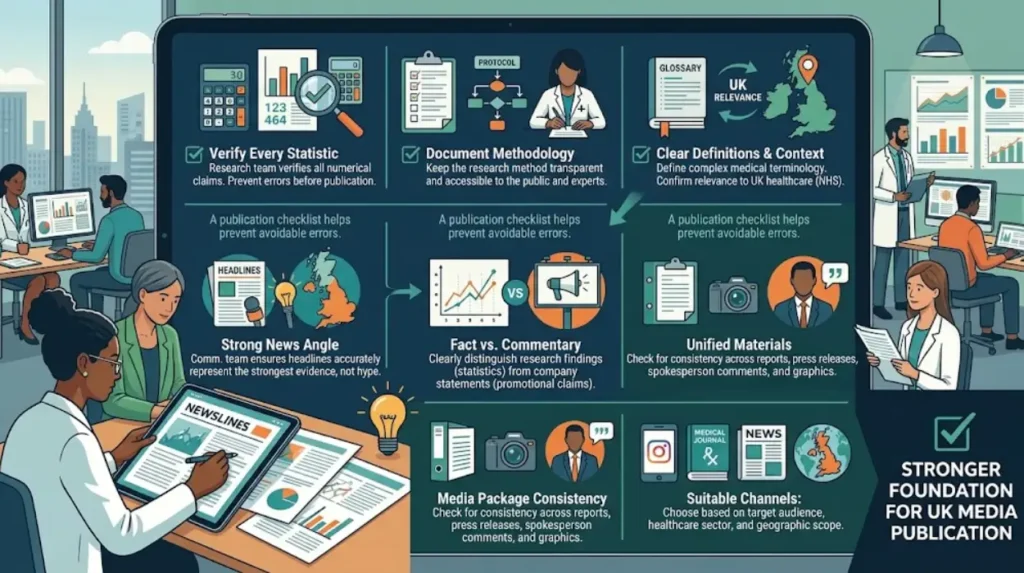
Before publishing healthcare research, organisations need to verify every statistic, document the methodology, confirm UK relevance, identify the strongest news angle, prepare accurate media materials, and select suitable publication channels based on audience, sector, geographic scope, and editorial relevance.
A publication checklist helps prevent avoidable errors.
The research team needs to verify all numerical claims. The communications team needs to confirm that headlines accurately represent the evidence.
The methodology needs to remain accessible. Technical healthcare terminology needs clear definitions.
Organisations also need to distinguish research findings from promotional claims. A statistic represents evidence. A company statement represents commentary.
The final media package needs consistency across the report, press release, spokesperson comments, and supporting materials.
This process creates a stronger foundation for UK media publication.
Explore More Expert Insights:
How to Turn Fintech Data Into a Citable UK Report
How a Media-Published Report Reaches 15 UK News Sites
What is the overall process for getting healthcare research published on UK news?
The healthcare research publication process starts with original research, continues through validation and news-angle development, then moves into press material preparation, media distribution, editorial assessment, publication, and performance monitoring across relevant UK news and sector channels.
The complete process follows a defined sequence:
- Conduct the research using a documented methodology.
- Validate the data and confirm statistical accuracy.
- Identify the news angle from the strongest findings.
- Prepare the research report with evidence and methodology.
- Create media materials including a press release and key statistics.
- Select relevant UK media channels based on audience and subject.
- Distribute the research story through an appropriate publishing approach.
- Respond to editorial requirements with accurate supporting information.
- Monitor published coverage across relevant outlets.
- Reuse verified findings across owned and professional communication channels.
For a healthcare organisation, research publication is therefore a structured process rather than a single media activity. Strong methodology provides the evidence. Clear news angles provide editorial relevance. Suitable distribution connects the findings with UK audiences.
The next stage is evaluating how a dedicated publishing provider manages healthcare research reports, media distribution, and publication opportunities. Healthcare Research Reports provides that service-level context for organisations moving from research preparation to publication.