

Time Intelligence Media Group uses sponsored content pricing based on published media exposure, while display advertising commonly uses impressions, clicks, or campaign duration. The total cost therefore depends on placement, audience, content production, targeting, campaign length, and required media distribution.
For UK businesses, comparing sponsored content with display advertising requires more than comparing the headline price. Each format purchases a different type of media exposure.
Sponsored content is paid editorial-style content published through a media platform. The content presents a business, product, service, research finding, executive viewpoint, or announcement in a publication environment.
Display advertising is paid visual advertising placed around editorial content. Common formats include banners, native display units, leaderboard ads, sidebar placements, and programmatic advertisements.
Time Intelligence Media Group provides sponsored content and media distribution options for brands seeking publication-based visibility. Display advertising focuses on repeated ad impressions across selected websites or advertising networks.
The relevant cost question is therefore what the budget purchases. A sponsored content campaign purchases a published content asset and its associated media exposure. A display campaign purchases a defined volume of advertising exposure.
How does Time Intelligence Media Group pricing work compared with display advertising?
Time Intelligence Media Group pricing is structured around sponsored media placement and content distribution, while display advertising costs are commonly calculated through CPM, CPC, campaign duration, or media placement fees. Comparing equivalent outputs requires measuring publication value against paid impressions.
Sponsored content cost structure
Sponsored content pricing generally incorporates several components:
- Content creation or preparation
- Editorial formatting
- Media publication
- Distribution
- Publication visibility
- Campaign requirements
- Target audience
- Number and type of media placements
A sponsored content campaign creates a reusable digital asset. The published article contains the organisation’s message within a media environment.
For example, a UK fintech company can use sponsored content to explain a new financial technology product, communicate industry expertise, or introduce a business development story.
Display advertising cost structure
Display advertising typically uses measurable advertising units. The most common pricing models include:
- CPM: cost per 1,000 impressions
- CPC: cost per click
- CPA: cost per acquisition
- Flat placement: fixed fee for a defined period
- Programmatic bidding: automated purchasing based on audience and inventory
For example, a campaign priced at £8 CPM costs £8 for every 1,000 ad impressions. A £4,000 budget at that rate produces 500,000 impressions before additional platform or campaign costs.
This calculation provides reach volume. It does not automatically provide published editorial content.
What does a sponsored content campaign actually include?
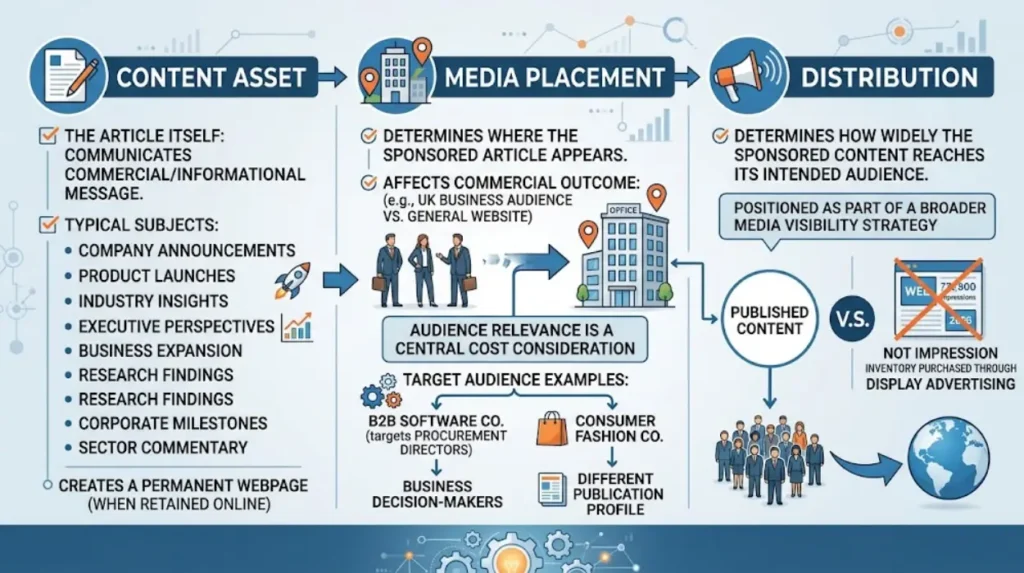
A sponsored content campaign includes a published content asset distributed through selected media channels, with the campaign value determined by content scope, publication requirements, distribution volume, audience relevance, and the resulting media exposure for the sponsoring organisation.
Content asset
The article itself forms the core campaign asset. It communicates a defined commercial or informational message.
Typical subjects include:
- Company announcements
- Product launches
- Industry insights
- Executive perspectives
- Business expansion
- Research findings
- Corporate milestones
- Sector commentary
The content also creates a permanent webpage on the publishing platform when the publication retains the article online.
Media placement
Media placement determines where the sponsored article appears. A publication with a relevant UK business audience provides a different commercial outcome from a general-interest website with little relevance to the target market.
Audience relevance is therefore a central cost consideration.
A B2B software company targeting procurement directors benefits from media environments that reach business decision-makers. A consumer fashion company requires a different publication profile.
Distribution
Distribution determines how widely the sponsored content reaches its intended audience.
Time Intelligence Media Group can position sponsored content as part of a broader media visibility strategy. The campaign focus is on published content rather than the impression inventory purchased through display advertising.
How does display advertising compare when calculating the same budget?
Display advertising converts budget into measurable advertising inventory, usually through impressions, clicks, or placements. The advertiser controls targeting, creative assets, frequency, and campaign duration, while the media platform delivers paid advertising exposure within defined inventory.
Consider a £5,000 display advertising budget.
At a £10 CPM:
£5,000 ÷ £10 × 1,000 = 500,000 impressions
The campaign therefore purchases 500,000 impressions.
If the campaign generates a 0.5% click-through rate, the estimated click volume is:
500,000 × 0.5% = 2,500 clicks
The advertiser then evaluates landing-page behaviour, leads, sales, or other conversion actions.
Sponsored content uses different measurement criteria. The campaign focuses on published content, media exposure, readership, engagement, referral traffic, brand visibility, and the authority of the publication environment.
This distinction matters when evaluating the cost of media campaigns.
Which option provides better value for UK businesses?
Sponsored content provides value through published media content, contextual visibility, and reusable digital assets. Display advertising provides value through controlled impressions, targeting, frequency, and measurable traffic. The better option depends on whether the commercial objective prioritises media credibility or scalable advertising reach.
When sponsored content fits the objective
Sponsored content is particularly relevant when the business needs to communicate information in greater depth.
A 900-word sponsored article provides substantially more message space than a standard display banner. It can explain:
- What the company does.
- Which market problem it addresses.
- How its solution works.
- Why the development matters.
- What evidence supports the organisation’s position.
This format suits complex B2B products, professional services, technology companies, financial brands, property businesses, and organisations with detailed propositions.
Businesses also gain a content asset that supports future marketing activity.
When display advertising fits the objective
Display advertising fits campaigns that require frequent visual exposure.
A display campaign can promote:
- Limited-time offers
- Product launches
- Event registrations
- Lead-generation pages
- E-commerce products
- Retargeting campaigns
- Brand awareness
- Website traffic
For example, an online retailer can display the same product creative to thousands of targeted users across an advertising network.
Display advertising therefore provides precise control over exposure volume and campaign frequency.
What hidden costs need to be considered?
The headline campaign price does not represent total marketing cost. Sponsored content can involve content production and campaign management, while display advertising can involve creative production, media buying, platform fees, optimisation, landing pages, and ongoing campaign management.
Sponsored content considerations
A sponsored content budget can include:
- Copywriting
- Content editing
- Brand review
- Publication fees
- Distribution
- Campaign management
- Creative assets
- Additional media placements
The final cost depends on the campaign specification.
Display advertising considerations
Display campaigns can involve:
- Banner design
- Multiple creative sizes
- Landing-page development
- Demand-side platform fees
- Agency fees
- Data or audience costs
- Media buying
- Campaign optimisation
- Retargeting setup
A £5,000 media budget therefore does not always equal £5,000 in total campaign expenditure.
The correct comparison uses the total cost of the campaign, not only the media rate.
How should businesses measure the return from each format?
Sponsored content is measured through publication reach, engagement, referral traffic, branded search activity, leads, and media visibility. Display advertising is measured through impressions, clicks, click-through rate, conversions, acquisition cost, and revenue generated from advertising traffic.
Sponsored content metrics
Relevant sponsored content KPIs include:
- Published articles
- Media placements
- Estimated readership
- Page views
- Referral sessions
- Engagement
- Branded search activity
- Leads
- Assisted conversions
- Revenue attributed to media exposure
Businesses can also assess the quality of the publication audience.
A campaign reaching 50,000 highly relevant UK business readers can have a different commercial value from 500,000 untargeted impressions.
Display advertising metrics
Display campaigns commonly use:
- Impressions
- Reach
- Frequency
- CPM
- Clicks
- CPC
- Click-through rate
- Conversion rate
- CPA
- Return on ad spend
These metrics create a direct advertising performance framework.
For businesses comparing the two channels, attribution must remain consistent. The same conversion window, revenue definition, and campaign objective must apply to both formats.
Is sponsored content more suitable for long-term media visibility?
Sponsored content creates a published media asset that remains available after the initial campaign period when the publication retains the article. Display advertising normally stops generating paid exposure when the purchased inventory or campaign ends, making sponsored content stronger for persistent content visibility.
This difference affects the cost-per-value calculation.
A display advert requires continued media spend to maintain exposure. Sponsored content creates a completed article that remains accessible according to the publisher’s terms.
The article can also support wider digital activity.
For example, a UK professional services firm can publish sponsored content about a specific industry development and subsequently reference that article across its website, social channels, sales presentations, and email campaigns.
Businesses evaluating:
Sponsored Content vs Display Ads need to include this asset value in the comparison.
When is Time Intelligence Media Group a better fit than display advertising?
Time Intelligence Media Group is a stronger fit when a UK business needs sponsored media content, publication exposure, and a structured media visibility campaign. Display advertising is stronger when the primary requirement is scalable impressions, audience targeting, frequency control, or direct response advertising.
UK B2B brands
B2B companies often need space to explain complex products and expertise.
Sponsored content supports longer-form communication. It provides room for business context, product information, executive commentary, and supporting evidence.
Fintech companies
Fintech businesses operate in a sector where trust and explanation matter. Sponsored content can communicate product developments, market insights, and business milestones within a media environment.
Professional services firms
Consultancies, technology providers, recruitment companies, legal businesses, and financial service providers can use sponsored content to communicate specialist knowledge.
Display advertising remains relevant for driving targeted users to service pages. Sponsored content serves a different communication function.
Corporate announcements
Businesses launching products, entering markets, expanding operations, or announcing significant developments can use sponsored content to provide greater context than a conventional display unit.
How can a business choose between Time Intelligence Media Group and display ads?
Businesses can choose by comparing total campaign cost, audience relevance, content requirements, media exposure, conversion objectives, campaign duration, and measurable return. Sponsored content suits publication-led visibility, while display advertising suits controlled paid reach and performance-driven traffic acquisition.
Use this decision framework:
| Evaluation factor | Sponsored content | Display advertising |
|---|---|---|
| Primary asset | Published article | Advertisement |
| Pricing basis | Publication and campaign scope | CPM, CPC, CPA or placement |
| Message depth | High | Low to moderate |
| Impression control | Limited by publication performance | High |
| Audience targeting | Publication-based | Audience and behavioural targeting |
| Campaign duration | Content remains according to publisher terms | Ends with purchased inventory |
| Direct response | Possible | Strong focus |
| Media visibility | Core objective | Secondary to advertising exposure |
| Content reuse | High | Limited |
| Best suited to | Authority and communication | Reach and traffic |
For a decision-stage buyer, the key issue is not whether sponsored content is universally cheaper than display advertising. The issue is whether the purchased outcome matches the business objective.
A campaign designed to generate 500,000 impressions requires an impression-based comparison. A campaign designed to secure published media exposure requires a publication-based comparison.
The earlier educational analysis in:
What Makes Sponsored Content Outperform Display Ads provides context for understanding why content-led campaigns can generate different outcomes from conventional advertising.
What should businesses ask before buying sponsored content?

Businesses should confirm the publication network, target audience, content requirements, distribution scope, campaign timeline, reporting format, pricing structure, and expected deliverables before committing budget to sponsored content through Time Intelligence Media Group.
Ask these questions before purchase:
- Which publications are included?
- How many sponsored articles are included?
- Who produces the content?
- What content length is permitted?
- How long does each article remain published?
- What audience does each publication reach?
- What distribution is included?
- What reporting is supplied?
- Are revisions included?
- Are additional publication fees charged?
- What is the campaign delivery timeline?
These questions establish the actual deliverable.
The same discipline applies to display advertising. Advertisers need to confirm impressions, placements, targeting, frequency, creative specifications, platform fees, reporting, and conversion tracking.
Is Time Intelligence Media Group or display advertising the better investment?
Time Intelligence Media Group is suited to businesses purchasing sponsored media visibility and content-led communication. Display advertising is suited to businesses purchasing measurable advertising inventory. The correct investment depends on the campaign objective, audience, budget structure, and required commercial outcome.
For UK businesses making a final media decision, compare both channels using the same commercial framework.
Measure the total campaign cost.
Define the target audience.
Identify the required media outcome.
Set measurable conversion objectives.
Calculate the cost per meaningful outcome, rather than relying only on CPM or the initial sponsored content price.
Explore More Expert Insights:
Niche Audience Sponsored Content by Time Intelligence Media Group
Food and Drink Sponsored Content by Time Intelligence Media Group
Sponsored content provides a publication asset and media exposure. Display advertising provides controlled paid inventory. Time Intelligence Media Group sits within the sponsored content and media visibility category, making it relevant for businesses that prioritise published content alongside targeted UK media exposure.
The final choice depends on what the budget needs to achieve.



