
Sponsored content is paid editorial-style content built around a brand message, while display advertising uses visual ad placements. Sponsored content prioritises information and context; display advertising prioritises immediate visibility, recognition, clicks, and direct promotional messaging.
Sponsored content appears within a publisher’s content environment. It uses formats such as articles, guides, interviews, case studies, and branded features. The content is paid for by an advertiser but presented in a format associated with the publisher’s editorial experience.
Display advertising uses visual placements across websites, apps, and digital platforms. Common formats include banners, leaderboard ads, rectangles, skyscrapers, and responsive display units.
The distinction affects how audiences encounter the brand.
Sponsored content gives users information before asking for action. Display advertising places the promotional message directly in front of users.
For UK businesses, the choice depends on the campaign objective, audience intent, conversion path, and measurement framework.
How does sponsored content work?
Sponsored content follows a content-led distribution process:
- A brand defines its target audience and campaign objective.
- Content is created around a relevant topic.
- The publisher distributes the content to its audience.
- Users read or interact with the content.
- Calls to action direct interested users towards a website, landing page, product, or service.
For example, a UK fintech company launching an accounting platform can publish a sponsored article explaining cash-flow management for small businesses. The article introduces the problem, provides useful information, and positions the platform within that context.
How do display ads work?
Display advertising follows a more direct advertising process. The advertiser selects audience criteria, creative formats, placements, budget, and campaign objectives. Ads then appear across selected digital environments.
A property company, for example, can use display banners promoting a new residential development. The advert can include an image, headline, price point, location, and call to action.
Why does sponsored content influence conversions differently from display ads?
Sponsored content influences conversions through information, relevance, trust signals, and sustained engagement. Display ads influence conversions through visibility, repetition, creative impact, and direct calls to action. Each format supports different stages of the customer decision process.
Conversion does not start with the same audience behaviour for every campaign.
A user reading an article about business finance has a different information need from a user who sees a banner promoting accounting software. Sponsored content addresses an active information need. Display advertising interrupts or accompanies existing digital activity.
This difference creates distinct conversion mechanisms.
What makes sponsored content conversion-focused?
Sponsored content connects the commercial message with useful information. This structure creates several conversion points.
A typical sponsored article contains:
- A relevant subject
- An identifiable audience problem
- Educational information
- Brand positioning
- Supporting evidence
- A contextual call to action
- A landing page or website destination
The user receives information before encountering the commercial proposition.
This structure is particularly relevant for B2B products with longer decision cycles. Software, financial services, professional services, property, healthcare, and business training often require more explanation than a standard banner provides.
What makes display advertising conversion-focused?
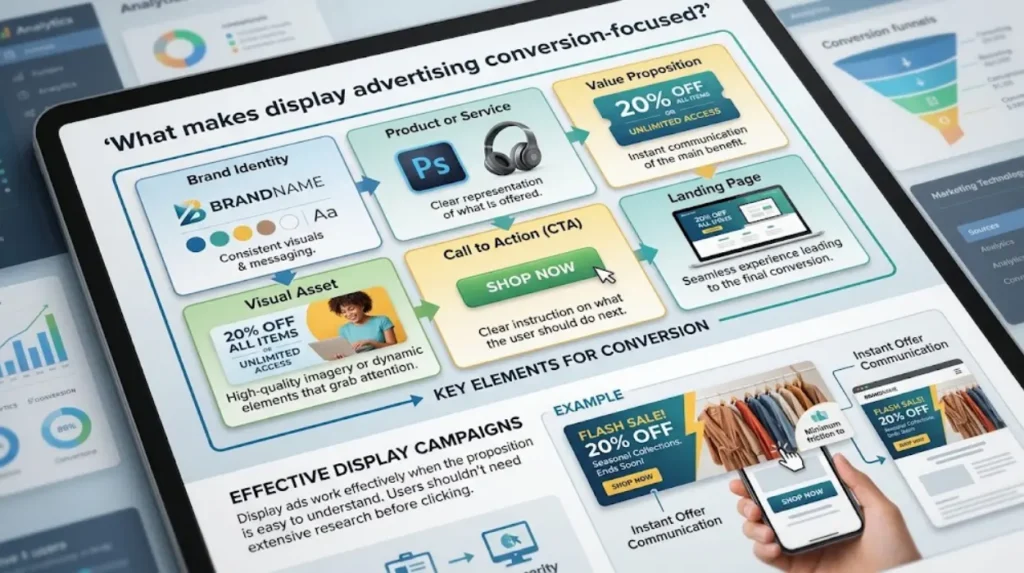
Display advertising compresses the commercial proposition into a small visual format. The creative needs to communicate the offer quickly.
Key elements include:
- Brand identity
- Product or service
- Value proposition
- Visual asset
- Call to action
- Landing page
Display campaigns work effectively when the proposition is easy to understand.
For example, an ecommerce retailer promoting a 20% seasonal discount can communicate the offer through a banner immediately. The audience does not require extensive product education before clicking.
Which factors determine whether sponsored content or display ads convert better?
Conversion performance depends on audience intent, campaign objective, content depth, creative quality, landing-page experience, distribution, targeting, and measurement. No single advertising format delivers the same conversion result across every industry, audience, and purchase journey.
The most useful comparison focuses on campaign conditions rather than format alone.
Does audience intent affect conversion rates?
Audience intent has a direct relationship with advertising effectiveness.
High-intent audiences actively search for information, products, suppliers, or solutions. Sponsored content can address these audiences through detailed topics that match their information needs.
Display advertising performs differently. Audience targeting identifies users through demographics, interests, behaviour, context, or previous website activity.
For example, a user researching UK payroll compliance requires different content from someone who already visited a payroll software pricing page.
The first audience needs information. The second audience has stronger commercial intent.
Does purchase complexity matter?
Purchase complexity affects the amount of information required before conversion.
Simple products often need limited explanation. A display advertisement can communicate the essential offer quickly.
Complex products require more information. Sponsored content provides space for definitions, evidence, product context, use cases, and explanations.
A business insurance product, enterprise software platform, or professional consultancy service often requires several information stages before purchase.
This makes content depth an important consideration in conversion strategy.
What metrics show whether sponsored content converts better than display ads?
Sponsored content is measured through engagement, referral traffic, assisted conversions, branded search activity, lead generation, and direct conversions. Display advertising is commonly measured through impressions, click-through rate, conversions, cost per acquisition, and return on ad spend.
The measurement model must match the campaign objective.
Which metrics matter for sponsored content?
Important sponsored content metrics include:
- Page views
- Engaged sessions
- Average engagement time
- Referral traffic
- Scroll depth
- Click-through rate
- Lead submissions
- Assisted conversions
- Direct conversions
- Branded search activity
A sponsored article that generates fewer immediate clicks than a banner still produces measurable value when users later visit the brand website through another channel.
Attribution therefore requires more than last-click measurement.
Which metrics matter for display advertising?
Display advertising commonly uses:
- Impressions
- Reach
- Frequency
- Click-through rate
- Cost per click
- Conversion rate
- Cost per acquisition
- Return on ad spend
These metrics provide clear information about delivery and direct response.
For example, a campaign generating 500,000 impressions, 2,500 clicks, and 100 conversions has a 0.5% click-through rate and a 4% post-click conversion rate.
The same calculation framework does not fully capture the value of a content-led campaign.
How does the customer journey affect sponsored content and display advertising?
Sponsored content supports awareness, consideration, and research by providing detailed information. Display advertising supports awareness, retargeting, direct response, and repeated brand exposure. Combining formats creates coverage across different stages of the customer journey.
A customer journey often includes several stages.
Awareness
At the awareness stage, audiences recognise a problem or discover a new brand.
Sponsored content introduces the brand through a relevant subject. Display advertising introduces the brand through visual exposure.
Consideration
At the consideration stage, users compare solutions.
Sponsored content provides detailed explanations, evidence, comparisons, and use cases. This supports research-heavy purchasing decisions.
Display advertising reinforces recognition and directs users towards product pages or comparison resources.
Conversion
At the conversion stage, users take a defined commercial action.
This action can include submitting a form, requesting a consultation, purchasing a product, booking a demonstration, or registering for an event.
Display ads with clear offers can drive direct response. Sponsored content can direct informed users to a conversion page after establishing contextual relevance.
Businesses evaluating distribution options can also examine:
Sponsored Content as part of a wider content-led acquisition strategy.
When is sponsored content a stronger choice for UK businesses?
Sponsored content is a stronger strategic choice when the campaign requires education, contextual relevance, detailed messaging, publisher credibility, or sustained consideration. It fits complex products, B2B services, regulated sectors, and audiences requiring information before conversion.
UK businesses in information-intensive sectors often require communication beyond a short advert.
Which industries benefit from content-led campaigns?
Relevant sectors include:
- Financial technology
- Professional services
- Business software
- Property
- Construction
- Healthcare
- Education
- Recruitment
- Corporate services
For example, a UK construction technology company can use sponsored content to explain digital project management challenges. The article provides context before directing users towards the company’s solution.
A banner can promote the same solution, but the format limits the amount of information available.
Why does publisher context matter?
Publisher context determines where the audience encounters the sponsored message.
A business publication reaches professional audiences. A technology publication reaches technology-focused users. A property publication reaches property professionals and buyers.
Contextual relevance reduces the distance between the subject being consumed and the commercial message.
This makes publisher selection an important component of sponsored content performance.
When are display ads a stronger choice?
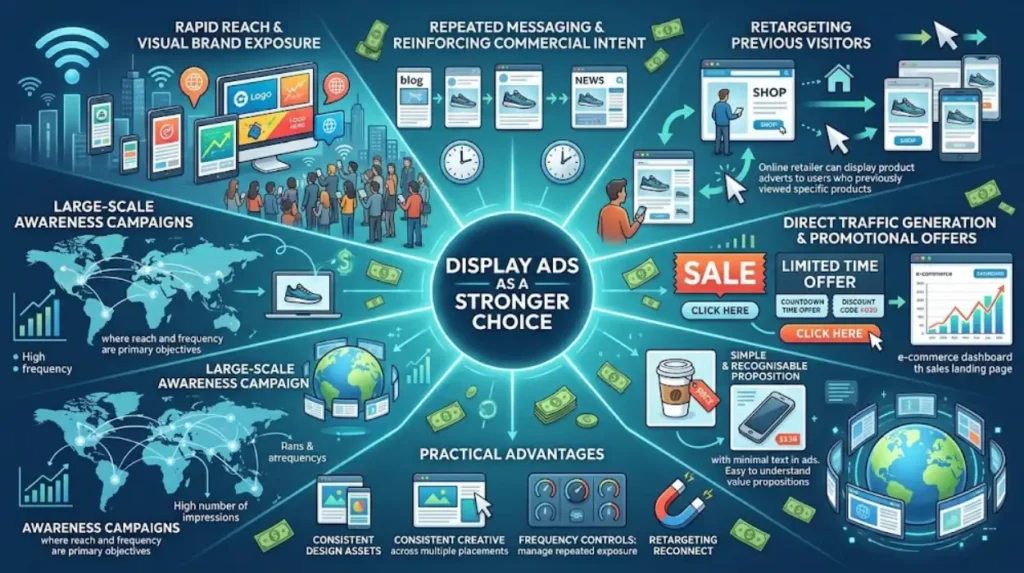
Display advertising is a stronger choice when the campaign requires rapid reach, visual brand exposure, repeated messaging, retargeting, promotional offers, or direct traffic generation. It works particularly well when the commercial proposition is simple and recognisable.
Display advertising has several practical advantages.
A campaign can use consistent creative across multiple placements. Frequency controls can manage repeated exposure. Retargeting can reconnect with previous website visitors.
For example, an online retailer can display product adverts to users who previously viewed specific products. The advert reinforces the existing commercial intent.
Display advertising also supports large-scale awareness campaigns where reach and frequency are primary objectives.
How can businesses compare sponsored content and display advertising costs?
Cost comparison requires more than comparing placement prices. Businesses need to evaluate media fees, production costs, distribution, impressions, traffic, leads, conversions, acquisition costs, and revenue generated from each campaign.
A low media cost does not automatically produce a lower customer acquisition cost.
Sponsored content can involve research, writing, design, editorial production, publisher placement, and distribution. Display advertising involves creative production, media buying, platform fees, and campaign management.
Businesses considering specific distribution approaches can compare:
Time Intelligence Media Group vs display ads using total campaign cost and measurable outcomes rather than placement price alone.
What is the right cost framework?
A useful framework compares:
Total campaign cost ÷ measurable business outcome
The outcome can be:
- Qualified lead
- Sales enquiry
- Product purchase
- Demonstration booking
- Registration
- Revenue
For example, a £5,000 campaign producing 50 qualified leads has a cost per qualified lead of £100.
The same framework applies across sponsored content and display advertising.
Should businesses choose sponsored content or display ads?
Businesses should select the format according to campaign objectives, audience intent, product complexity, conversion journey, budget, and measurement requirements. Sponsored content suits education-led consideration; display advertising suits visual reach, repetition, retargeting, and direct-response campaigns.
The decision becomes clearer when campaign requirements are defined first.
Choose sponsored content when the campaign needs:
- Detailed explanation
- Audience education
- Contextual relevance
- Publisher-led distribution
- Long-form messaging
- Consideration-stage engagement
Choose display advertising when the campaign needs:
- High reach
- Visual recognition
- Promotional messaging
- Retargeting
- Frequency
- Direct response
Many campaigns use both formats because they serve different functions.
Explore More Expert Insights:
How Sponsored Content Targets Niche UK Audiences
How Food and Drink Sponsored Content Reaches UK Readers
Sponsored content builds the information layer. Display advertising reinforces visibility and directs users towards commercial destinations.
The most accurate evaluation therefore measures each format against its intended role rather than treating clicks as the only conversion indicator. For UK marketers, a structured campaign model connects content, media placement, audience intent, landing pages, attribution, and revenue into one measurable conversion framework.