

Sponsored content gives UK brands a structured way to communicate with defined audience segments through relevant editorial environments. Niche audience sponsored content by Time Intelligence Media Group connects brands with focused UK audiences through targeted media placements, relevant content formats, sector-specific publications, and measurable distribution designed for defined commercial objectives.
What is niche audience sponsored content?
Niche audience sponsored content is paid editorial-style content created for a specific audience segment, industry, profession, interest group, or geographic market. It combines targeted media placement with informative brand messaging to reach readers who match defined business criteria.
Niche audiences differ from broad consumer audiences because their interests, professional responsibilities, purchasing criteria, and information needs are more specific.
Examples include:
- UK fintech decision-makers
- Property investors and developers
- Healthcare professionals
- Hospitality executives
- Food and drink buyers
- Technology leaders
- Construction professionals
- Financial services audiences
- SME owners
- B2B procurement professionals
Sponsored content addresses these audiences through publications and media environments relevant to their interests.
For brands, audience definition comes before content distribution. A campaign needs a clear understanding of who the content targets, what information those people seek, and which media environments attract them.
This approach connects directly with the principles explained in:
Niche UK audiences, where audience characteristics determine the relevance and effectiveness of sponsored content.
How does Time Intelligence Media Group target niche UK audiences?
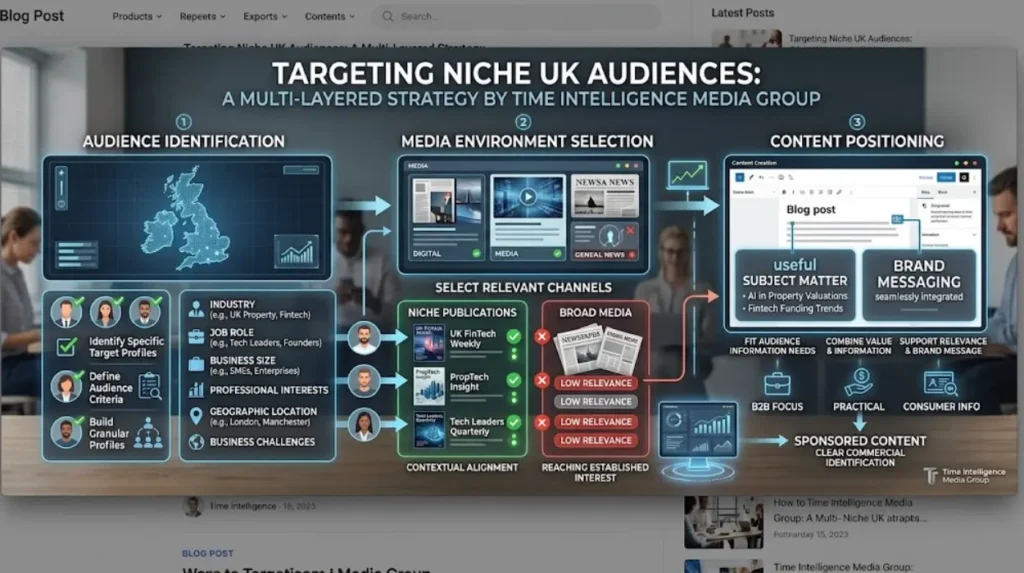
Time Intelligence Media Group targets niche UK audiences by combining audience relevance, media placement, content positioning, sector context, and distribution requirements. The approach focuses sponsored content on defined readership groups instead of relying solely on broad, undifferentiated media exposure.
Audience identification
Audience identification establishes the specific group that the campaign needs to reach.
A campaign targeting UK property professionals requires different media environments from one targeting fintech founders. The content topic, terminology, examples, publication selection, and distribution strategy reflect that difference.
Audience criteria can include:
- Industry
- Job role
- Business size
- Professional interests
- Geographic location
- Consumer interests
- Purchasing responsibility
- Business challenges
These criteria create a defined audience profile.
Media environment selection
Media selection determines where sponsored content appears.
A relevant publication gives the content contextual alignment. A fintech article placed within a finance-focused environment reaches an audience with established interest in financial services.
For example, a cybersecurity company targeting UK technology leaders requires technology-focused media rather than a general lifestyle publication.
Content positioning
Content positioning determines how the brand message fits the audience’s information needs.
A B2B audience responds to specific business information. A consumer niche responds to practical information connected to its interests.
Sponsored content therefore combines brand information with useful subject matter. This structure supports reader relevance while maintaining clear commercial identification.
What does a niche sponsored content campaign include?
A niche sponsored content campaign includes audience definition, content development, publication selection, distribution, brand positioning, and performance measurement. Each component supports a specific stage of the campaign and creates a direct connection between the target audience and the sponsored message.
Audience segmentation
Segmentation defines the intended readership.
A UK campaign can focus on one industry, several related sectors, or a professional audience with a shared interest. More precise segmentation creates clearer content requirements and publication criteria.
Sponsored content development
The content reflects the audience’s knowledge level and search behaviour.
A professional audience requires industry terminology and evidence-based information. A consumer audience requires accessible explanations, practical information, and clear product relevance.
Publication targeting
Publication targeting connects the content with an appropriate media environment.
For example, a construction company targeting project managers can use construction and infrastructure-focused media. A financial technology company can target publications covering banking, investment, payments, or financial innovation.
Distribution
Distribution places the content within selected media environments and expands its potential visibility.
The distribution strategy depends on campaign objectives, audience characteristics, publication relevance, and content format.
Measurement
Measurement establishes whether the campaign achieved its defined objectives.
Relevant metrics include:
- Content views
- Referral traffic
- Engagement
- Time spent on content
- Click-through activity
- Lead activity
- Audience reach
- Publication placements
Measurement connects media activity with commercial performance.
Why does niche sponsored content matter for UK brands?
Niche sponsored content matters because specialised audiences require specialised communication. Targeted media placements place brand messages within relevant editorial contexts, helping businesses address defined sectors, professions, interests, and markets with content designed around specific audience information needs.
The UK media market contains publications serving highly specific communities.
A single industry includes multiple audience groups. Financial services, for example, contains banking professionals, fintech founders, investors, compliance specialists, payment providers, and financial advisers.
Each group consumes different information.
Niche sponsored content addresses this fragmentation through audience-specific messaging.
It also provides brands with greater control over context. The brand selects the subject, message, target audience, and media environment rather than relying entirely on general advertising exposure.
This makes sponsored content particularly relevant for B2B companies and specialist consumer brands.
How can sponsored content support different UK industries?
Sponsored content supports different UK industries by adapting audience targeting, editorial topics, terminology, and media placement to sector-specific requirements. The campaign structure changes according to the people a brand needs to reach, from fintech professionals to property investors and technology buyers.
Financial technology
Fintech brands can use sponsored content to explain payment technology, digital banking, financial infrastructure, cybersecurity, compliance, or investment technology.
The audience can include founders, financial executives, technology professionals, investors, and institutional decision-makers.
Property and construction
Property and construction brands can address developers, contractors, architects, investors, facilities professionals, and project managers.
Content topics can include construction technology, property investment, sustainable development, building management, and infrastructure.
Food and drink
Food and drink brands can target buyers, hospitality professionals, retailers, consumers, and industry specialists.
Content can focus on market developments, product categories, consumer trends, sourcing, sustainability, or business strategy.
Healthcare
Healthcare-related campaigns require precise audience definition because professional and consumer audiences have different information requirements.
A campaign can target healthcare professionals, healthcare businesses, technology providers, or consumers depending on the permitted subject matter and communication objectives.
Technology
Technology companies can use sponsored content to reach IT decision-makers, business leaders, developers, cybersecurity professionals, and technology buyers.
Topics can include artificial intelligence, cloud computing, cybersecurity, software, data infrastructure, and digital transformation.
How does niche sponsored content differ from broad media advertising?
Niche sponsored content differs from broad advertising through its emphasis on editorial context, audience relevance, subject depth, and targeted media placement. Advertising prioritises promotional visibility, while sponsored content combines commercial messaging with structured information relevant to a defined readership.
Broad advertising attempts to reach large audiences.
Niche sponsored content prioritises audience relevance.
This distinction affects campaign planning. A business selling specialist enterprise software does not need every media reader. It needs exposure among people responsible for technology purchasing, digital transformation, or operational systems.
Sponsored content creates space for detailed explanations.
It can introduce a business problem, explain a solution category, provide industry information, and connect the topic with the sponsoring brand.
This format supports longer-form communication than many conventional advertising placements.
What benefits does Time Intelligence Media Group provide for niche audience campaigns?
Time Intelligence Media Group provides a structured sponsored content approach focused on audience targeting, relevant media environments, content positioning, and measurable distribution. The service supports brands that require focused UK exposure rather than broad media visibility without defined audience relevance.
Focused audience reach
Campaigns focus on defined audience segments rather than treating the UK market as one uniform readership.
Relevant editorial environments
Content appears within media contexts connected to its subject and target audience.
Brand visibility
Sponsored content gives brands an editorial-style environment for communicating expertise, products, services, or market perspectives.
Search visibility
Well-structured sponsored content can create additional indexed content and referral pathways when publication and linking arrangements support them.
Audience relevance
The central objective remains relevance. The content needs to answer questions that matter to the intended audience.
Measurable activity
Campaign reporting provides a framework for evaluating visibility, engagement, traffic, and other defined performance indicators.
When is niche audience sponsored content the right choice?
Niche audience sponsored content is appropriate when a brand has a clearly defined market and requires communication within relevant media environments. It fits specialist B2B sectors, professional audiences, regional markets, emerging categories, and brands with specific commercial audience requirements.
It is particularly relevant when:
- The target market is specialised.
- The product requires explanation.
- Industry credibility matters.
- The campaign has a defined UK audience.
- Brand awareness needs sector-specific exposure.
- The business operates in a competitive specialist market.
- The content requires more context than a conventional advertisement provides.
A specialist software provider, for example, benefits from communicating with technology decision-makers who understand the problem addressed by its platform.
A property consultancy can focus content on investors and developers instead of general audiences.
An emerging fintech brand can communicate its proposition within financial services media environments.
How should brands evaluate a niche sponsored content campaign?
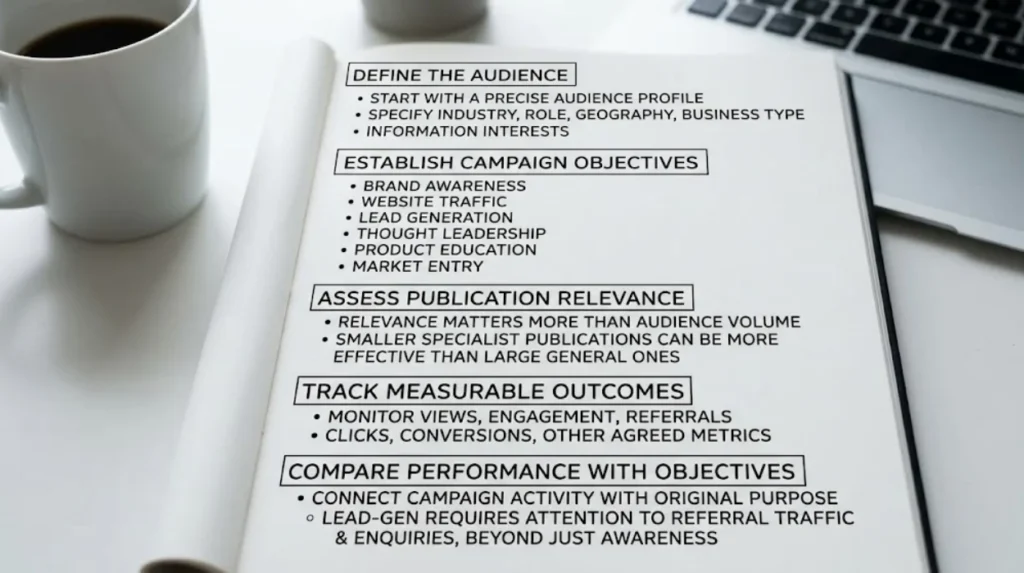
Brands should evaluate niche sponsored content against predefined audience, media, content, traffic, engagement, and commercial objectives. Evaluation requires measurable criteria established before publication so campaign performance reflects the intended audience and business purpose rather than exposure alone.
Define the audience
Start with a precise audience profile.
Specify industry, role, geography, business type, and information interests.
Establish campaign objectives
Objectives can include brand awareness, website traffic, lead generation, thought leadership, product education, or market entry.
Assess publication relevance
Publication relevance matters more than audience volume alone.
A smaller specialist publication with strong audience alignment can provide more relevant exposure than a large general publication.
Track measurable outcomes
Monitor views, engagement, referrals, clicks, conversions, and other agreed metrics.
Compare performance with objectives
The final evaluation needs to connect campaign activity with the original purpose.
For example, a lead-generation campaign requires stronger attention to referral traffic and enquiries than a campaign focused purely on brand awareness.
Explore More Expert Insights:
Food and Drink Sponsored Content by Time Intelligence Media Group
Beauty Sponsored Content by Time Intelligence Media Group
Why choose Time Intelligence Media Group for niche UK sponsored content?
Time Intelligence Media Group provides brands with a decision-focused approach to niche UK sponsored content, combining audience targeting, relevant media placement, content distribution, and measurable campaign objectives. The service is designed for businesses seeking specialised UK audience exposure through sponsored editorial content.
The decision process starts with the audience.
The brand identifies who needs to see the content. The campaign then aligns the subject, messaging, publication environment, and distribution strategy with that audience.
This structure supports sectors where relevance matters more than general reach.
For businesses evaluating specialist media campaigns,
Sponsored Content can provide a further route into the relevant sponsored content solution.
Niche audience sponsored content works best when every campaign element supports the same objective: reaching the right UK audience with information that fits its professional or consumer interests.
For brands with clearly defined markets, this approach creates a structured route from audience identification to content publication, distribution, measurement, and commercial evaluation.



