Credible sponsored content gives UK brands a controlled way to communicate with audiences through established news environments while maintaining clear commercial disclosure, factual accuracy, professional presentation, and editorially appropriate formatting. Time Intelligence Media Group provides sponsored content distribution designed around these requirements.
What makes sponsored content credible for UK audiences?
Credible sponsored content combines transparent commercial labelling, factual claims, professional editorial presentation, relevant publication placement, accurate brand information, and consistent disclosure. These elements help audiences understand the commercial nature of content while retaining confidence in the information presented.
Credibility begins with transparency. Sponsored content must not create confusion between paid material and independent journalism. Clear labels such as “Sponsored”, “Paid Content”, or “Advertisement Feature” identify the commercial relationship.
Content quality also affects perceived credibility. A sponsored article containing unsupported claims, excessive promotional language, inaccurate statistics, or irrelevant information reduces trust.
UK audiences also recognise established publication standards. Content distributed through suitable news websites needs to match the expected tone, structure, formatting, and subject relevance of the publication environment.
For brands evaluating:
Credible sponsored content, the distinction between visibility and credibility is important. Distribution creates exposure. Credibility depends on how the content is presented, disclosed, supported, and positioned.
How does Time Intelligence Media Group approach credible sponsored content?
Time Intelligence Media Group approaches sponsored content through structured content preparation, transparent commercial positioning, publication targeting, factual presentation, and distribution across relevant media environments. The process connects brand messaging with publication requirements while preserving clear identification of paid content.
The process starts with the brand’s communication objective. This determines the subject, audience, publication category, and information required within the article.
The next stage involves content development. The article presents the organisation, product, service, research, event, announcement, or business development using factual information and a defined narrative structure.
Publication selection then determines where the sponsored content appears. Relevance is central to this process. A fintech announcement requires a different publication environment from a property development article or healthcare business feature.
Content preparation
Content preparation includes:
- Defining the primary subject and commercial objective
- Establishing factual claims and supporting information
- Structuring headlines and subheadings
- Applying relevant UK terminology
- Reviewing brand references
- Maintaining transparent sponsored-content disclosure
- Preparing publication-ready copy
This process reduces inconsistencies between the brand’s message and the requirements of the selected media environment.
Publication alignment
Publication alignment considers subject relevance, audience profile, content format, and publication standards. A credible placement connects the article topic with the interests of the publication’s audience.
For example, a UK fintech company announcing a new payment platform requires media environments relevant to financial technology, business, payments, or digital finance.
What components define a credible sponsored content campaign?
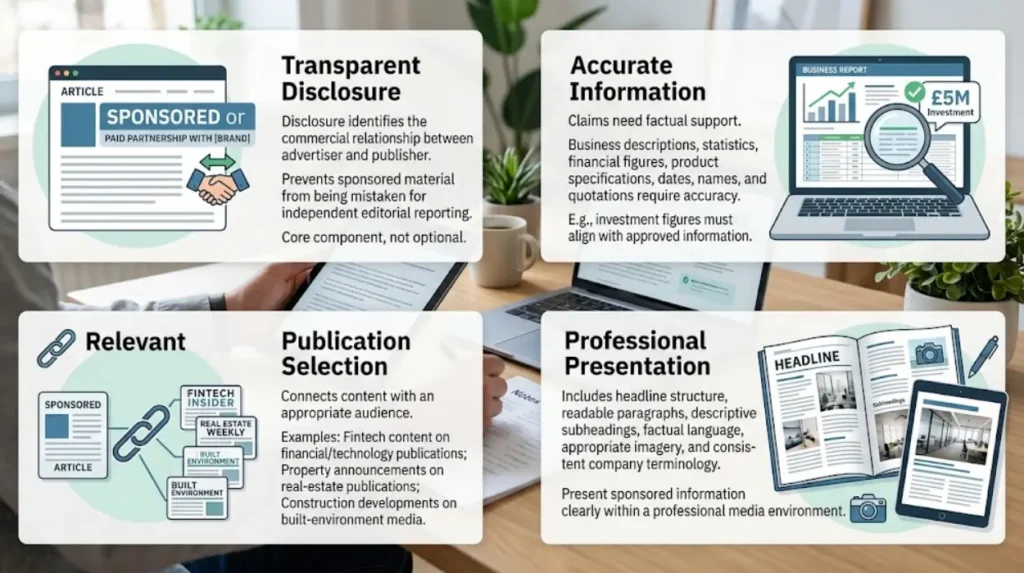
A credible sponsored content campaign includes accurate information, transparent disclosure, relevant publication selection, professional writing, consistent brand details, appropriate formatting, and measurable distribution. Each component contributes to content quality, audience understanding, and reliable evaluation of campaign performance.
Transparent disclosure
Disclosure identifies the commercial relationship between the advertiser and publisher. It prevents sponsored material from being mistaken for independent editorial reporting.
Transparency is therefore a core component rather than an optional formatting feature.
Accurate information
Claims need factual support. Business descriptions, statistics, financial figures, product specifications, dates, names, and quotations require accuracy.
For example, a company announcing a £5 million investment needs the article to present the figure consistently with the company’s approved information.
Relevant publication selection
Publication relevance connects content with an appropriate audience.
Examples include:
- Fintech content on financial and technology publications
- Property announcements on real-estate publications
- Construction developments on built-environment media
- Healthcare business news on relevant healthcare publications
- Corporate announcements on business-focused news websites
Professional presentation
Professional presentation includes headline structure, readable paragraphs, descriptive subheadings, factual language, appropriate imagery, and consistent company terminology.
The objective is not to disguise commercial content as editorial journalism. The objective is to present sponsored information clearly within a professional media environment.
How is sponsored content prepared for UK news websites?
Sponsored content for UK news websites is prepared by defining the audience, researching the subject, organising factual information, writing publication-ready copy, checking commercial disclosure, and aligning the final article with the selected publication’s content and formatting requirements.
UK terminology and communication conventions influence content preparation. British English applies throughout the article, including spelling, terminology, punctuation, and sector-specific language.
The headline establishes the primary subject. The introduction provides the essential information early. Subsequent sections develop supporting details without unnecessary repetition.
Factual review
A factual review checks:
- Company names
- Executive names and job titles
- Dates
- Locations
- Financial figures
- Product or service descriptions
- Research statistics
- Quotes
- Website references
- Regulatory or industry terminology
This process is particularly important for regulated sectors.
A financial services company, for example, requires accurate terminology when describing regulated activities, financial products, authorisation, or compliance-related information.
Commercial language review
Sponsored content remains commercial communication. Excessive promotional claims reduce information quality.
Statements such as “the UK’s leading”, “number one”, or “best-in-class” require substantiation when presented as factual claims.
A stronger approach uses verifiable information. For example, a company can state the number of customers, operating locations, funding amount, product launch date, or measurable business achievement when those facts are documented.
Why does publication relevance matter for sponsored content credibility?
Publication relevance strengthens sponsored content credibility because the audience expects the subject to fit the publication’s coverage area. Relevant placement connects the article with readers who already consume information about that industry, market, location, or business category.
Relevance operates at several levels.
Industry relevance connects the subject with the publication’s specialist area. Geographic relevance connects the content with a specific UK market or region. Audience relevance connects the subject with readers who have a defined professional or consumer interest.
For example, a Manchester property development announcement has stronger contextual relevance on a property or regional business publication than on an unrelated specialist website.
This distinction matters during media planning. A large number of placements does not automatically create stronger credibility. Appropriate placements provide greater contextual alignment.
How can brands evaluate the credibility of sponsored content before publication?
Brands can evaluate sponsored content by checking disclosure, factual accuracy, publication relevance, writing quality, audience alignment, brand consistency, formatting, distribution details, and reporting requirements before publication. These criteria create a practical framework for assessing campaign readiness and quality.
A pre-publication assessment can use a structured checklist.
Content checklist
- Is the commercial nature clearly disclosed?
- Are all factual claims verified?
- Are statistics supported by reliable information?
- Are company names and titles correct?
- Does the headline accurately represent the article?
- Does the article avoid unsupported superlatives?
- Does the content use British English?
- Does the subject match the target publication?
- Are links and brand references accurate?
Distribution checklist
Brands also need to establish where the content will appear and how publication results will be reported.
Useful reporting fields include publication name, publication date, article URL, content title, geographic relevance, and campaign objective.
This information creates an auditable record of the campaign.
What business outcomes can credible sponsored content support?
Credible sponsored content supports controlled brand visibility, targeted audience communication, thought-leadership positioning, product awareness, corporate announcements, event promotion, and digital visibility. Outcomes depend on content quality, publication relevance, distribution scope, and campaign measurement.
Sponsored content serves different business communication requirements.
Brand awareness
A company entering a new UK market can use sponsored content to introduce its organisation, offering, leadership team, or market activity to relevant audiences.
Thought leadership
Senior executives can publish structured commentary around business trends, operational developments, technology, regulation, or industry change.
The content remains commercially sponsored while providing a defined information focus.
Product and service awareness
A company launching a product can explain its functionality, target market, availability, and business purpose through a structured sponsored feature.
For example, a B2B software company launching an AI-powered compliance platform can explain its functions, intended users, implementation process, and launch details.
Corporate announcements
Sponsored content also supports announcements involving investment, expansion, partnerships, appointments, events, research, acquisitions, and market entry.
These use cases require precise factual presentation because the content communicates specific corporate information.
How does credible sponsored content differ from ordinary advertising?
Sponsored content uses an article-based format to communicate detailed information within a publisher’s media environment, while conventional advertising focuses on direct promotional messaging. Both are commercial communications, but sponsored content provides greater space for structured explanation and contextual information.
Traditional display advertising generally communicates through a concise creative asset, headline, call to action, or promotional message.
Sponsored content provides a longer editorial-style format. It can explain a business development, product, service, research finding, executive perspective, or corporate announcement in greater detail.
The distinction does not remove the requirement for disclosure. Sponsored content remains paid communication and requires appropriate identification.
For brands comparing content options, the correct choice depends on the communication objective.
A short promotional message fits direct advertising. A detailed business announcement or explanatory feature fits a sponsored-content format.
What should UK brands check before choosing a sponsored content provider?
UK brands should assess publication relevance, disclosure practices, content standards, distribution scope, reporting, sector experience, turnaround requirements, and campaign transparency before selecting a sponsored content provider. These criteria establish whether the service matches the brand’s communication and media distribution requirements.
Publication network
Brands need visibility into the types of publications available for distribution. Industry, geography, audience, and publication category all affect campaign suitability.
Content standards
The provider needs a defined process for content preparation, factual review, formatting, and commercial disclosure.
Reporting
Campaign reporting needs to identify where content appeared and provide relevant publication information.
Sector compatibility
A provider experienced in business, fintech, property, healthcare, technology, construction, or other specialist sectors can structure content around the information requirements of those markets.
Distribution requirements
Brands also need to establish publication timing, target markets, number of placements, content specifications, and reporting expectations before commissioning a campaign.
When is credible sponsored content suitable for UK businesses?
Credible sponsored content is suitable when a UK business needs controlled media visibility for a corporate announcement, product launch, thought-leadership feature, market expansion, event, partnership, research finding, or business development requiring detailed audience communication.
Common use cases include:
Fintech companies
Fintech brands can communicate product launches, funding announcements, partnerships, payment technology developments, and market expansion.
Property and construction firms
Property businesses can communicate developments, acquisitions, investment activity, planning milestones, and project announcements.
Professional services firms
Consultancies, legal businesses, recruitment companies, and financial advisers can publish structured information about expertise, research, leadership, or market developments.
Technology companies
Technology brands can explain new software, artificial intelligence applications, cybersecurity developments, infrastructure solutions, or business partnerships.
Events and conferences
Organisers can use sponsored content to communicate event dates, speakers, themes, locations, registration information, and industry relevance.
These use cases share one requirement: the content needs a defined purpose and an audience that matches the subject.
How can brands make a decision about credible sponsored content?
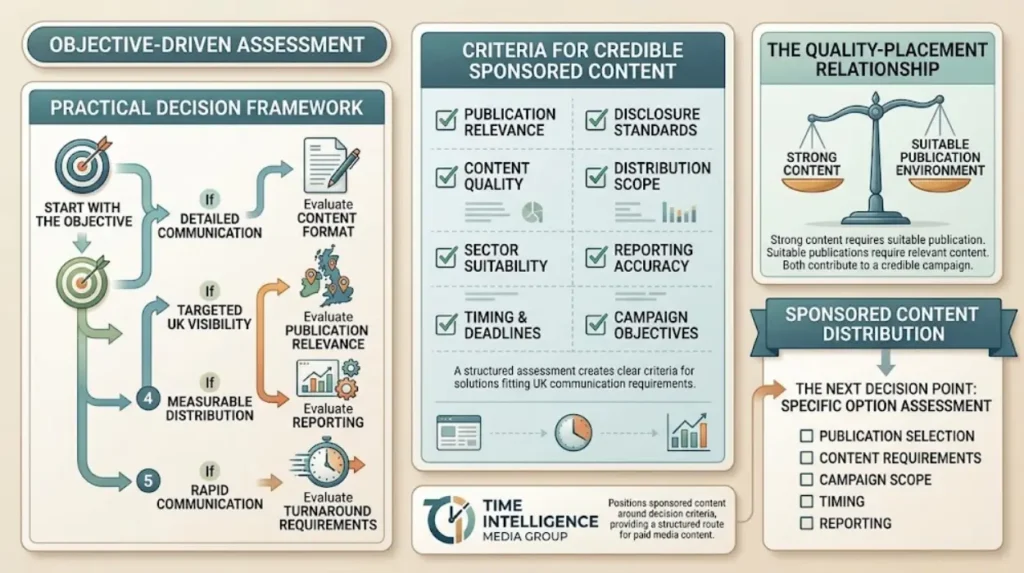
Brands can make a decision by comparing publication relevance, disclosure standards, content quality, distribution scope, sector suitability, reporting, timing, and campaign objectives. A structured assessment creates clear criteria for selecting a sponsored content solution that fits UK communication requirements.
A practical decision framework starts with the objective.
If the objective is detailed communication, evaluate content format. If the objective is targeted UK visibility, evaluate publication relevance. If the objective is measurable distribution, evaluate reporting. If the objective is rapid communication, evaluate turnaround requirements.
Time Intelligence Media Group positions sponsored content around these decision criteria, providing brands with a structured route for preparing and distributing paid media content.
The final evaluation also needs to consider the relationship between content quality and media placement. Strong content requires suitable publication environments. Suitable publications require relevant content. Both elements contribute to a credible sponsored-content campaign.
For organisations ready to assess a specific distribution option,
Sponsored content distribution provides the next decision point. The evaluation can then focus on publication selection, content requirements, campaign scope, timing, and reporting.
What is the key takeaway about credible sponsored content?
Credible sponsored content depends on transparency, factual accuracy, professional presentation, publication relevance, and measurable distribution. For UK businesses, these criteria provide a clear way to share commercial information through the right news and media outlets.
Credibility does not come from paid placement alone. It comes from the complete content and distribution process.
Explore More Expert Insights:
Manufacturing Sponsored Content by Time Intelligence Media Group
Automotive Sponsored Content by Time Intelligence Media Group
A strong campaign identifies its commercial nature, presents verified information, selects relevant publications, follows professional content standards, and provides clear publication reporting.
For UK brands using sponsored content for business communication, these elements provide a practical framework for evaluating campaign quality and selecting an appropriate media distribution approach.