

Sponsored content is paid editorial-style content published by a news website, publisher, or digital media platform. It communicates information about an organisation, product, service, research finding, event, or industry issue while remaining commercially funded. Its credibility depends on transparency, evidence, editorial quality, relevance, and audience trust.
Credible sponsored content does not rely on payment alone to establish authority. The content must provide accurate information, identify its commercial nature, use verifiable evidence, maintain professional standards, and match the expectations of the publication’s audience. These factors determine how readers interpret and trust sponsored material.
What is sponsored content on a news site?
Sponsored content is paid material published by a news organisation or media platform that follows defined editorial and advertising standards while clearly communicating its commercial relationship to readers. It can include articles, interviews, reports, investigations, explainers, or industry-focused features.
News sites publish several forms of sponsored material. Common examples include sponsored articles, branded features, sponsored interviews, thought leadership articles, research summaries, and educational explainers.
The defining characteristic is commercial sponsorship. An organisation funds the publication or distribution of the content, while the media platform provides a publishing environment and audience access.
Sponsored content differs from ordinary editorial coverage because its publication involves a commercial relationship. It also differs from a conventional advertisement because the format generally contains substantially more informational or editorial-style material.
How is sponsored content different from editorial news?
Editorial news is produced under a publication’s independent editorial process. Sponsored content is commercially funded and therefore requires clear disclosure.
A credible sponsored article does not attempt to disguise its commercial origin. Labels such as “Sponsored”, “Paid Content”, “Advertiser Content”, or equivalent wording help readers understand the nature of the material.
Transparency is therefore a fundamental part of credibility. Readers can evaluate information more accurately when the commercial relationship is visible.
Why does transparency make sponsored content more credible?
Transparency establishes credibility because readers understand who funded the content, why it was published, and whether it represents independent journalism or paid communication. Clear sponsorship labels reduce ambiguity and support informed interpretation of commercial information.
Transparency starts with disclosure. A news site needs to make the commercial relationship identifiable before or alongside the content.
The disclosure needs to be understandable. Technical or obscure wording creates unnecessary uncertainty. A clear label communicates that the content has a commercial sponsor.
What information does transparent sponsored content disclose?
Credible sponsored content commonly makes the following information clear:
- The content is sponsored or commercially funded.
- The sponsoring organisation is identifiable.
- The publishing platform is identifiable.
- The content follows applicable advertising and media standards.
- Claims are supported by appropriate evidence.
- Commercial interests are distinguishable from independent editorial reporting.
For example, an article discussing a company’s new technology can identify the company as the sponsor while presenting technical claims using published research, documented specifications, or independently verifiable information.
Transparency does not reduce the informational value of sponsored content. It establishes the context required to evaluate that information.
How does evidence affect the credibility of sponsored content?

Evidence strengthens sponsored content when factual claims are supported by reliable sources, documented data, recognised research, official records, or clearly identified expert information. Evidence enables readers to verify important statements instead of relying solely on promotional assertions.
Evidence is particularly important when sponsored content discusses measurable outcomes, market conditions, scientific findings, financial information, technical performance, or industry statistics.
A credible article distinguishes between facts, attributed statements, and promotional claims.
What types of evidence strengthen sponsored content?
Useful evidence includes:
- Government statistics.
- Regulatory information.
- Academic research.
- Industry reports.
- Published company data.
- Financial filings.
- Technical documentation.
- Survey results.
- Named expert commentary.
- Official datasets.
For example, a sponsored article about UK energy efficiency can reference published government energy data rather than presenting unsupported claims about household savings.
Evidence also needs contextual accuracy. A statistic without a date, source, geographical scope, or measurement definition provides limited value.
How does editorial quality influence sponsored content credibility?
Editorial quality influences credibility through accurate writing, logical structure, factual consistency, professional language, relevant information, and effective sourcing. High-quality sponsored content follows recognisable publishing standards rather than functioning as an extended promotional message.
Editorial quality affects how readers process information. Poor grammar, unsupported statements, excessive product claims, and repetitive sales language reduce informational value.
A professionally structured article usually contains a clear headline, introduction, relevant sections, supporting evidence, attributed statements, and a logical conclusion.
What makes sponsored content editorially strong?
Strong sponsored content has several identifiable characteristics:
- Clear subject: The article addresses one defined topic.
- Relevant information: Each section contributes to the subject.
- Accurate claims: Factual statements have appropriate support.
- Readable structure: Headings and paragraphs organise information.
- Attribution: Expert statements identify their source.
- Balanced presentation: Commercial information does not replace useful information.
- Consistent terminology: Important entities and concepts are defined accurately.
For example, a sponsored article about artificial intelligence in manufacturing can explain specific applications, implementation requirements, workforce implications, and measurable performance indicators instead of repeatedly promoting one software product.
How does relevance to the news site’s audience affect credibility?
Audience relevance improves credibility because readers receive information connected to the publication’s established subject areas, geographic focus, professional interests, or community concerns. Relevant sponsored content provides useful information within a recognisable editorial context.
A news site’s audience develops expectations around subject matter. A technology publication attracts readers interested in technology. A regional newspaper serves readers with stronger interest in local developments.
Sponsored content becomes more credible when its subject matches that context.
What does audience relevance look like?
Consider three examples:
- A UK business publication publishes sponsored research about SME financing.
- A technology publication publishes a sponsored analysis of cybersecurity risks.
- A regional news site publishes sponsored information about a local infrastructure project.
Each example connects the subject with the publication’s audience.
Irrelevant placement creates a mismatch. Readers encounter information that does not correspond with the publication’s normal subject matter, reducing its contextual value.
Audience relevance therefore involves more than reaching a large number of readers. It concerns whether the intended audience has a legitimate informational interest in the subject.
How does accurate attribution support credible sponsored content?
Attribution supports credibility by identifying the origin of statements, research, statistics, quotations, and specialist information. Readers can distinguish between independently sourced information, expert commentary, company statements, and claims made by the sponsor.
Attribution is especially important when content contains expert opinions or research findings.
A statement such as “industry demand increased by 35%” requires a source. A statement such as “the company reported a 35% increase in demand” identifies the organisation responsible for the claim.
Which information requires attribution?
Attribution is appropriate for:
- Direct quotations.
- Survey findings.
- Research conclusions.
- Market statistics.
- Government data.
- Company announcements.
- Expert assessments.
- Financial figures.
- Technical claims.
Clear attribution also prevents readers from interpreting a sponsor’s statement as independent editorial analysis.
This distinction is central to credible commercial communication. The source of information needs to remain visible throughout the article.
How do headlines affect the credibility of sponsored content?
A credible sponsored content headline accurately represents the article’s subject without making unsupported promises, exaggerated claims, or misleading comparisons. The headline establishes expectations, so factual accuracy between headline and article directly affects reader trust.
Headlines influence the first interpretation of content. A headline that promises an absolute result creates a higher evidential requirement than a headline describing a specific finding.
For example, “How UK SMEs Are Using Cloud Accounting” describes a defined subject. “The Best Accounting System for Every UK SME” makes a broad comparative claim requiring substantially stronger evidence.
What makes a sponsored content headline credible?
A credible headline is:
- Specific.
- Relevant to the article.
- Consistent with the evidence.
- Appropriate for the publication’s audience.
- Free from unsupported superlatives.
- Clear about the subject.
The headline also needs to reflect the commercial context when required by the publication’s disclosure practices.
How does factual accuracy affect trust in sponsored content?
Factual accuracy affects trust because readers assess whether statements, statistics, names, dates, quotations, and claims correspond with reliable information. Errors create uncertainty about the wider article and weaken confidence in its commercial and informational content.
Accuracy applies to basic details as well as complex claims.
Names need correct spelling. Dates need verification. Statistics need appropriate sources. Quotations need to represent the speaker’s actual statement. Product specifications need to match documented information.
What factual errors commonly damage credibility?
Common problems include:
- Outdated statistics.
- Incorrect company information.
- Misquoted experts.
- Unsupported market percentages.
- Missing dates.
- Inaccurate product specifications.
- Misleading comparisons.
- Incorrect regulatory references.
A credible content production process therefore includes fact-checking before publication.
How do disclosure standards affect sponsored content credibility in the UK?
UK sponsored content requires clear commercial identification because readers need to recognise advertising or paid communication. Disclosure practices help distinguish sponsored material from independent editorial content and support transparent communication between publishers, sponsors, and audiences.
In the UK, commercial content operates within established advertising and consumer-protection frameworks. The Advertising Standards Authority (ASA) and Committee of Advertising Practice (CAP) provide standards relevant to advertising communications, including requirements concerning misleading claims and transparency.
News publishers also maintain their own editorial and commercial policies. These policies define how sponsored material is labelled, presented, reviewed, and separated from independent journalism.
Why is clear labelling important?
Clear labelling answers a fundamental reader question: “Who is paying for this content?”
A visible “Sponsored” or equivalent label provides that information directly.
The distinction becomes particularly important when sponsored content uses an editorial format. The article can resemble a standard news feature in structure while remaining commercially funded. Disclosure maintains the distinction.
What role does expert commentary play in sponsored content credibility?
Expert commentary strengthens credibility when specialists have relevant qualifications, identifiable expertise, and clearly attributed statements connected to the article’s subject. Expert input adds specialised knowledge while allowing readers to distinguish professional analysis from sponsor claims.
Experts provide useful context in technical subjects. Their value depends on relevance and attribution rather than titles alone.
For example, an article about construction safety can include commentary from a qualified safety professional. An article about financial regulation can reference a specialist with relevant regulatory expertise.
What makes expert commentary credible?
Credible expert commentary includes:
- The expert’s name.
- Relevant professional role.
- Relevant area of expertise.
- Clear attribution.
- Statements connected to the article’s subject.
Expert commentary does not replace evidence. It complements research, data, documentation, and other authoritative sources.
How can sponsored content remain informative without becoming overly promotional?
Informative sponsored content prioritises useful knowledge, evidence, context, and clearly attributed information while limiting unsupported promotional claims. The commercial purpose remains disclosed, but the article provides substantive information that addresses a defined reader need.
The distinction between information and promotion is visible in the proportion and type of content.
An article that repeatedly lists product advantages without supporting context provides limited educational value. An article that explains an industry problem, presents evidence, discusses relevant developments, and then identifies a sponsor’s contribution provides broader information.
What content elements improve informational value?
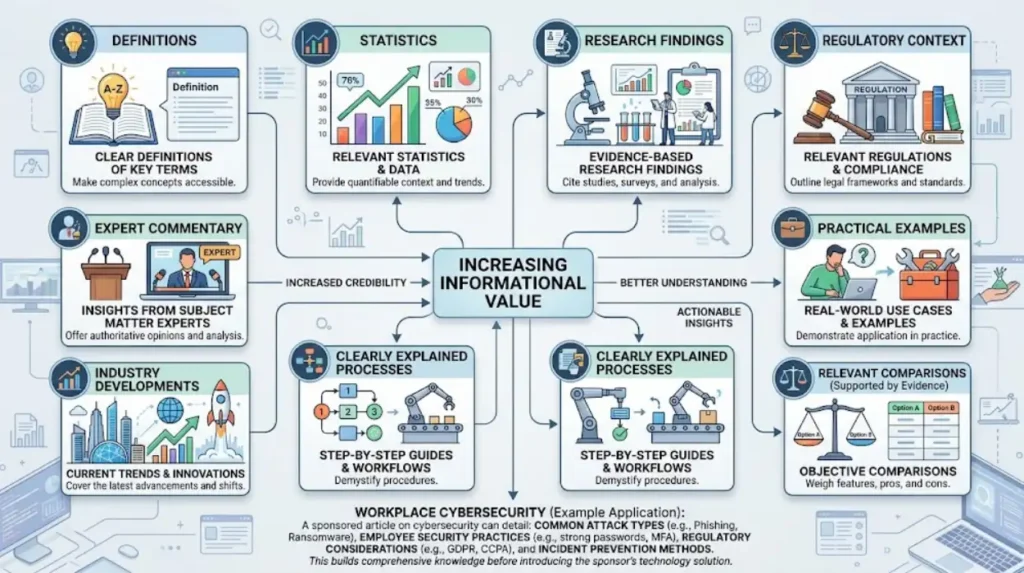
Useful elements include:
- Definitions.
- Statistics.
- Research findings.
- Regulatory context.
- Expert commentary.
- Practical examples.
- Industry developments.
- Clearly explained processes.
- Relevant comparisons supported by evidence.
For example, sponsored content about workplace cybersecurity can explain common attack types, employee security practices, regulatory considerations, and incident prevention methods before discussing a sponsor’s technology.
What are the main characteristics of credible sponsored content?
Credible sponsored content combines transparency, evidence, editorial quality, audience relevance, factual accuracy, clear attribution, appropriate disclosure, expert context, and useful information. These characteristics work together to establish a trustworthy commercial communication environment for readers.
The core characteristics can be summarised as follows:
| Credibility factor | What it establishes |
|---|---|
| Transparency | The commercial relationship is visible |
| Evidence | Claims have supporting information |
| Editorial quality | Content meets professional publishing standards |
| Audience relevance | The subject matches reader interests |
| Accuracy | Facts and details are correct |
| Attribution | Sources and speakers are identifiable |
| Disclosure | Commercial content is distinguishable |
| Expert context | Specialist information has identifiable origins |
| Informational value | Readers receive substantive knowledge |
These factors apply across different sponsored content formats, including articles, interviews, research features, industry explainers, and branded reports.
Explore More Expert Insights:
How Manufacturing Firms Use Sponsored Editorial Content
Why Automotive Brands Use Sponsored Content in the UK
When is sponsored content considered credible by readers?
Readers are more likely to regard sponsored content as credible when its commercial nature is transparent, factual claims are supported, sources are identifiable, writing is professional, information is relevant, and promotional statements remain distinguishable from evidence-based content.
Credibility is therefore not created by a single feature. It results from several connected content practices.
A sponsored article with excellent writing but no disclosure lacks transparency. An article with clear disclosure but unsupported statistics lacks evidential strength. An article with strong evidence but little relevance provides limited audience value.
The strongest approach integrates all major credibility factors into the content production process.
For organisations researching:
Credible sponsored content, the next stage involves examining how these principles translate into practical content development and publication decisions.
For readers evaluating:
Credible sponsored content, credibility also depends on how consistently these standards are applied across the complete sponsored content process.
Understanding these foundations helps publishers, sponsors, marketers, journalists, and readers distinguish credible sponsored communication from content that relies primarily on commercial promotion.



