

Manufacturing sponsored content is paid editorial-style content distributed through relevant media channels to reach defined industrial audiences. Time Intelligence Media Group provides manufacturing sponsored content that helps companies present products, expertise, projects, and industry developments through targeted media placements for UK manufacturing audiences.
For manufacturing companies, sponsored content provides a controlled publishing route for messages that require more context than a conventional advertisement. It supports detailed explanations of technologies, manufacturing processes, business developments, engineering capabilities, and sector-specific solutions.
The format is particularly relevant when a company needs to communicate with specialist audiences rather than broad consumer markets. Manufacturing buyers, engineers, procurement professionals, operations leaders, technical managers, and business decision-makers require specific information before evaluating suppliers and solutions.
Businesses evaluating the broader role of this channel can first review:
Manufacturing sponsored content to understand how sponsored placements reach trade readers.
What is manufacturing sponsored content?
Manufacturing sponsored content is paid media content created around a company, product, service, technology, or industry subject and published through relevant media channels. It combines controlled brand messaging with an editorial-style content format.
The content differs from standard display advertising because it provides substantially more information. A manufacturing sponsored article can explain a production technology, introduce an engineering solution, document a facility investment, or explain a technical innovation.
The company retains control over the core commercial message. The publishing environment provides access to an established audience.
What does manufacturing sponsored content cover?
Typical subjects include:
- Industrial machinery and equipment
- Automation and robotics
- Engineering services
- Manufacturing software
- Industrial technology
- Supply chain solutions
- Factory investment
- Sustainability initiatives
- Energy efficiency
- Materials and components
- Manufacturing case studies
- Product launches
- Technical expertise
- Industry research
For example, an automation manufacturer can use sponsored content to explain how robotic systems improve production consistency, reduce manual handling, and support higher production volumes.
How does Time Intelligence Media Group deliver manufacturing sponsored content?
Time Intelligence Media Group delivers manufacturing sponsored content through a structured process covering content planning, audience definition, editorial development, media placement, publication, and performance review for a defined manufacturing marketing objective.
The process starts with the commercial objective. A business identifies the product, service, market, or business development that requires exposure.
The target audience follows. Manufacturing campaigns require precise audience definition because an article aimed at procurement managers has different information requirements from one targeting production engineers.
Content development then translates the commercial message into an informative editorial format. The subject remains commercially relevant while providing useful industry information.
What are the main delivery stages?
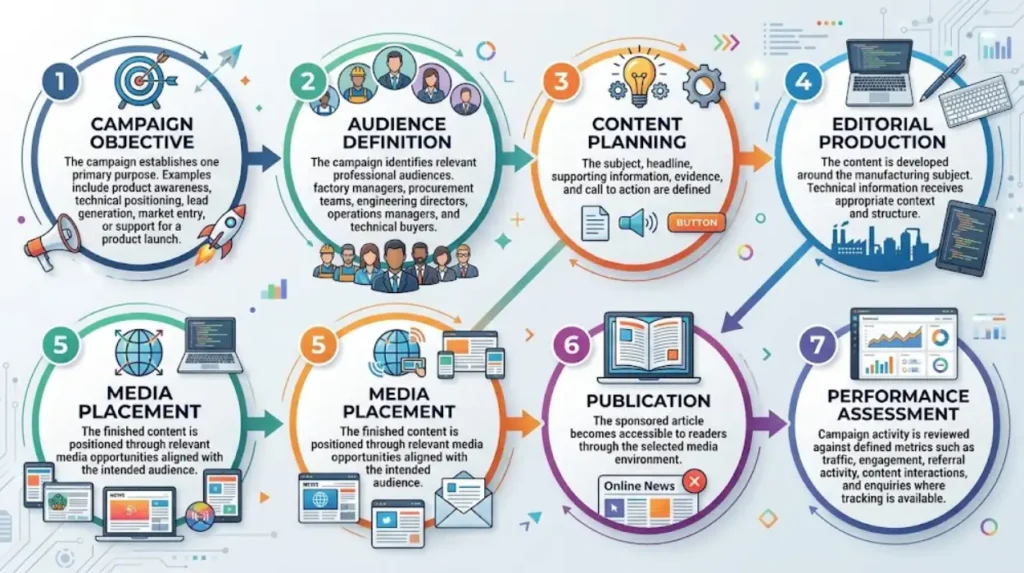
1. Campaign objective
The campaign establishes one primary purpose. Examples include product awareness, technical positioning, lead generation, market entry, or support for a product launch.
2. Audience definition
The campaign identifies relevant professional audiences. Examples include factory managers, procurement teams, engineering directors, operations managers, and technical buyers.
3. Content planning
The subject, headline, supporting information, evidence, and call to action are defined.
4. Editorial production
The content is developed around the manufacturing subject. Technical information receives appropriate context and structure.
5. Media placement
The finished content is positioned through relevant media opportunities aligned with the intended audience.
6. Publication
The sponsored article becomes accessible to readers through the selected media environment.
7. Performance assessment
Campaign activity is reviewed against defined metrics such as traffic, engagement, referral activity, content interactions, and enquiries where tracking is available.
What components are included in a manufacturing sponsored content campaign?
A manufacturing sponsored content campaign includes audience targeting, content strategy, editorial development, media placement, brand messaging, technical information, calls to action, tracking, and performance measurement aligned with the company’s commercial objective.
Each component performs a distinct function. Audience targeting establishes who needs to see the content. Content strategy establishes what information those readers need.
Editorial development determines how the information is presented. Media placement determines where the content appears.
Which content formats work for manufacturing companies?
Manufacturing companies use several sponsored content formats based on their commercial objective.
Technical article: Explains a manufacturing technology, process, component, or industrial application.
Product-focused article: Introduces a product while providing information about its application and operational value.
Case study: Presents a customer problem, implementation process, and measurable result.
Industry commentary: Positions company expertise around a defined manufacturing issue.
Project announcement: Communicates factory investments, installations, partnerships, expansions, or major business developments.
Research-led article: Uses company data, market findings, surveys, or technical research to create an evidence-based subject.
For example, a precision engineering company can publish a case study covering component requirements, production challenges, manufacturing processes, quality controls, and measurable delivery outcomes.
How does sponsored content differ from traditional manufacturing advertising?
Sponsored content provides substantially more space for explanation than conventional advertising. Traditional advertising prioritises immediate visibility, while sponsored content communicates detailed information about products, expertise, applications, projects, and industry subjects.
A banner advertisement can communicate a brand name, product, proposition, and call to action within a limited format.
Sponsored content supports a longer information journey. It gives manufacturing companies space to explain technical details and establish the context behind a commercial proposition.
This distinction matters in B2B manufacturing because purchasing decisions often involve multiple stakeholders.
When is sponsored content more suitable?
Sponsored content is suitable when the message requires explanation.
Examples include:
- Explaining a complex engineering system
- Introducing industrial software
- Presenting automation applications
- Documenting a factory investment
- Explaining sustainability improvements
- Demonstrating technical expertise
- Supporting a product launch
- Communicating a manufacturing case study
A business selling industrial inspection equipment, for example, can use sponsored content to explain inspection requirements, technology capabilities, implementation considerations, and operational outcomes.
How does manufacturing sponsored content reach UK trade audiences?
Manufacturing sponsored content reaches UK trade audiences by placing relevant commercial information within media environments used by professionals interested in engineering, production, industrial technology, procurement, logistics, and manufacturing business developments.
Audience relevance depends on the relationship between the content subject and the publication environment.
A technical article about factory automation has greater contextual relevance within manufacturing and engineering media than within an unrelated general-interest environment.
The content also benefits from professional terminology. Terms such as industrial automation, predictive maintenance, CNC machining, production efficiency, supply chain management, robotics, and manufacturing technology identify the subject clearly.
Which UK manufacturing audiences can companies target?
Relevant audiences include:
- Manufacturing directors
- Operations directors
- Engineering managers
- Production managers
- Procurement professionals
- Factory managers
- Technical buyers
- Plant managers
- Supply chain professionals
- Industrial technology decision-makers
The audience determines the depth and terminology of the content.
An engineering audience requires technical specifications and operational information. A senior business audience requires commercial outcomes, investment implications, efficiency measures, and strategic relevance.
What business outcomes can manufacturing sponsored content support?
Manufacturing sponsored content supports measurable business objectives including brand visibility, product awareness, technical positioning, referral traffic, audience engagement, campaign support, and qualified commercial interest when content and distribution align with the target manufacturing audience.
The outcome depends on the campaign objective and measurement framework.
A product awareness campaign focuses on exposure and engagement. A lead-generation campaign focuses on interactions that move potential buyers towards enquiry.
Which metrics matter?
Important campaign metrics include:
Content views: Measures the number of visits generated by the published content.
Engagement: Shows reader interaction with the article.
Referral traffic: Measures visits sent from the media placement to the company website.
Click-through activity: Tracks movement from sponsored content towards a defined destination.
Enquiries: Connects content exposure with commercial responses when appropriate tracking systems are implemented.
Conversion rate: Measures the percentage of relevant visitors completing a defined action.
Manufacturing companies can connect these metrics with campaign objectives instead of measuring visibility in isolation.
How should a manufacturing company prepare content for publication?
A manufacturing company prepares sponsored content by defining its audience, commercial objective, core message, technical evidence, supporting examples, brand information, destination page, and measurable call to action before publication begins.
Preparation improves content accuracy and reduces unnecessary revisions.
The company first identifies the single subject that deserves media attention. It then gathers supporting information.
What information does the content team need?
Useful source material includes:
- Product specifications
- Technical documentation
- Customer results
- Manufacturing statistics
- Project information
- Expert commentary
- Industry research
- Images and diagrams
- Company background
- Relevant website pages
- Contact information
Technical claims require accurate supporting information. Numerical statements require consistent data.
The final call to action also needs a defined destination. This can be a product page, technical resource, case study, contact page, or campaign landing page.
How can companies evaluate Time Intelligence Media Group for manufacturing sponsored content?
Companies evaluating Time Intelligence Media Group should assess audience relevance, content development, media placement, campaign objectives, reporting, tracking requirements, delivery process, and alignment between sponsored content and their wider UK manufacturing marketing strategy.
A decision-stage evaluation focuses on operational fit rather than the concept alone.
The company needs to establish what it wants the campaign to achieve and which manufacturing audience it needs to reach.
What should buyers check before starting?
A practical evaluation covers seven areas:
- Audience: Does the campaign address the required manufacturing professionals?
- Content: Does the format support the level of technical detail required?
- Placement: Are relevant media environments available for the campaign?
- Messaging: Can the company communicate its commercial proposition clearly?
- Tracking: Can traffic and defined actions be measured?
- Reporting: Are campaign results presented against agreed metrics?
- Business objective: Does the activity support a defined marketing or commercial goal?
This evaluation creates a direct connection between media activity and business requirements.
What types of manufacturing companies can use sponsored content?
Manufacturing sponsored content applies across industrial sectors where companies need to explain products, technologies, capabilities, projects, or expertise to professional audiences through targeted editorial-style media communication.
The format applies to both product-led and service-led manufacturing businesses.
Which manufacturing sectors are relevant?
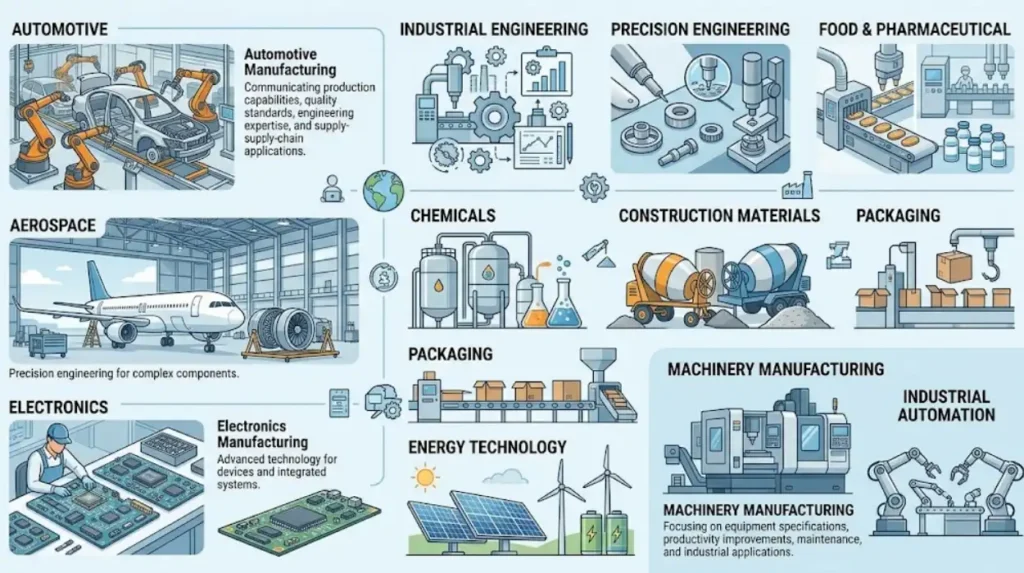
Examples include:
- Automotive manufacturing
- Aerospace manufacturing
- Electronics manufacturing
- Industrial engineering
- Precision engineering
- Food manufacturing
- Pharmaceutical manufacturing
- Chemical manufacturing
- Construction materials
- Packaging
- Energy technology
- Machinery manufacturing
- Industrial automation
For example, an automotive component manufacturer can use sponsored content to communicate production capabilities, quality standards, engineering expertise, and supply-chain applications.
A machinery manufacturer can focus on equipment specifications, productivity improvements, maintenance requirements, and industrial applications.
Explore More Expert Insights:
Automotive Sponsored Content by Time Intelligence Media Group
Why Time Intelligence Media Group Beats Sponsored Content Rivals
What is the next step for a manufacturing sponsored content campaign?
The next step is to define the campaign objective, target manufacturing audience, content subject, preferred media environment, destination page, tracking requirements, and success metrics before confirming the sponsored content programme with Time Intelligence Media Group.
A structured brief gives the campaign a defined commercial purpose.
The brief identifies the subject, audience, message, supporting evidence, and required action. It also establishes the metrics used to evaluate performance.
For businesses ready to move from audience research to campaign execution,
Manufacturing sponsored content provides the relevant decision-stage pathway.
Time Intelligence Media Group can be evaluated as a sponsored content option when a UK manufacturing company requires controlled editorial-style communication aimed at professional industry audiences. The decision rests on audience relevance, content requirements, media placement, measurement, and alignment with the company’s marketing objective.



