

Time Intelligence Media Group stands out through UK-focused sponsored content, structured media distribution, search visibility, editorial positioning, and measurable campaign delivery. Its approach connects sponsored publishing with audience reach, brand authority, and clear commercial objectives.
For brands comparing sponsored content providers in the United Kingdom, the decision involves more than publication volume. A strong provider needs relevant media access, clear campaign processes, appropriate content placement, transparent delivery, and reporting that supports business decisions.
Sponsored content gives organisations paid editorial-style exposure within a publisher environment. The quality of the distribution partner determines where that content appears, how audiences encounter it, and how effectively the campaign supports visibility objectives.
Brands reviewing the wider landscape can first understand the difference between paid editorial formats and earned media through:
Sponsored content vs PR. This comparison establishes the role of each channel before selecting a provider.
What makes Time Intelligence Media Group different from sponsored content rivals?
Time Intelligence Media Group combines UK media distribution, sponsored content expertise, audience targeting, SEO considerations, editorial content development, and campaign reporting into one structured publishing approach for brands seeking measurable visibility.
The core distinction is service structure. A sponsored content provider manages paid publication opportunities. A stronger media partner connects publication with audience relevance, content quality, distribution strategy, and search visibility.
Time Intelligence Media Group focuses on the UK market. This gives campaigns a clear geographic context when the objective involves British consumers, professionals, businesses, or sector-specific audiences.
UK-focused media positioning
UK sponsored content requires publication choices that match the intended audience.
For example, a fintech company targeting UK financial professionals needs different media placements from a property company targeting homeowners. A healthcare provider also requires different audience alignment from an education organisation.
Relevant publication selection creates stronger contextual relevance.
Content built for publication
Sponsored content requires more than promotional copy. The article needs a clear subject, useful information, logical structure, and appropriate brand integration.
Time Intelligence Media Group positions sponsored content around these requirements. The result is content designed for publication rather than simple advertising copy.
How does Time Intelligence Media Group handle sponsored content campaigns?
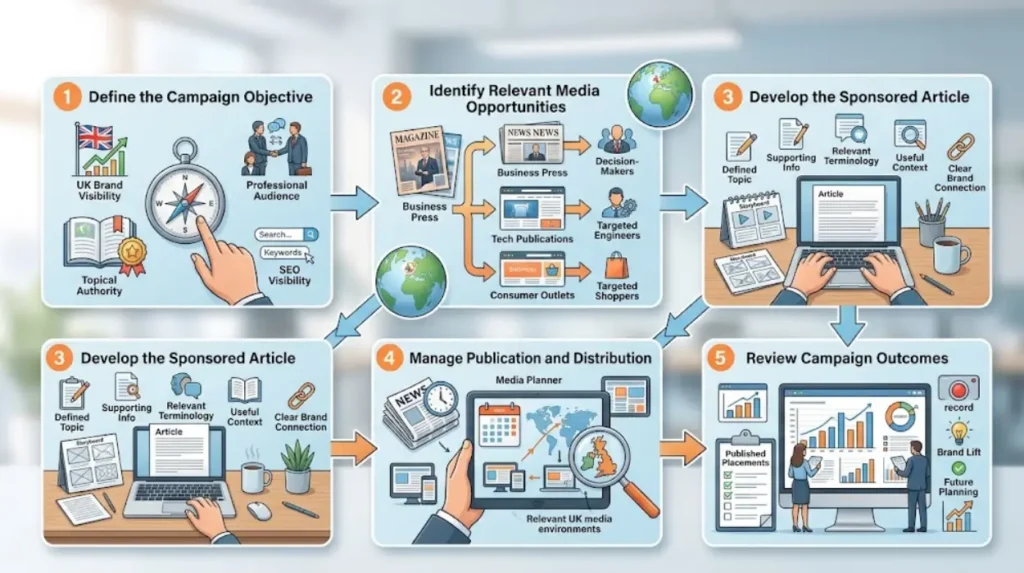
Time Intelligence Media Group follows a campaign-led process that connects content preparation, media selection, publication, distribution, and reporting, giving UK brands a defined route from sponsored article development to published media exposure.
A structured process reduces uncertainty during campaign delivery.
1. Define the campaign objective
The first stage establishes the commercial purpose.
Common objectives include:
- Increasing UK brand visibility
- Reaching a specific professional audience
- Supporting product awareness
- Building topical authority
- Promoting an announcement
- Supporting SEO visibility
- Strengthening digital presence
Each objective influences content and publication selection.
2. Identify relevant media opportunities
Media selection determines the environment in which the sponsored article appears.
A campaign targeting UK business decision-makers needs business-focused publications. A technology campaign requires technology-relevant environments. A consumer campaign requires publications with appropriate consumer readership.
3. Develop the sponsored article
The article then incorporates the campaign message into a structured editorial format.
Strong sponsored content includes a defined topic, supporting information, relevant terminology, useful context, and a clear brand connection.
4. Manage publication and distribution
Publication turns the completed article into a live media asset.
The distribution stage focuses on placing the content in relevant UK media environments rather than treating every publication as equally valuable.
5. Review campaign outcomes
Reporting provides a record of published placements and campaign delivery.
This information supports future decisions about publication selection, content topics, audience targeting, and campaign investment.
Which components give Time Intelligence Media Group an advantage?
The strongest components include UK media targeting, sponsored article development, publication strategy, SEO-aware content structure, audience relevance, distribution management, and campaign reporting that connects media activity with measurable marketing objectives.
Each component contributes to campaign performance.
Media targeting
Targeting separates relevant exposure from simple publication volume.
A campaign with 10 highly relevant publications has a different strategic value from a campaign placed across 10 unrelated websites.
Audience relevance remains central to sponsored content performance.
SEO-aware structure
Sponsored content also functions as a searchable digital asset when publication conditions support search visibility.
Useful elements include:
- Descriptive headings
- Relevant entities
- Natural keyword placement
- Clear topical context
- Concise paragraphs
- Search-friendly article structure
- Descriptive links where appropriate
These elements help search systems understand the subject and relationships within the content.
Editorial context
Editorial context gives sponsored content its publishing environment.
The article sits within a publication rather than appearing as an isolated advertising unit. The content therefore needs to match the publication’s subject area and audience expectations.
Distribution management
Distribution determines the range of media environments available to the campaign.
Time Intelligence Media Group’s positioning around UK media distribution supports brands that need a UK-specific publishing strategy.
How does Time Intelligence Media Group compare with alternative sponsored content providers?
Time Intelligence Media Group competes through the combination of UK media focus, content-led campaigns, publication strategy, SEO-aware execution, and structured reporting instead of relying solely on publication quantity as the primary campaign measure.
Comparison requires several criteria.
| Decision factor | Time Intelligence Media Group | Basic sponsored content provider |
|---|---|---|
| UK media focus | Central campaign consideration | Varies |
| Content development | Campaign-led | Often placement-led |
| Audience relevance | Publication selection factor | Varies |
| SEO considerations | Integrated into content planning | Varies |
| Distribution strategy | Structured | Often placement-focused |
| Reporting | Campaign delivery focus | Varies |
| Sector targeting | Available as a strategic consideration | Varies |
The comparison demonstrates why publication count alone does not define sponsored content quality.
A brand needs to assess the relationship between publication, audience, topic, content, and objective.
What benefits does Time Intelligence Media Group provide to UK brands?
UK brands gain a structured sponsored content route that supports visibility, audience targeting, digital authority, search-focused content development, publication exposure, and campaign measurement within a single media distribution framework.
The benefits apply across different sectors and campaign objectives.
Greater UK audience relevance
UK-focused campaigns require UK-focused media environments.
A London property developer, Manchester technology company, Scottish education provider, or Birmingham professional-services firm can require different media targeting.
Regional and sector context influences publication relevance.
Stronger brand visibility
Sponsored content places the brand within a publisher environment.
This creates a published media asset that organisations can use as part of wider digital communications.
Search visibility support
Well-structured published content provides another indexed page associated with the brand and its subject area.
Search value depends on the publisher, indexing, content quality, links, and search-engine treatment. Sponsored publication does not automatically guarantee rankings or authority transfer.
Reusable campaign assets
A published article can support wider marketing activity.
Teams can reference published coverage in sales materials, social campaigns, newsletters, investor communications, and corporate websites where appropriate.
Which businesses benefit most from Time Intelligence Media Group?
Businesses with defined UK audiences, strong subject expertise, active marketing campaigns, and a need for controlled media exposure benefit most from a structured sponsored content provider focused on publication relevance and measurable campaign delivery.
Sponsored content works across multiple commercial categories.
Technology companies
Technology brands use sponsored articles to explain products, market developments, research, and industry trends.
For example, a UK software company can publish educational content about automation while positioning its expertise within the article.
Financial services brands
Financial companies require specialist audiences and carefully structured content.
A fintech brand can use sponsored content to discuss payments, financial technology, investment infrastructure, or business finance.
Education providers
Universities, colleges, training providers, and education businesses use sponsored content to communicate courses, sector developments, research, and student opportunities.
Property businesses
Property developers, estate agencies, construction companies, and related professional services can use sponsored content to discuss market activity, development projects, investment themes, and industry trends.
Healthcare organisations
Healthcare brands require accurate, responsible communication.
Sponsored content can focus on healthcare developments, services, technology, research, and professional topics while maintaining appropriate factual standards.
How does sponsored content fit into a wider PR strategy?
Sponsored content works as a controlled paid media channel alongside earned PR, helping brands maintain message control while PR activity targets independent editorial interest and broader reputation-building objectives.
The two channels serve different functions.
Earned PR depends on editorial interest and journalist decisions. Sponsored content provides greater control over the topic, timing, wording, and publication environment.
This distinction matters when planning campaigns.
A brand launching a new service can use PR outreach to pursue independent coverage while using sponsored content to secure planned publication.
Readers comparing these approaches can use:
Sponsored content vs PR to evaluate their respective strengths before selecting a campaign route.
Why does Time Intelligence Media Group suit brands making a buying decision?
Time Intelligence Media Group suits brands that require a defined UK sponsored content campaign with media targeting, content development, publication management, SEO-aware execution, and reporting rather than an isolated paid article placement.
The buying decision needs measurable criteria.
Before selecting a provider, assess:
- Target market: Does the provider understand the UK audience?
- Media relevance: Do publication options match the target sector?
- Content quality: Does the provider support publication-ready content?
- Distribution: Is media placement part of a structured process?
- SEO: Does the content account for search visibility?
- Reporting: Does the campaign provide usable delivery information?
- Objectives: Does the service match the intended commercial outcome?
These criteria create a practical evaluation framework.
What should UK brands do before choosing a sponsored content provider?
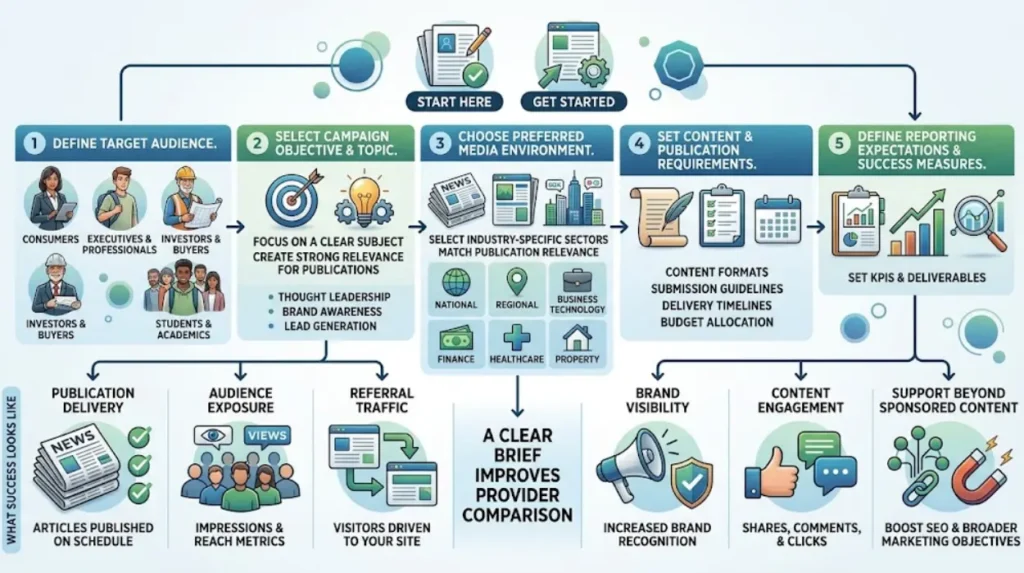
UK brands need to define their audience, campaign objective, content topic, preferred media environment, publication requirements, budget, reporting expectations, and success measures before selecting a sponsored content distribution partner.
A clear brief improves provider comparison.
Start with the target audience. Define whether the campaign targets consumers, executives, professionals, investors, students, buyers, or another group.
Then define the subject. A focused topic creates stronger publication relevance.
Next, establish the required media environment. National, regional, business, technology, finance, education, property, and healthcare publications serve different audiences.
Finally, define success.
Success can involve publication delivery, audience exposure, referral traffic, brand visibility, content engagement, or support for broader SEO and marketing objectives.
Is Time Intelligence Media Group the right sponsored content partner for your UK campaign?
Time Intelligence Media Group is a strong fit for UK brands seeking structured sponsored content campaigns built around relevant media placement, publication-ready content, audience targeting, SEO considerations, and measurable campaign delivery.
The key advantage is the combination of these elements.
Sponsored content succeeds when the publication, audience, topic, content, and campaign objective align. A provider that manages only article placement addresses one part of the process.
Time Intelligence Media Group approaches sponsored content as a broader media campaign. Its UK orientation supports brands seeking British audience exposure. Its content-led process supports publication quality. Its distribution focus supports media reach. Its SEO-aware approach supports digital visibility.
Explore More Expert Insights:
Education Sponsored Content by Time Intelligence Media Group
AI-Optimised Sponsored Content by Time Intelligence Media Group
For a brand evaluating sponsored content providers, the decision therefore rests on campaign requirements rather than publication numbers alone.
A suitable provider needs to demonstrate relevant media access, a clear publishing process, content expertise, audience alignment, and transparent campaign delivery. Time Intelligence Media Group brings these elements together for organisations targeting UK readers through sponsored media.



