

Sponsored content has become an established part of digital marketing for UK ecommerce brands. It combines paid media placement with editorial-style content to communicate a product, category, campaign, or brand message through a publisher’s audience.
For ecommerce businesses, sponsored content provides a structured way to present useful information alongside commercial messaging. It appears across online publications, lifestyle websites, business platforms, specialist media, and other digital channels.
Understanding sponsored content requires a clear distinction between advertising, editorial content, affiliate marketing, and organic search content. Each format has different commercial purposes, disclosure requirements, audience relationships, and distribution methods.
This guide explains what sponsored content means for UK ecommerce brands, how it works, what it contains, and where businesses use it.
What is sponsored content for UK ecommerce brands?
Sponsored content is paid digital content created or commissioned by a brand and published through a media platform for an audience. It promotes products, services, or expertise while following the publisher’s content format and disclosure requirements.
Sponsored content is a form of paid media. An ecommerce brand funds the creation, placement, or distribution of content through a publisher or media platform.
The content often resembles the structure of other material on the publication. It can take the form of an article, product guide, buying guide, interview, listicle, video, or visual feature.
The commercial relationship separates sponsored content from independent editorial coverage. The publisher identifies the paid relationship through appropriate labels such as “Sponsored”, “Paid Content”, or “Advertisement Feature”.
For example, a UK footwear retailer can sponsor an article explaining how to choose running shoes for different training needs. The article provides useful information while incorporating relevant products from the retailer.
Sponsored content therefore combines commercial sponsorship, publisher distribution, audience relevance, and disclosed brand involvement.
How does sponsored content differ from traditional advertising?
Sponsored content differs from traditional advertising because it uses an editorial-style format to communicate information, while conventional advertising relies on direct promotional formats such as banners, display advertisements, product placements, or short promotional messages.
Traditional advertising usually focuses on immediate product visibility. A display advertisement can contain a product image, headline, price, promotional offer, and call to action.
Sponsored content provides more space for context. It can explain a consumer problem, introduce product categories, compare features, provide practical information, or discuss market developments.
A sponsored article about winter clothing, for example, can explain insulation, waterproofing, layering, and fabric selection before presenting relevant products.
How is sponsored content different from editorial content?
Editorial content is produced according to a publication’s independent editorial process. Sponsored content is connected to a commercial arrangement.
The distinction is important because paid content requires transparent disclosure. UK advertising rules require marketing communications to remain identifiable as advertising.
How is sponsored content different from affiliate content?
Affiliate content generates commission or another commercial benefit when users complete qualifying actions through tracked links. Sponsored content is based on a paid publishing or content arrangement.
A single article can contain both sponsorship and affiliate relationships, but the commercial mechanisms remain distinct.
How does sponsored content work for ecommerce brands?
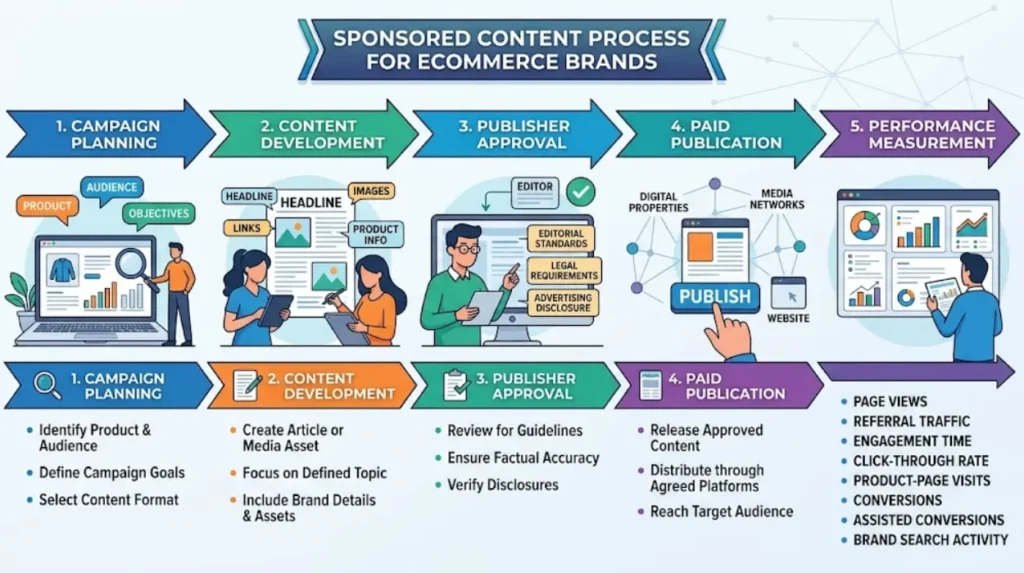
Sponsored content typically moves through five stages: campaign planning, content creation, publisher approval, paid publication, and performance measurement. Each stage establishes the message, audience, format, placement, disclosure, and measurable objectives.
The process begins with campaign planning. The ecommerce brand identifies the product, audience, campaign objective, and suitable content format.
Content development follows. The article or media asset is created around a defined topic. Product information, brand details, images, links, and supporting evidence form the content structure.
The publisher then reviews the material. Review criteria include editorial standards, formatting, legal requirements, advertising disclosure, factual accuracy, and audience suitability.
Once approved, the publisher releases the sponsored content through its agreed platform. Distribution can involve an individual publication, a media network, or several relevant digital properties.
Performance measurement follows publication. Ecommerce teams track metrics that correspond with the campaign objective.
Common measurements include:
- Page views
- Referral traffic
- Engagement time
- Click-through rate
- Product-page visits
- Conversions
- Assisted conversions
- Brand search activity
This process gives sponsored content a defined commercial structure from planning through measurement.
For readers seeking the next stage of understanding around distribution:
What elements does effective ecommerce sponsored content contain?
Effective ecommerce sponsored content contains a defined audience, relevant topic, clear brand connection, useful information, accurate product details, appropriate media assets, transparent sponsorship disclosure, and measurable links or actions connected to the campaign objective.
The topic establishes relevance. It needs a direct connection with the audience’s interests or purchasing context.
The brand connection explains why the ecommerce company appears in the content. This connection remains clear without turning every paragraph into a sales message.
Product information provides factual detail. Examples include material, dimensions, specifications, availability, pricing, features, compatibility, or use cases.
Visual assets also support ecommerce content. Product photography, infographics, charts, illustrations, and videos provide additional information when the format permits them.
Why does disclosure matter?
Disclosure tells users that commercial involvement exists. UK advertising rules require marketing communications to be clearly identifiable as such.
Clear labels protect transparency between publishers, advertisers, and audiences. Examples include “Sponsored Content”, “Paid Partnership”, and “Advertisement Feature”.
The exact wording depends on the platform, format, and commercial arrangement.
What role do links play in sponsored content?
Links can connect sponsored content with relevant ecommerce destinations. A product guide can link to a category page, while an educational feature can link to supporting resources.
Link placement needs contextual relevance. Search engines also distinguish paid placements from editorial links. Appropriate attributes and disclosure practices form part of responsible digital publishing.
Why do UK ecommerce brands use sponsored content?
UK ecommerce brands use sponsored content to communicate product information, reach defined publisher audiences, support campaigns, introduce categories, explain product benefits, and create longer-form brand exposure than conventional short-form advertising formats provide.
Sponsored content provides additional space for explanation. This matters when consumers need more information before purchasing.
A furniture retailer, for example, can publish a sponsored interior design guide covering room dimensions, furniture selection, materials, and maintenance. Product references then fit within the information structure.
A skincare retailer can use sponsored educational content to explain product categories, routines, ingredients, and usage considerations.
A technology retailer can publish content explaining differences between laptop specifications, operating systems, screen sizes, and processor types.
These examples demonstrate how sponsored content supports different stages of consumer research.
It also creates an identifiable media asset that remains accessible on the publisher’s platform after publication, subject to the publisher’s policies and content retention practices.
What types of sponsored content do ecommerce brands publish?
Ecommerce brands publish sponsored articles, buying guides, product features, listicles, interviews, videos, seasonal guides, trend reports, and educational features. The selected format depends on the product, audience, publisher, campaign objective, and available content assets.
Sponsored articles provide space for detailed explanations and product context.
Buying guides focus on consumer decision criteria. A guide for home appliances, for example, can discuss capacity, energy efficiency, installation requirements, and product features.
Listicles organise information into numbered sections. Examples include “Seven Features to Look for in a Family Laptop” or “Five Considerations When Choosing Outdoor Furniture”.
Interviews use a question-and-answer structure to present brand representatives, specialists, founders, or subject experts.
Sponsored video combines visual storytelling with spoken or written information. It suits demonstrations, product explanations, tutorials, and campaign narratives.
Seasonal content connects products with specific periods. Examples include Christmas shopping, summer travel, back-to-school purchasing, and winter home preparation.
The format determines how information is structured and how audiences interact with the content.
Where does sponsored content appear in the UK?
Sponsored content appears across UK news websites, lifestyle publications, business media, specialist publications, consumer platforms, and other digital publishers that offer paid content opportunities to relevant commercial audiences.
Publisher selection influences audience relevance and content context.
A fashion ecommerce brand can target lifestyle or fashion publications. A business software retailer can use technology or business publications. A home improvement retailer can focus on property, interiors, or consumer-interest platforms.
Geographic relevance also matters. UK ecommerce campaigns can target national audiences or focus on specific regions and cities.
The publication’s audience profile, topic relevance, content format, traffic characteristics, and advertising policies all influence suitability.
Sponsored content therefore involves more than producing an article. The publishing environment forms part of the campaign structure.
How does sponsored content support the ecommerce customer journey?
Sponsored content supports the ecommerce customer journey by providing information during awareness, research, consideration, and product evaluation stages. Its role changes according to the consumer’s knowledge, search behaviour, product category, and purchase decision.
At the awareness stage, content introduces a topic or consumer problem.
During research, educational content explains product categories and important selection criteria.
During consideration, buying guides and product features provide more specific information.
During evaluation, detailed specifications, comparisons, demonstrations, and use cases help consumers assess available options.
For example, someone researching office furniture can first read about ergonomic workspace design. A later sponsored guide can explain desk types, chair features, dimensions, and materials.
The content remains informational while maintaining a clear commercial relationship.
What should UK ecommerce brands understand before using sponsored content?

UK ecommerce brands need to understand sponsorship disclosure, advertising rules, publisher requirements, audience relevance, content quality, link practices, product accuracy, campaign objectives, and measurement before using sponsored content as part of digital marketing activity.
Compliance is a central consideration. Commercial content needs clear identification.
Content quality also matters. Poorly structured material reduces informational value and creates a weak publishing experience.
Product claims require accuracy. Statements about performance, price, availability, health effects, environmental benefits, or technical specifications need appropriate substantiation.
Audience relevance is equally important. A highly visible publication without a suitable audience does not automatically create strong commercial relevance.
Measurement completes the process. Ecommerce teams need defined metrics before publication so performance can be evaluated against the original campaign objective.
Sponsored content is therefore a structured media format rather than simply an article containing product links.
What is the main role of sponsored content in UK ecommerce?
Sponsored content gives UK ecommerce brands a paid publishing format for presenting useful information alongside disclosed commercial messaging. It connects products with relevant topics, publisher audiences, consumer research, and measurable digital marketing objectives.
Its defining characteristics are clear: commercial sponsorship, publisher distribution, useful content, transparent disclosure, and measurable performance.
The format covers multiple content types, including articles, buying guides, interviews, listicles, videos, and seasonal features.
Explore More Expert Insights:
How Thought Leadership Content Builds UK Brand Authority
Why Sponsored Listicles Perform Well on UK News Sites
For ecommerce businesses, the central value of understanding sponsored content lies in knowing how paid media and informative content operate together. The distinction between sponsorship and independent editorial coverage remains essential.
When planned around audience needs, accurate product information, suitable publishers, clear disclosure, and defined measurements, sponsored content becomes a structured part of the UK ecommerce media landscape.



