
Thought leadership content helps a UK brand build authority by demonstrating expertise, addressing industry questions, and providing evidence-based perspectives. Consistent expert content increases recognition, supports credibility, strengthens search visibility, and positions organisations as informed voices within their sectors.
What is thought leadership content?
Thought leadership content is expert-led material that presents informed perspectives, original insights, research, or practical analysis on topics within a defined industry. It establishes expertise by helping audiences understand complex issues through credible, specific, and useful information.
Thought leadership differs from standard promotional content. Promotional content focuses on products, services, offers, or direct commercial messages. Thought leadership focuses on knowledge, interpretation, evidence, and industry understanding.
A thought leadership article can examine changes in financial regulation, explain developments in artificial intelligence, analyse construction trends, or discuss changes in consumer behaviour. The central purpose is to provide useful expertise rather than repeat general information.
What makes content thought leadership?
Strong thought leadership contains identifiable expertise. It connects a subject with evidence, experience, research, data, or a clearly developed professional viewpoint.
Common formats include:
- Expert commentary
- Industry analysis
- Original research
- Data-led articles
- Executive insights
- Trend analysis
- Regulatory commentary
- Educational guides
- Research reports
- Expert interviews
For example, a UK fintech executive discussing the operational impact of new payment regulations provides a defined subject, professional context, and practical interpretation. The content becomes more authoritative when it includes evidence and specific implications.
How does thought leadership build brand authority in the UK?
Thought leadership builds UK brand authority by repeatedly associating an organisation with expertise, relevant subjects, credible evidence, and useful analysis. Consistent publication creates recognition across audiences and reinforces the organisation’s position within its specific industry and market.
Brand authority describes the level of trust and recognition an organisation develops around its expertise. In the UK market, authority develops through repeated evidence of knowledge rather than through a single article.
A company operating in professional services, technology, healthcare, finance, property, or manufacturing can establish authority by consistently addressing subjects that matter to its audience.
The process has several connected stages.
1. Expertise becomes visible
An organisation can possess extensive internal knowledge without external audiences recognising it. Thought leadership turns that knowledge into public information.
An executive discussing supply-chain resilience, for example, demonstrates knowledge when the content explains specific risks, operational factors, and measurable consequences.
2. Expertise becomes associated with the brand
Repeated coverage of relevant subjects creates a consistent association between the organisation and its specialist area.
A business publishing informed analysis about UK cybersecurity regulation repeatedly becomes associated with cybersecurity expertise. The association strengthens when content remains accurate, focused, and relevant.
3. Recognition becomes authority
Authority develops when audiences repeatedly encounter useful expertise from the same organisation. Journalists, industry professionals, decision-makers, and search users gain more context about the organisation’s knowledge.
This creates a foundation for stronger brand recognition within a defined market.
Which elements make thought leadership content authoritative?

Authoritative thought leadership combines specialist knowledge, original information, credible evidence, clear authorship, precise language, relevant examples, and consistent subject focus. These elements demonstrate expertise while giving readers verifiable information they can understand, assess, and use.
Authority depends on content quality and evidence. A long article without substance does not automatically demonstrate expertise.
Original insight
Original insight gives an article a distinct informational value. It can come from proprietary research, internal analysis, professional experience, surveys, operational data, or interpretation of external developments.
For example, a property company analysing rental demand across five UK cities provides stronger insight than an article simply stating that rental demand is changing.
Evidence
Evidence supports factual claims. Useful evidence includes government statistics, recognised research, industry reports, company data, regulatory publications, and documented case information.
Evidence also helps separate thought leadership from unsupported commentary.
Expertise
The author needs a clear relationship with the subject. A finance director discussing corporate reporting has direct professional relevance. A technology leader analysing enterprise software adoption has specialist context.
Clear author biographies also help audiences understand why the individual is qualified to discuss the topic.
Specificity
Specific information increases clarity. Statements such as “businesses face significant challenges” provide little information.
A statement identifying a regulatory change, affected business category, implementation date, and operational consequence provides much stronger context.
Consistency
Authority develops through repeated subject relevance. Publishing one article about cybersecurity and then moving across unrelated subjects creates a weaker expertise signal than consistently covering cybersecurity, data protection, threat management, and related technology developments.
How does thought leadership improve search visibility?
Thought leadership improves search visibility by creating detailed, relevant content around important industry entities, questions, concepts, and relationships. Consistent expert publishing expands topical coverage and gives search systems more evidence about an organisation’s knowledge and subject relevance.
Search visibility refers to how prominently a brand and its content appear across search results for relevant queries.
Thought leadership supports visibility through topical depth. Instead of targeting one keyword repeatedly, authoritative content can cover the wider subject environment.
For example, content about UK fintech regulation can address payment services, compliance requirements, financial crime controls, open banking, consumer protection, and regulatory developments.
How does topical coverage work?
Topical coverage connects related subjects through meaningful content. Each article answers a specific question while contributing to a broader knowledge structure.
A business focused on renewable energy can publish content about:
- UK energy policy
- Solar technology
- Grid infrastructure
- Energy storage
- Commercial energy costs
- Sustainability reporting
- Renewable investment
- Corporate energy management
These subjects create a broader topical context than repeated articles targeting the same phrase.
Why does factual depth matter?
Search systems evaluate content through language, entities, relationships, context, and relevance. Detailed content gives search engines more information about the subject being discussed.
Thought leadership therefore works best when it answers specific questions, defines important entities, uses accurate terminology, and connects related concepts logically.
For readers exploring the next stage of content distribution,
How does thought leadership influence journalists and industry audiences?
Thought leadership gives journalists and professional audiences accessible expert information, informed commentary, and sector-specific analysis. Useful material provides context for industry discussions and establishes identifiable experts who consistently contribute knowledge to relevant conversations.
Journalists frequently require expert context when developing stories. Thought leadership creates a published record of an organisation’s expertise and its subject areas.
An executive who consistently publishes informed analysis about UK business regulation creates a clear expertise profile. Journalists examining related developments can identify that published knowledge as evidence of subject familiarity.
What makes content useful to journalists?
Useful content provides information beyond basic announcements. Strong examples include:
- Clear explanations of regulatory changes
- Data interpretation
- Industry trend analysis
- Expert commentary
- Original survey findings
- Market observations
- Technical explanations
- Sector-specific implications
For example, an article explaining how a new UK regulation affects small financial firms provides more editorial context than a general statement about regulatory change.
How does professional recognition develop?
Professional recognition grows through repeated exposure to relevant expertise. Industry audiences encounter the same organisation across articles, reports, interviews, events, publications, and professional discussions.
This repeated presence strengthens familiarity with the organisation’s expertise and specialist areas.
How does consistency affect UK brand authority?
Consistency strengthens brand authority because repeated expert publishing creates a recognisable knowledge pattern. Regular coverage of related subjects reinforces expertise, improves audience familiarity, supports topical depth, and establishes a clearer connection between the organisation and its specialist market.
Consistency does not mean publishing identical articles. It means maintaining a stable subject area while addressing different questions and developments.
A UK healthcare organisation can maintain consistency by covering digital health, patient data, healthcare technology, regulation, clinical innovation, and operational efficiency.
The topics remain connected while individual articles provide different information.
How frequently should thought leadership be published?
There is no universal publication frequency that defines authority. Content quality and subject relevance remain more important than publishing volume.
A structured programme can include monthly research analysis, fortnightly expert commentary, and quarterly reports. The exact schedule depends on available expertise, research capacity, industry developments, and audience demand.
The critical factor is continuity.
Which industries use thought leadership to build authority?
Thought leadership supports authority across industries where expertise influences trust, reputation, professional decisions, or public understanding. Common sectors include finance, technology, healthcare, professional services, property, construction, education, manufacturing, energy, and business consultancy.
Different industries require different forms of expertise.
Financial services
Financial organisations can discuss regulation, investment trends, financial technology, risk management, payments, and consumer finance.
Technology
Technology organisations can address artificial intelligence, cybersecurity, cloud computing, data infrastructure, software development, and digital transformation.
Healthcare
Healthcare organisations can provide educational analysis covering healthcare technology, patient services, medical innovation, regulation, and operational developments.
Property and construction
Property and construction firms can discuss planning, housing demand, development trends, sustainability, infrastructure, building technology, and market conditions.
The common factor is specialist knowledge applied to relevant industry questions.
What role does original research play in thought leadership?
Original research strengthens thought leadership by providing first-party evidence that adds information to an industry conversation. Surveys, datasets, interviews, benchmarks, and research findings give audiences specific information unavailable through generic commentary or repeated secondary claims.
Original research provides a direct source of information. It also gives an organisation material for multiple content formats.
A survey of 500 UK business leaders, for example, can support an article, research report, executive commentary piece, presentation, and industry discussion.
Which research formats work well?
Useful formats include:
- Surveys
- Industry benchmarks
- Customer research
- Expert interviews
- Market datasets
- Annual reports
- Trend studies
- Comparative analysis
The research methodology needs to be transparent. Readers need enough information to understand the sample, timeframe, subject, and measurement approach.
How can thought leadership support long-term brand authority?
Thought leadership supports long-term authority by creating a growing body of expert information that reinforces subject expertise across multiple channels. Each useful publication adds evidence to the organisation’s knowledge profile and strengthens recognition within its target market.
Authority develops as an accumulated result of expertise, consistency, evidence, visibility, and recognition.
A single article provides limited evidence of sustained expertise. A structured body of 20 detailed articles, four research reports, and regular expert commentary creates a much clearer knowledge record.
The content also creates reusable information assets. A research finding can support editorial commentary. A regulatory analysis can support an expert interview. A technical guide can answer recurring customer questions.
This creates a connected information ecosystem around the organisation’s specialist subject.
What are the main benefits of thought leadership for UK brands?
The main benefits include stronger expertise recognition, improved topical search visibility, greater professional credibility, stronger journalist relevance, increased audience trust, clearer differentiation, and a deeper published knowledge base supporting long-term brand authority.
The benefits connect directly to the quality and consistency of the content.
Key outcomes include:
- Expertise recognition: Audiences understand what the organisation knows.
- Brand credibility: Evidence and specialist analysis strengthen professional perception.
- Search visibility: Comprehensive subject coverage supports relevant search discovery.
- Media relevance: Published expertise provides useful context for journalists.
- Audience education: Complex subjects become easier to understand.
- Industry differentiation: Distinct research and analysis separate the organisation from generic competitors.
- Knowledge accumulation: Each publication contributes to a larger body of publicly available expertise.
What should organisations focus on when developing thought leadership content?
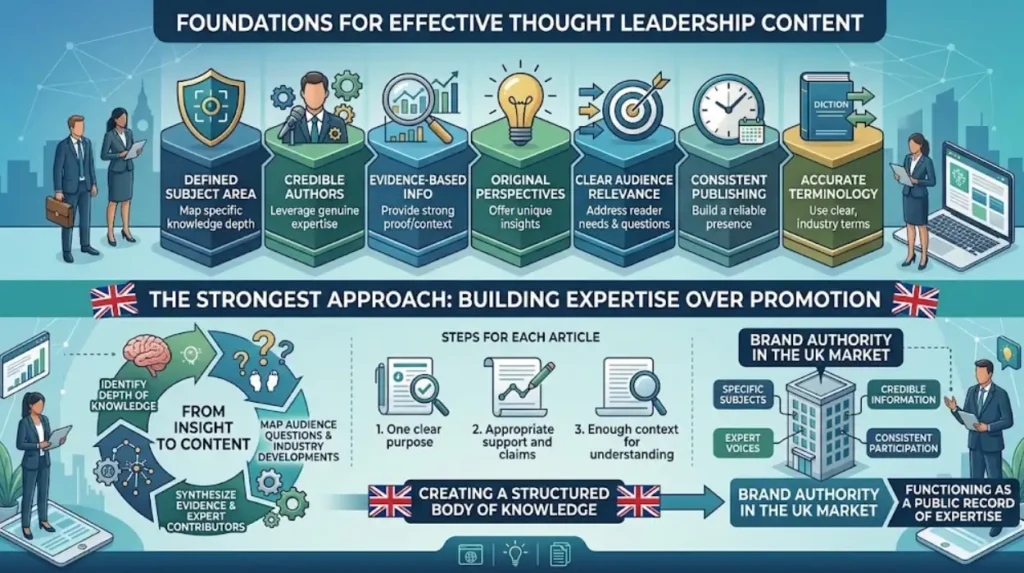
Organisations need a defined subject area, credible authors, evidence-based information, original perspectives, clear audience relevance, consistent publishing, and accurate terminology. These foundations create useful content that demonstrates expertise and supports sustainable UK brand authority.
The strongest approach starts with expertise rather than promotion. Organisations need to identify the subjects where their internal knowledge has genuine depth.
They then need to map audience questions, industry developments, relevant entities, evidence sources, and expert contributors.
Each article needs one clear purpose. Each claim needs appropriate support. Each explanation needs enough context for readers to understand the subject.
Over time, this process creates a structured body of knowledge.
Thought leadership content therefore functions as more than a publishing format. It creates a public record of expertise. In the UK market, that record supports brand authority by connecting an organisation with specific subjects, credible information, expert voices, and consistent industry participation.
Explore More Expert Insights: