

Thought leadership content positions a company, founder, executive, or subject-matter expert around informed perspectives, specialist knowledge, and evidence-based commentary. It communicates expertise through editorial-style content that addresses relevant business issues, explains industry developments, and provides useful perspectives for professional audiences.
For UK organisations, thought leadership content supports brand visibility across relevant media environments. It gives senior professionals a structured way to communicate expertise beyond corporate websites, social media posts, and conventional promotional materials.
What is thought leadership content?
Thought leadership content is expert-led material that demonstrates knowledge, addresses industry questions, and presents informed perspectives. It connects an organisation’s expertise with topics relevant to UK businesses, decision-makers, journalists, customers, and professional audiences.
Thought leadership differs from direct advertising. The content focuses on expertise rather than a simple product pitch. A founder can discuss market trends. A technology executive can explain emerging risks. A financial services specialist can analyse changes affecting businesses.
The strongest content establishes a clear subject area. It uses evidence, professional experience, original observations, and practical information. It also identifies the person or organisation responsible for the perspective.
What does effective thought leadership contain?
Effective thought leadership content commonly includes:
- A defined industry subject
- An identifiable expert or spokesperson
- A clear central argument
- Supporting evidence and relevant data
- Original observations
- Practical implications
- Professional language
- A credible author or organisation
- Relevant UK market context
For example, a UK fintech executive discussing the operational impact of changing payment technology provides a defined subject, an expert perspective, and business relevance.
Thought leadership also requires editorial discipline. Statements need to remain accurate and relevant. Claims require appropriate support. Promotional language needs to remain secondary to the educational value of the content.
Businesses using this format gain a structured content asset that communicates expertise while remaining relevant to external audiences.
How does Time Intelligence Media Group deliver thought leadership content?
Time Intelligence Media Group provides a structured thought leadership content service covering content development, editorial preparation, publication coordination, and media distribution. The process connects expert knowledge with suitable publication opportunities and defined communication objectives.
The process begins with the subject and communication objective. The organisation identifies the expertise it wants to communicate and the audience it needs to reach.
The next stage focuses on content development. Key information, expert viewpoints, business context, and supporting material form the basis of the article. The content receives an editorial structure designed for readability and relevance.
What happens during content development?
A typical development process includes:
- Topic selection – The subject is defined around expertise and audience relevance.
- Expert input – Relevant information and professional viewpoints establish authority.
- Content structuring – Arguments are organised into a logical editorial format.
- Editorial preparation – Language, clarity, factual consistency, and presentation receive attention.
- Publication preparation – The content is prepared for distribution through appropriate media channels.
- Media coordination – Publication opportunities are managed according to the agreed distribution strategy.
The process keeps the expert perspective central. The resulting article represents a defined area of knowledge rather than functioning as a conventional sales message.
This approach also creates consistency across multiple pieces of content. A company can build a recognisable subject position through recurring commentary on specific business or industry themes.
Organisations evaluating publication options can also review how:
Thought leadership content gets published across multiple sites and how distribution supports broader media visibility.
What types of thought leadership content can businesses publish?
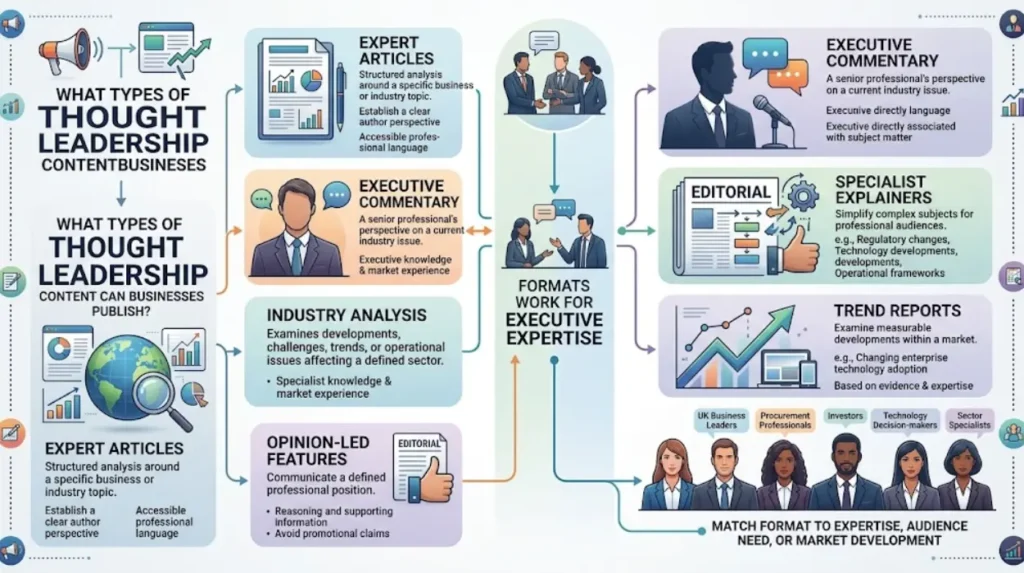
Businesses can publish expert articles, executive commentary, industry analysis, opinion-led features, specialist explainers, trend reports, and insight-driven editorial pieces. Each format communicates expertise while addressing a defined topic, audience need, business issue, or market development.
Different formats serve different communication objectives. A company introducing specialist knowledge can use an explanatory article. An established executive can publish commentary around a significant industry development.
Which formats work for executive expertise?
Expert Articles
Expert articles provide structured analysis around a specific business or industry topic. They establish a clear author perspective and explain the subject in accessible professional language.
Executive Commentary
Executive commentary presents a senior professional’s perspective on a current industry issue. The executive becomes directly associated with the subject matter.
Industry Analysis
Industry analysis examines developments, challenges, trends, or operational issues affecting a defined sector. It works well for businesses with specialist knowledge and substantial market experience.
Opinion-Led Features
Opinion-led features communicate a defined professional position. The article presents reasoning and supporting information rather than relying on promotional claims.
Specialist Explainers
Explainers simplify complex subjects for professional audiences. Examples include regulatory changes, technology developments, financial processes, procurement practices, or operational frameworks.
Trend Reports
Trend-focused content examines measurable developments within a market. A technology business, for example, can discuss changing enterprise technology adoption based on relevant evidence and professional expertise.
The selected format needs to match the expertise being communicated. A technical subject requires clarity and accurate terminology. A leadership topic requires a clear organisational or executive perspective.
The content also needs a specific audience. UK business leaders, procurement professionals, investors, technology decision-makers, and sector specialists have different information requirements.
What benefits does thought leadership content provide for UK businesses?
Thought leadership content strengthens expert positioning by associating a company or executive with defined subjects, useful analysis, and credible information. Published content also creates additional opportunities for brand visibility, audience engagement, search discovery, and professional recognition across relevant media environments.
The principal benefit is expertise positioning. Repeated publication around a defined subject creates a consistent association between the organisation and that area of knowledge.
How does thought leadership support brand authority?
Brand authority develops through identifiable expertise and consistent communication. Thought leadership gives senior professionals a formal publishing format for explaining their knowledge.
For example, a UK cybersecurity company can publish regular expert commentary about business security risks. A property consultancy can discuss commercial property trends. A financial services company can analyse relevant market developments.
Each article contributes to a broader subject profile.
How does publication support digital visibility?
External publication creates additional locations where a company, executive, or subject can appear. These placements provide opportunities for audiences to encounter the organisation outside its owned channels.
Thought leadership also supports broader search visibility when content is relevant, clearly structured, and associated with identifiable entities and topics. The objective is not keyword repetition. The objective is clear topical relevance.
Businesses can also connect educational content with commercial information through an organised content funnel. Readers first discover an industry subject, then evaluate available approaches, and finally review a relevant service.
This structure allows:
Thought leadership content to support both awareness and commercial consideration without changing the expert focus of the article.
How does thought leadership support trust?
Trust develops when content provides useful information and clearly identifies its source. Author attribution, professional credentials, evidence, and subject expertise contribute to content credibility.
A company publishing detailed commentary on a subject it actively operates within has a direct connection between expertise and published information.
The content remains strongest when it avoids unsupported claims. Specific facts, defined terminology, relevant examples, and transparent perspectives create a clearer information environment.
Which UK businesses can use thought leadership content?
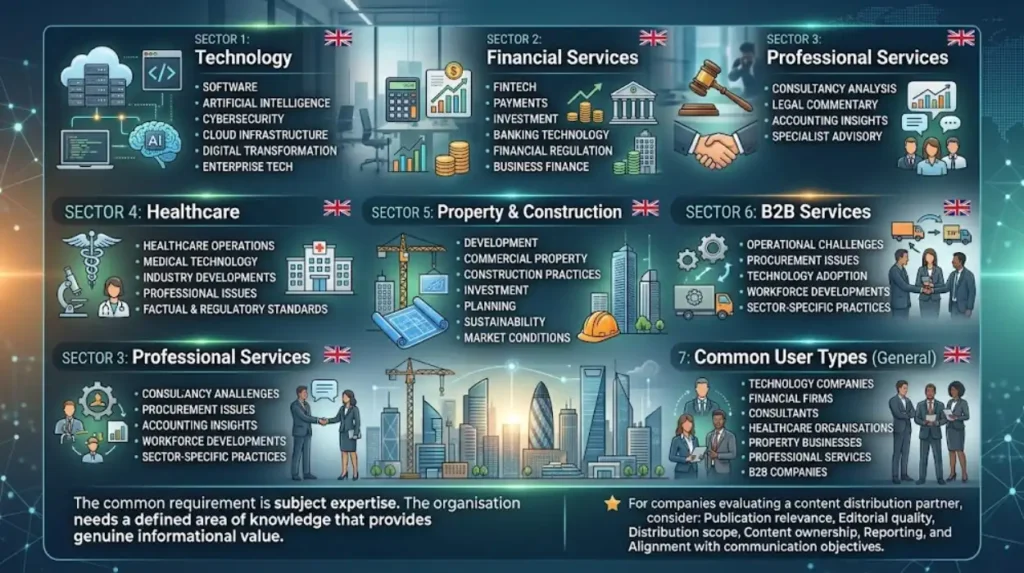
Thought leadership content suits UK businesses that possess specialist expertise and need to communicate that knowledge to professional audiences. Common users include technology companies, financial services firms, consultants, healthcare organisations, property businesses, professional services firms, and B2B companies.
The service applies across industries because expertise exists across multiple business categories.
Which sectors benefit from expert-led content?
Technology
Technology companies can publish content about software, artificial intelligence, cybersecurity, cloud infrastructure, digital transformation, and enterprise technology.
Financial Services
Financial businesses can address subjects such as fintech, payments, investment, banking technology, financial regulation, and business finance.
Professional Services
Consultancies, legal firms, accountants, and specialist advisers can communicate expertise through analysis, commentary, and practical explanations.
Healthcare
Healthcare organisations can publish specialist information around healthcare operations, technology, industry developments, and professional issues, while maintaining appropriate factual and regulatory standards.
Property and Construction
Property businesses can discuss development, commercial property, construction practices, investment, planning, sustainability, and market conditions.
B2B Services
B2B companies can use thought leadership to explain operational challenges, procurement issues, technology adoption, workforce developments, and sector-specific business practices.
The common requirement is subject expertise. The organisation needs a defined area of knowledge that provides genuine informational value.
For companies evaluating a content distribution partner, the decision also involves publication relevance, editorial quality, distribution scope, content ownership, reporting, and alignment with communication objectives.
What should businesses evaluate before choosing a thought leadership content service?
Businesses should evaluate editorial quality, topic expertise, publication relevance, distribution scope, author attribution, content accuracy, reporting, timelines, and service transparency. The provider also needs a defined process that connects content production with the organisation’s intended audience and communication objectives.
A clear evaluation framework reduces uncertainty during supplier selection.
What questions should businesses ask?
Businesses can assess a thought leadership content service through these criteria:
- What content formats are included?
- How is expert information collected?
- Who manages editorial preparation?
- Which UK publications are targeted?
- How is publication relevance assessed?
- What attribution appears with published content?
- What distribution process is used?
- What reporting is provided after publication?
- What timelines apply?
- What revisions are included?
- How are commercial claims handled?
- How does the service support the organisation’s broader content strategy?
These questions distinguish content creation from distribution and distinguish distribution from measurable publication outcomes.
Businesses also need to define their objective before selecting a service. The objective can involve executive positioning, industry visibility, media presence, specialist audience reach, brand authority, or a combination of these outcomes.
Time Intelligence Media Group’s thought leadership content service provides a decision-oriented option for organisations seeking professionally prepared expert content and media publication support in the UK.
Explore More Expert Insights:
Sponsored Listicles by Time Intelligence Media Group
Sponsored Video Content by Time Intelligence Media Group
The service fits businesses that need to turn internal expertise into structured external content. It connects subject knowledge, editorial development, and publication activity within one process.
For organisations ready to move from educational content into a practical publication strategy, thought leadership content provides a defined route from expertise to external visibility. The right approach starts with a specific subject, a credible expert, a defined audience, and a publication objective.



