

A lead-driven sponsored article is paid editorial content structured to educate a defined audience, establish relevance, present a solution, and guide qualified readers towards a measurable next step through clear messaging, evidence, and conversion-focused content.
Sponsored content combines editorial presentation with commercial intent. The article appears within a publisher’s media environment while communicating a brand’s expertise, product, service, or solution.
A lead-driven structure differs from a standard promotional article. Its purpose extends beyond visibility. Each section moves the reader towards an identifiable action.
That action includes visiting a service page, downloading a resource, requesting information, registering for an event, or completing an enquiry form.
For UK B2B audiences, the structure also needs contextual relevance. A fintech article, for example, requires different evidence and terminology from a property, healthcare, or professional-services article.
For readers who want to understand the conversion factors behind this format,
What Makes a Sponsored Article Convert Into Leads can provide the broader context.
How do you structure a sponsored article for lead generation?
Structure the article around one audience problem, one primary solution, one evidence set, and one conversion action. Use a clear introduction, informative sections, proof points, solution positioning, and a direct call to action.
1. Start with the audience problem
The opening establishes the reader’s commercial or operational problem.
A B2B sponsored article about PR distribution, for example, can address difficulties such as limited media visibility, inconsistent coverage, or weak campaign attribution.
The problem needs a defined business context. Avoid broad statements such as “marketing is changing”. Use specific conditions that the target audience recognises.
2. Define the problem
Explain what the problem means and why it affects the intended audience.
For example, a UK technology company seeking media exposure faces different requirements from a local consumer brand. The article needs to establish the relevant market, audience, and business objective.
3. Introduce the solution category
The article then explains the type of solution that addresses the problem.
This section remains educational. It explains what the solution does, how it works, and which requirements it addresses.
4. Present evidence
Evidence supports the solution. Useful evidence includes statistics, documented processes, case examples, customer outcomes, certifications, industry expertise, and relevant credentials.
Each evidence point needs a direct connection to the reader’s problem.
5. Create the conversion path
The final section connects the information to a specific action.
One article needs one primary conversion objective. Multiple competing CTAs dilute the reader’s next step.
What sections should a sponsored article include?
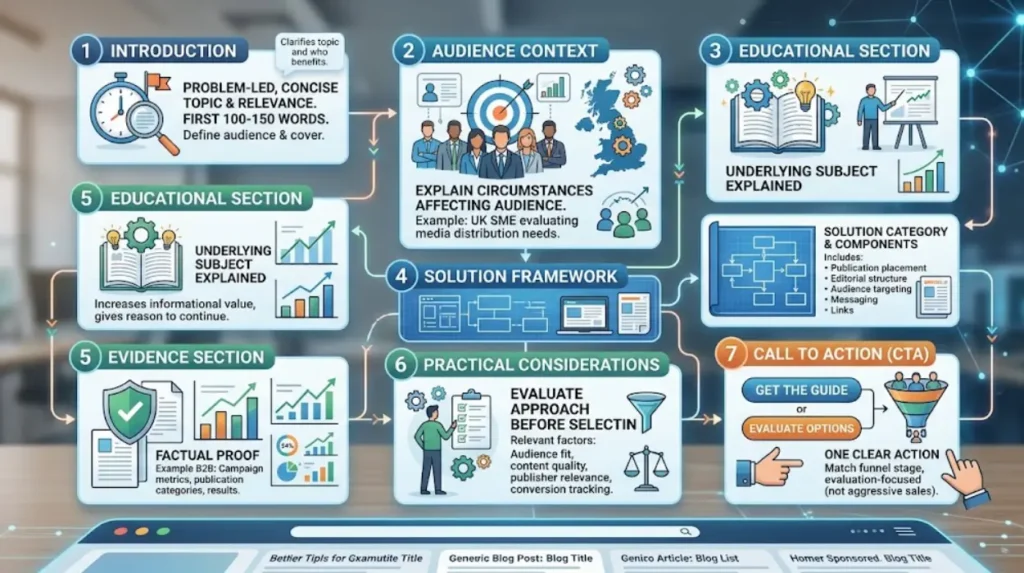
A conversion-focused sponsored article normally contains seven core sections: a problem-led introduction, audience context, educational explanation, solution framework, evidence, practical considerations, and a single relevant call to action.
Introduction
The introduction identifies the topic and establishes relevance.
Keep it concise. The first 100–150 words need to clarify what the article covers and who benefits from the information.
Audience context
Explain the circumstances affecting the target audience.
For example, a UK SME evaluating media distribution needs information about audience reach, publication relevance, distribution quality, reporting, and campaign objectives.
Educational section
Explain the underlying subject before introducing a commercial solution.
This increases informational value and gives the reader a reason to continue.
Solution framework
Describe the solution category and its components.
For sponsored content, this includes publication placement, editorial structure, audience targeting, messaging, links, campaign tracking, and conversion mechanisms.
Evidence section
Use factual proof to reinforce the claims.
A B2B article can include examples such as campaign metrics, publication categories, sector-specific results, or documented workflows.
Practical considerations
Explain what the reader needs to evaluate before selecting an approach.
Relevant factors include audience fit, content quality, publisher relevance, distribution scope, conversion tracking, reporting, and campaign objectives.
Call to action
End with one clear action.
The CTA needs to match the article’s funnel stage. Content uses an evaluation-focused action rather than an aggressive sales message.
Readers ready to evaluate a lead-generation solution can explore:
Get Lead-Driven Sponsored Content From Time Intelligence Media Group.
How do you write the introduction of a sponsored article?
Write the introduction around a specific audience problem, establish its business relevance, define the article’s purpose, and introduce the information the reader will gain without leading with promotional claims or excessive brand messaging.
A strong introduction answers three questions quickly:
- What problem does the audience face?
- Why does the problem matter?
- What will the article explain?
Consider a sponsored article targeting UK B2B marketers. The opening can focus on the difficulty of turning media exposure into identifiable enquiries.
The introduction then establishes the distinction between visibility and lead generation.
This creates a logical transition into the article’s main sections.
Avoid starting with company history. Avoid placing a product description in the first paragraph. Avoid using several CTAs before the reader understands the subject.
How do you balance educational and commercial content?
Balance educational and commercial content by explaining the reader’s problem first, providing useful information throughout the article, and introducing the commercial solution only after the audience understands the relevant criteria and decision factors.
Sponsored content becomes more useful when commercial information follows educational context.
A practical structure uses the following progression:
Problem → Context → Education → Solution → Evidence → Evaluation → Action
The problem establishes relevance.
The educational section builds understanding.
The solution section explains how the category addresses the problem.
Evidence supports the claims.
Evaluation criteria help the reader assess available options.
The final action connects the reader with the next stage.
This structure prevents the article from becoming a sales page disguised as editorial content.
What evidence makes sponsored content more credible?
Credible sponsored content uses specific evidence connected directly to its claims, including measurable results, documented processes, recognised certifications, customer examples, relevant expertise, and transparent explanations of how the promoted solution operates.
Use measurable evidence
Specific figures provide stronger context than generic claims.
For example, “15 UK publications” communicates a defined distribution scope. “Increased visibility” does not define an outcome.
Use relevant examples
Examples need to match the target audience.
A fintech example is more relevant to a fintech decision-maker than an unrelated retail example.
Explain processes
A documented process shows how an outcome is produced.
For example, an article about sponsored content can explain content briefing, editorial production, publication selection, campaign launch, tracking, and performance reporting.
Connect evidence to the claim
Every proof point needs contextual relevance.
If an article claims that audience targeting improves lead quality, it needs to explain which audience characteristics are targeted and how those characteristics connect with the intended customer profile.
How should a sponsored article use keywords and links?
Use the primary keyword in the title and relevant sections, add semantic variations naturally, and place internal links where they provide useful progression without interrupting the reader’s understanding or creating an excessive concentration of commercial anchors.
Keyword optimisation supports discoverability, but sponsored content also needs semantic completeness.
For a lead-generation article, relevant terminology includes:
- sponsored article
- sponsored content
- lead generation
- lead-driven content
- content marketing
- B2B sponsored content
- conversion-focused content
- editorial advertising
- qualified leads
- call to action
- audience targeting
- content distribution
- campaign tracking
These terms describe connected entities and processes.
Internal links also create a logical information path. Article can connect readers from educational information towards a solution-focused page.
The anchor text needs to describe the destination accurately. Avoid inserting links solely to increase link quantity.
How do you create a CTA that generates qualified leads?
Create one CTA that matches the article’s intent, communicates the next action clearly, and connects with the reader’s current decision stage. Use specific action language instead of generic phrases such as “click here” or “learn more.”
A reader is evaluating options.
The CTA therefore needs to support evaluation.
Examples include:
- Explore lead-driven sponsored content
- Review sponsored content options
- See how the campaign process works
- Request a media reach assessment
- Explore distribution and content packages
The CTA should also align with the article’s preceding information.
If the article explains how sponsored content supports lead generation, the next action can introduce a relevant sponsored-content solution.
This creates continuity between the reader’s information need and the commercial destination.
How does article structure affect lead quality?
Article structure affects lead quality by filtering readers through relevant information before the conversion point, ensuring that people who complete the CTA understand the problem, solution category, business relevance, and next step before submitting an enquiry.
A poorly structured article attracts attention without establishing qualification.
A structured article creates progressive understanding.
The reader first identifies the problem. The article then provides context. The reader learns how the solution works and evaluates its relevance. The CTA follows this progression.
This process reduces the gap between content engagement and commercial intent.
Lead quality also depends on audience targeting. A highly relevant article published to the right professional audience produces stronger contextual alignment than generic content distributed without a defined audience.
Which sponsored article formats work for different B2B objectives?
Different B2B objectives require different article structures. Educational explainers build understanding, solution comparisons support evaluation, case-led articles demonstrate outcomes, and service-focused sponsored content connects qualified readers with a specific commercial next step.
Educational sponsored articles
These explain an industry problem or process.
Example: a guide explaining how UK businesses evaluate media distribution.
Comparison articles
These compare approaches using defined criteria.
Example: comparing in-house content distribution with outsourced sponsored content.
Case-led articles
These focus on a documented business situation and outcome.
Example: explaining how a B2B company used sponsored content to reach a defined professional audience.
Solution-focused articles
These explain a specific service category and its implementation.
Example: an article explaining how lead-driven sponsored content works from briefing through publication and reporting.
The format needs to match the reader’s decision stage.
How do you measure whether a sponsored article drives leads?
Measure sponsored article performance using traffic, engagement, referral activity, CTA interactions, landing-page visits, enquiries, conversion rate, and qualified leads, with tracking configured before publication to connect content activity with commercial outcomes.
Useful measurements include:
| Metric | What it measures |
|---|---|
| Article views | Content exposure |
| Engaged visits | Reader interaction |
| CTA clicks | Commercial interest |
| Landing-page visits | Post-article intent |
| Form submissions | Lead generation |
| Conversion rate | Efficiency of the conversion path |
| Qualified leads | Commercial relevance |
| Cost per lead | Campaign efficiency |
Measurement needs to continue beyond publication.
A sponsored article that generates 5,000 views but no relevant enquiries has a different commercial result from an article generating 1,500 views and 25 qualified enquiries.
The objective determines the relevant success metric.
What is the complete process for creating a lead-driven sponsored article?
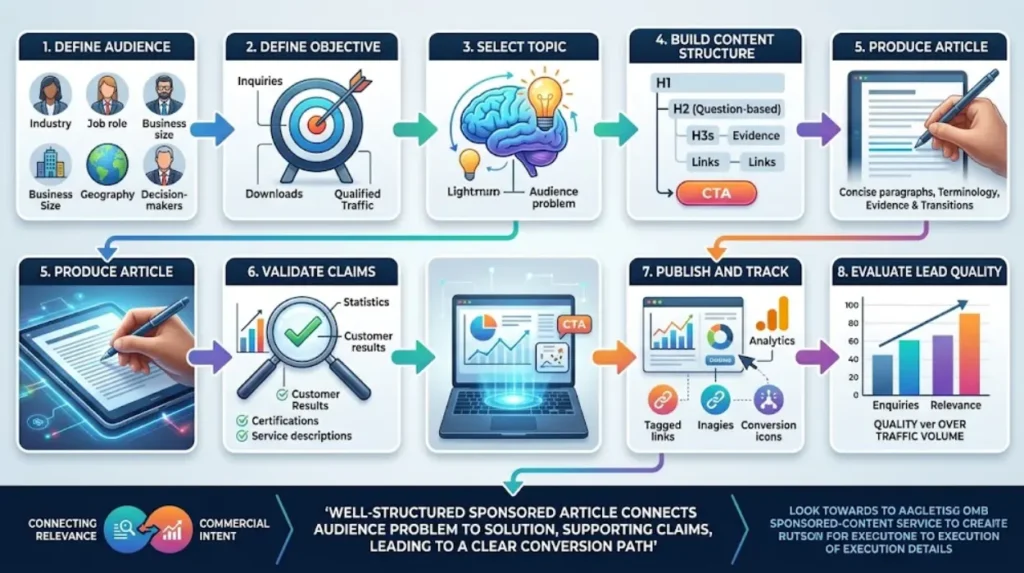
The complete process includes audience research, objective definition, topic selection, content planning, article production, evidence validation, editorial review, publication, CTA tracking, performance measurement, and lead-quality analysis after launch.
Step 1: Define the audience
Identify industry, job role, business size, geography, and decision-making responsibility.
Step 2: Define the objective
Select one primary objective such as enquiries, registrations, downloads, or qualified traffic.
Step 3: Select the topic
Choose a topic directly connected to the audience’s problem.
Step 4: Build the content structure
Create the H1, question-based H2 sections, supporting H3s, evidence points, internal links, and CTA.
Step 5: Produce the article
Use concise paragraphs, specific terminology, factual evidence, and clear transitions.
Step 6: Validate commercial claims
Check statistics, customer results, certifications, service descriptions, and other factual claims before publication.
Step 7: Publish and track
Configure analytics, tagged links, CTA tracking, and conversion measurement.
Step 8: Evaluate lead quality
Review the number and relevance of enquiries rather than relying solely on traffic volume.
Explore More Expert Insights:
How B2B Sponsored Content Reaches Decision-Makers
How Sponsored Content Builds 15 Backlinks for UK Brands
A well-structured sponsored article connects editorial relevance with measurable commercial intent. The strongest structure keeps the audience problem at the centre, introduces the solution at the appropriate stage, supports claims with evidence, and ends with one clear conversion path.
For organisations evaluating a provider, the next stage is comparing how a specific sponsored-content service handles content creation, media placement, audience reach, tracking, and lead generation.



