Sponsored content is a paid editorial-style marketing format that places a brand, product, service, or expertise within relevant media environments. Lead-driven sponsored content goes further by connecting publication, audience, message, landing page, and conversion goal.
For UK businesses, the objective is not simply to publish an article. The objective is to create a measurable path from media exposure to qualified business interest. This requires clear audience targeting, useful content, strong positioning, relevant calls to action, and accurate conversion tracking.
Businesses evaluating sponsored content providers need to assess the complete delivery process. Time Intelligence Media Group provides a route for brands seeking sponsored content designed around lead generation, media visibility, and measurable business outcomes.
What is lead-driven sponsored content?
Lead-driven sponsored content is paid media content designed to attract a defined audience, communicate commercial value, and direct interested readers toward a measurable action that creates a qualified business lead.
Traditional sponsored content focuses heavily on publication and visibility. Lead-driven sponsored content adds a conversion structure.
The article identifies a specific audience problem. It explains a relevant solution. It establishes the advertiser as a credible source. It then directs readers toward a useful next step.
That next step depends on the campaign objective. Examples include:
- Requesting a consultation
- Downloading a report
- Booking a product demonstration
- Completing an enquiry form
- Registering for an event
- Visiting a service page
The structure of the article determines how naturally these actions fit the reader journey.
Brands planning the content strategy can also review:
Sponsored article structure to understand how the content framework supports lead generation.
How does Time Intelligence Media Group structure sponsored content for leads?
Time Intelligence Media Group structures sponsored content around audience intent, commercial messaging, publication placement, conversion paths, and measurable actions, creating an integrated campaign designed to move relevant UK readers from awareness toward business enquiry.
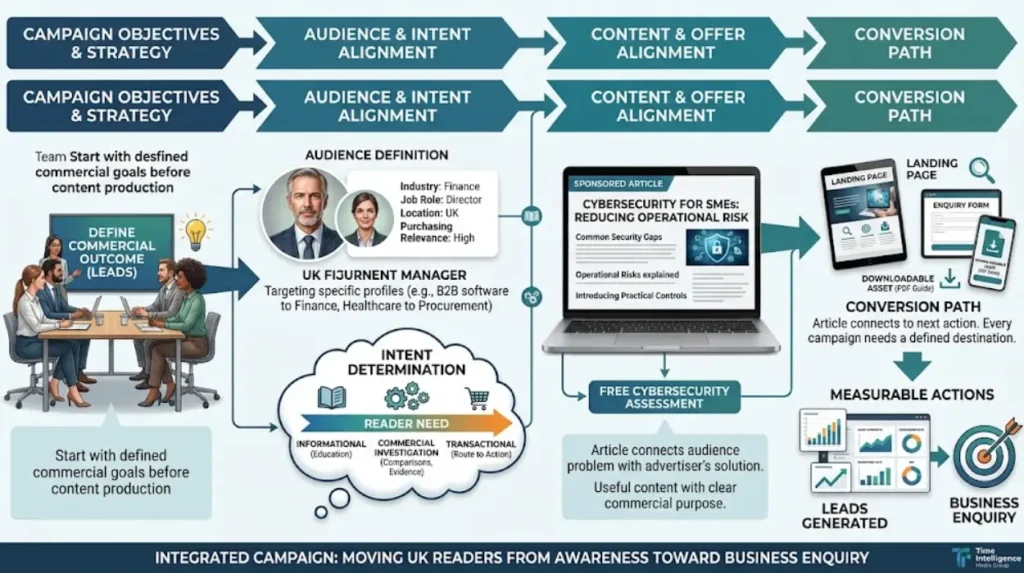
The process starts with campaign objectives. A lead generation campaign requires a defined commercial outcome before content production begins.
The next stage identifies the target audience. A B2B software company targeting UK finance directors requires different messaging from a healthcare company targeting procurement teams.
Audience and intent alignment
Audience definition includes industry, job role, business type, location, and purchasing relevance.
Intent determines what readers need from the article. Informational intent requires education. Commercial investigation requires comparisons, evidence, and solution details. Transactional intent requires a clear route toward action.
Content and offer alignment
The sponsored article connects the audience problem with the advertiser’s solution.
For example, a UK cybersecurity provider targeting SMEs can publish an article about common security gaps. The content explains the operational risks and introduces practical controls before directing interested readers toward a cybersecurity assessment.
This structure keeps the article useful while maintaining a clear commercial purpose.
Conversion path
The conversion path connects the article to the next action. A relevant landing page, enquiry form, booking page, or downloadable asset provides the destination.
Every campaign needs a defined destination. Without one, media exposure remains difficult to connect with lead generation.
What components make sponsored content lead-driven?
Effective lead-driven sponsored content combines a defined audience, strong editorial topic, commercial relevance, credible information, strategic calls to action, targeted media placement, conversion-focused landing pages, and measurable campaign tracking.
Each component has a distinct role.
Target audience
The audience defines who the campaign needs to reach. UK B2B campaigns often target decision-makers by industry and job function.
Editorial topic
The topic creates the reason for the audience to engage. A strong topic addresses a genuine business question connected to the advertised solution.
Commercial relevance
The product or service needs a logical relationship with the article. A financial technology provider fits content about payment automation more naturally than an unrelated consumer topic.
Credibility
Useful facts, clear explanations, practical examples, and evidence strengthen reader confidence.
Call to action
The CTA defines the next step. Examples include “Request a consultation”, “Book a demonstration”, and “Get a campaign assessment”.
Landing page
The landing page continues the message established in the article. It needs a clear value proposition and simple conversion mechanism.
Measurement
Tracking connects content exposure with measurable activity. Campaign reporting can include clicks, referral traffic, enquiries, conversions, and assisted conversions.
Why does media placement matter for sponsored content leads?
Media placement matters because the publication determines audience relevance, contextual credibility, referral potential, geographic reach, and exposure to readers who match the campaign’s target customer profile.
A sponsored article published on an irrelevant website attracts attention from the wrong audience.
Media selection therefore needs to reflect the campaign objective.
For UK brands, relevant placement can focus on business publications, industry media, regional outlets, technology publications, finance media, healthcare publications, or other specialist environments.
Relevance improves traffic quality
A smaller audience with strong commercial relevance can produce more valuable visits than a large audience with limited purchasing relevance.
For example, a B2B recruitment technology company benefits from reaching HR and business audiences rather than a broad entertainment audience.
Context supports credibility
The surrounding editorial environment influences how readers interpret sponsored information.
A technology company discussing artificial intelligence within a recognised technology publication has stronger contextual alignment than the same company appearing in an unrelated category.
Geographic targeting supports UK campaigns
UK campaigns need media selection that reflects the intended market.
A national campaign requires national reach. A London-focused campaign requires London-relevant media. A sector campaign requires publications read by the relevant professional audience.
How does sponsored content turn readers into leads?
Sponsored content turns readers into leads by matching the article to audience intent, presenting a relevant commercial solution, establishing enough trust to encourage action, and directing engaged readers toward a specific conversion point.
The conversion process contains several connected stages.
Stage 1: Attract
The headline and publication placement attract the intended audience.
The topic needs a direct relationship with a known customer problem. A vague promotional headline provides less information about the article’s value.
Stage 2: Educate
The article answers the reader’s question with useful information.
Educational content increases relevance because readers receive information before being asked to take action.
Stage 3: Position
The brand appears within a relevant solution context.
The content explains where the company’s expertise fits the problem. The positioning remains connected to the article’s subject.
Stage 4: Convert
The CTA gives the reader a defined next step.
A reader seeking professional assistance needs a simple route to contact the business. A reader researching a product needs access to relevant product information.
Stage 5: Measure
Analytics identify what happened after publication.
UTM parameters, landing-page analytics, CRM records, and conversion tracking connect campaign activity with lead outcomes.
What types of businesses benefit from lead-driven sponsored content?
Lead-driven sponsored content fits businesses with defined audiences, considered purchasing journeys, specialist expertise, measurable offers, or services that require education before a prospect starts a commercial conversation.
This format applies across multiple UK business sectors.
B2B technology
Technology businesses use sponsored content to explain software, automation, cybersecurity, cloud services, and artificial intelligence solutions.
Financial services
Fintech companies and professional financial businesses use educational content to explain complex products, regulatory developments, financial technology, and business finance solutions.
Healthcare
Healthcare organisations use informative content to explain services, technologies, professional solutions, and industry developments while directing relevant audiences toward appropriate commercial information.
Professional services
Consultancies, legal firms, accounting firms, recruitment companies, and business advisers use sponsored articles to demonstrate expertise around specific business problems.
Property and construction
Property companies and construction businesses use sponsored content to communicate market expertise, development services, investment opportunities, and specialist capabilities.
The strongest campaigns begin with audience-product relevance rather than publication volume alone.
What results can brands measure from sponsored content campaigns?
Brands can measure sponsored content through publication exposure, article engagement, referral traffic, CTA clicks, landing-page sessions, enquiry submissions, downloads, bookings, qualified leads, and revenue attribution where tracking connects campaigns with CRM data.
Measurement starts before publication.
Campaign URLs can include tracking parameters. Dedicated landing pages can isolate campaign traffic. CRM systems can record lead sources.
Core performance metrics
Useful metrics include:
- Impressions
- Article views
- Engagement
- Referral clicks
- Landing-page visits
- Conversion rate
- Form submissions
- Qualified leads
- Cost per lead
- Assisted conversions
The correct metric depends on the campaign objective.
A brand awareness campaign prioritises reach and engagement. A lead generation campaign prioritises qualified actions and conversion performance.
Why choose Time Intelligence Media Group for lead-driven sponsored content?
Time Intelligence Media Group provides businesses with sponsored content support focused on media placement, audience relevance, commercial messaging, publication, and measurable lead-generation objectives for UK-focused marketing campaigns.
The decision process needs to assess more than the publication itself.
Brands need clarity around the audience, placement, article production, commercial positioning, campaign links, reporting, and expected deliverables.
Time Intelligence Media Group supports campaigns where sponsored content forms part of a wider B2B marketing strategy.
The service is relevant when a business needs to combine media visibility with a defined commercial objective.
For decision-makers, the key evaluation points include:
- Target audience alignment
- UK media relevance
- Sponsored article development
- Brand positioning
- Conversion-focused calls to action
- Campaign tracking
- Performance reporting
These factors create a more complete framework for evaluating sponsored content providers.
How can UK businesses start a lead-driven sponsored content campaign?
UK businesses can start by defining the target audience, commercial objective, campaign offer, preferred media environment, conversion destination, tracking method, and content requirements before selecting a sponsored content distribution partner.
The first step is defining the lead.
A campaign needs a clear definition of what counts as a lead. This can be a completed enquiry, booked consultation, product demonstration, registration, or another measurable commercial action.
The second step is defining the audience.
The business identifies the industries, roles, locations, and decision-making responsibilities that matter.
The third step is selecting the content topic.
The topic needs to connect audience demand with the business solution. It also needs enough informational value to work within an editorial-style format.
The fourth step is preparing the conversion path.
The article needs a relevant destination. The landing page needs consistent messaging, a clear offer, and a simple action.
The final step is campaign measurement.
Tracking establishes which visits, clicks, enquiries, and leads originate from the sponsored content campaign.
Businesses comparing service options can also review:
Lead-driven sponsored content as part of their wider evaluation.
What makes a sponsored content campaign worth investing in?
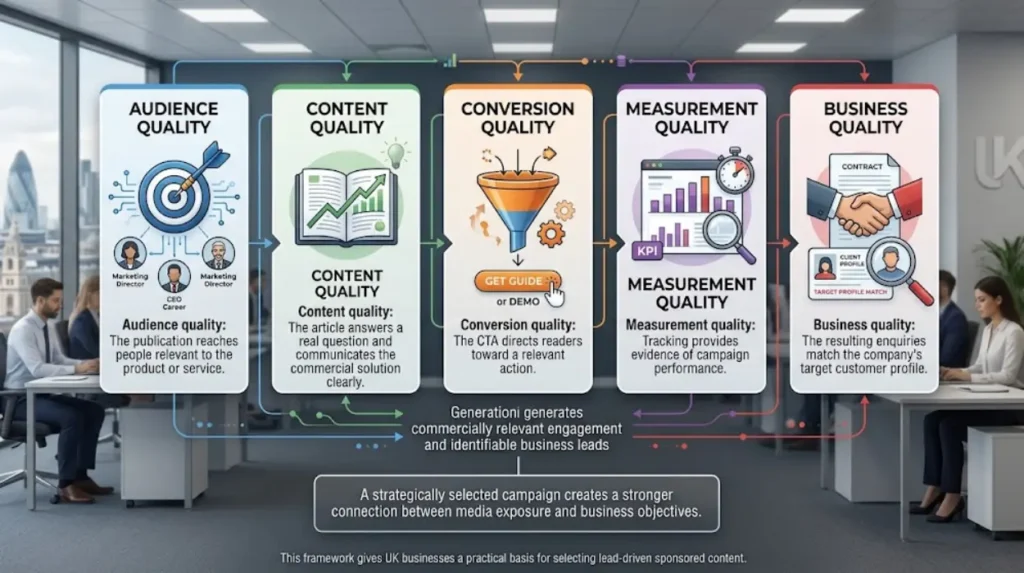
A sponsored content campaign earns its investment when its audience, publication, message, offer, conversion path, and measurement system work together to generate commercially relevant engagement and identifiable business leads.
Cost alone does not define campaign value.
A lower-cost placement with weak audience relevance produces limited commercial value. A strategically selected campaign creates a stronger connection between media exposure and business objectives.
The evaluation needs to consider the full campaign.
Audience quality
The publication reaches people relevant to the product or service.
Content quality
The article answers a real question and communicates the commercial solution clearly.
Conversion quality
The CTA directs readers toward a relevant action.
Measurement quality
Tracking provides evidence of campaign performance.
Business quality
The resulting enquiries match the company’s target customer profile.
This framework gives UK businesses a practical basis for selecting lead-driven sponsored content.
Explore More Expert Insights:
B2B Sponsored Content by Time Intelligence Media Group
Build Backlinks With Time Intelligence Media Group Sponsored Content
FAQs About Lead-Driven Sponsored Content
What is lead-driven sponsored content?
Lead-driven sponsored content is paid editorial-style content created to attract a defined audience and direct interested readers toward measurable business actions such as enquiries, bookings, downloads, or demonstrations.
How does sponsored content generate leads?
Sponsored content generates leads by combining audience targeting, useful information, commercial positioning, relevant calls to action, landing pages, and tracking that connects reader activity with conversion events.
Is sponsored content suitable for UK B2B companies?
Yes. Sponsored content suits UK B2B companies with defined audiences, specialist services, considered purchasing journeys, and commercial offers that benefit from educational explanation before direct conversion.
What should a sponsored article CTA include?
A sponsored article CTA needs one clear action that matches reader intent. Examples include requesting a consultation, booking a demonstration, downloading a report, or submitting an enquiry.
How can sponsored content performance be measured?
Performance can be measured through article views, engagement, referral clicks, landing-page traffic, CTA interactions, conversion rates, enquiries, qualified leads, cost per lead, and assisted conversions.
What does Time Intelligence Media Group provide?
Time Intelligence Media Group provides sponsored content support covering campaign objectives, audience relevance, content positioning, media placement, publication, conversion-focused messaging, and campaign measurement for businesses targeting relevant audiences.