Sponsored content is paid editorial-style content published on a third-party website. Its Google visibility depends on relevance, useful information, search intent, technical accessibility, content quality, and the publishing site’s overall search signals.
Sponsored content combines paid media placement with structured editorial content. It typically appears on a news website, industry publication, business publication, or specialist media platform. The content identifies the commercial relationship according to applicable advertising and publishing requirements.
Google evaluates the page itself rather than treating every sponsored article as an automatic ranking asset. The article needs a clear topic, useful information, accessible content, and alignment with the search query.
Sponsored content also differs from traditional display advertising. A banner delivers an advertisement through a visual placement. Sponsored content provides a complete information page that users can read and search engines can crawl.
How does Google evaluate sponsored content in 2026?
Google evaluates sponsored content through the same fundamental search-quality principles applied to other web pages, including relevance, helpfulness, originality, experience, accessibility, and technical quality. Paid publication does not guarantee organic rankings.
Google’s search systems identify the relationship between a query and a page through words, entities, concepts, page structure, and contextual signals.
A sponsored article about UK fintech regulation, for example, needs substantive information about fintech regulation. Mentioning “UK fintech” repeatedly without explaining the subject does not establish topical relevance.
Relevance to search intent
Search intent describes the information a user expects from a query. Common intent types include informational, commercial investigation, transactional, and navigational intent.
For example, the query “UK fintech regulation 2026” has an informational focus. A useful sponsored article explains regulatory developments, affected businesses, terminology, and relevant dates.
Content usefulness
Useful content answers the question directly. It provides facts, definitions, examples, processes, or evidence that satisfy the query.
A 1,200-word article containing specific regulatory terms, relevant examples, and clearly structured explanations provides stronger topical coverage than a 1,200-word promotional page containing repeated brand mentions.
Why does search intent matter for sponsored content rankings?

Search intent determines whether sponsored content answers the user’s actual query. Content that matches informational, commercial, transactional, or navigational intent provides clearer relevance and stronger topical alignment with its target search terms.
Search intent influences content structure from the beginning. A page targeting an informational query needs educational depth. A page targeting commercial investigation needs comparisons, specifications, evidence, and decision criteria.
Informational intent
Informational searches seek knowledge.
Examples include:
- “What is sponsored content?”
- “How does digital PR work?”
- “What makes an article authoritative?”
- “How does Google evaluate content?”
An informational sponsored article needs definitions and factual explanations before commercial references.
Commercial investigation intent
Commercial investigation searches involve evaluating options.
Examples include “best UK PR distribution methods” or “sponsored content publishing options UK.”
Content targeting this intent requires decision criteria, process explanations, pricing factors, and relevant comparisons.
This distinction helps prevent keyword targeting from becoming disconnected from the user’s purpose.
Which content characteristics help sponsored articles rank?
Sponsored articles require original information, clear topical coverage, accurate terminology, logical structure, useful examples, and direct answers. These characteristics help search engines understand the page and help users find the information they need.
Original information
Original information gives the article a distinct informational purpose. It includes original research, verified statistics, expert commentary, documented processes, case information, or detailed explanations.
Rewriting information already available across hundreds of pages provides limited differentiation.
Clear topical coverage
Topical coverage means addressing the important concepts surrounding the main subject.
For an article about UK sponsored content, relevant concepts include:
- Sponsored content
- Paid media
- Editorial disclosure
- Search intent
- Organic search
- Google Search
- Content quality
- Page experience
- Structured headings
- Internal linking
- External references
- Crawling and indexing
The article does not need to force every term into the copy. Each concept needs a legitimate contextual role.
Specific examples
Specific examples clarify abstract concepts.
For instance, an article targeting “sponsored content SEO” can explain how an article about renewable-energy investment uses terms such as solar generation, energy policy, investment funding, grid infrastructure, and UK energy targets.
The example establishes semantic relationships without relying on repetitive keyword placement.
How does content structure affect Google visibility?
Content structure gives users and search engines clear information about the subject, relationships between sections, and answers to individual queries. Descriptive headings, concise paragraphs, lists, and logical sequencing improve information accessibility.
Each section needs one identifiable purpose. The opening section defines the topic. Later sections explain ranking factors, content characteristics, technical considerations, and practical applications.
Descriptive headings
Headings identify the subject of each section.
“How does search intent affect rankings?” provides stronger contextual information than a generic heading such as “Important Factors.”
Concise paragraphs
Short paragraphs improve scanning and comprehension. Each paragraph needs one primary factual purpose.
Lists are useful for grouped information such as ranking factors, content components, technical checks, or examples.
Does keyword usage determine whether sponsored content ranks?
Keywords identify the language users employ in search queries, but rankings depend on broader topical relevance, search intent, content quality, and page-level signals. Repetition alone does not establish authority or satisfy search intent.
Keyword optimisation involves matching terminology to the subject naturally.
For “sponsored content ranking,” relevant variations include:
- Sponsored content SEO
- Sponsored articles in Google
- Ranking sponsored content
- Paid editorial content
- Sponsored article visibility
- Organic search rankings
- Search-friendly sponsored content
Entity relationships
Entities are identifiable people, organisations, places, products, concepts, or events.
An article about sponsored content in the UK can establish relationships between entities such as Google Search, UK publishers, advertising disclosures, digital PR, search intent, and organic search.
These relationships create clearer topical context than isolated keyword repetition.
How important are backlinks for sponsored content?
Paid links require appropriate treatment under search-engine guidelines. Sponsored relationships also require clear disclosure for readers under advertising and publishing standards.
A sponsored article can still provide value through its content, audience reach, brand visibility, referral traffic, and discoverability.
What technical factors affect sponsored content rankings?
Technical accessibility determines whether search engines can crawl, render, index, and retrieve a sponsored article. Page status, mobile accessibility, canonicalisation, structured content, performance, and indexability all affect search visibility.
A high-quality article requires a technically accessible publishing environment.
Crawlability
Search engines need to access the page. Blocked resources, incorrect robots directives, server errors, or inaccessible URLs interfere with crawling.
Indexability
A page needs appropriate indexation signals. A noindex directive prevents a page from entering Google’s index.
Mobile accessibility
The page needs to function properly on mobile devices. Text must remain readable, navigation must work, and important content must remain accessible.
Page experience
Page experience includes loading behaviour, interactivity, visual stability, security, and mobile usability.
Core Web Vitals provide measurable signals related to loading performance, responsiveness, and visual stability.
How does the publishing website affect sponsored content?
The publishing website provides the environment where sponsored content exists. Its topical relevance, technical accessibility, audience, editorial standards, site structure, and existing search visibility influence the article’s ability to attract organic users.
Publisher selection therefore involves more than audience size.
A relevant UK business publication provides contextual alignment for an article about UK business trends. A specialist healthcare publication provides stronger subject alignment for healthcare-related content.
Topical relevance
The publisher’s subject matter needs a logical relationship with the sponsored article.
For example, an article about commercial property investment fits naturally within a property publication.
Audience relevance
Audience relevance affects user engagement and referral potential. A publication reaching business decision-makers provides a different audience from a general entertainment publication.
Editorial environment
Consistent editorial standards create a clearer information environment. Sponsored articles need accurate claims, appropriate disclosure, and professional presentation.
What role does original research play in sponsored content?
Original research strengthens informational value by introducing evidence that users cannot obtain from generic summaries. Surveys, datasets, interviews, statistics, and documented findings provide additional substance to sponsored articles.
Research creates factual depth.
A sponsored article about UK marketing trends can include survey results from 500 UK businesses, broken down by company size or industry. The methodology and sample size provide context for the findings.
Evidence and attribution
Claims need appropriate evidence. Statistics need identifiable sources. Research needs methodology. Regulatory information needs authoritative references.
This structure improves factual clarity and makes important statements easier for users and search systems to interpret.
How can businesses measure whether sponsored content performs in search?
Sponsored content performance requires measurable search and engagement indicators. Organic impressions, clicks, ranking positions, referral traffic, indexed status, engagement data, and assisted conversions provide distinct evidence of page performance.
Measurement needs to separate search visibility from commercial outcomes.
Organic search metrics
Relevant metrics include:
- Organic impressions
- Organic clicks
- Average search position
- Indexed status
- Search queries
- Click-through rate
Audience metrics
Audience indicators include:
- Page views
- Engaged sessions
- Referral traffic
- Average engagement time
- Returning visitors
A page can generate referral traffic without ranking strongly in organic search. A page can also rank for informational searches without producing immediate conversions.
These metrics therefore require separate analysis.
Which industries use sponsored content for search visibility?
Sponsored content appears across industries where organisations need to explain complex subjects to defined audiences. Common sectors include finance, technology, healthcare, property, professional services, education, retail, and business services.
Industry relevance determines the terminology, evidence, regulatory context, and audience expectations within each article.
Financial services
Financial content uses terminology related to fintech, banking, payments, investment, regulation, lending, and financial technology.
Technology
Technology content commonly covers software, artificial intelligence, cybersecurity, cloud computing, data, and digital transformation.
Property
Property content includes commercial property, residential development, construction, planning, investment, and real estate finance.
Healthcare
Healthcare content requires accurate terminology, responsible claims, regulatory awareness, and appropriate evidence.
Industry-specific depth helps an article answer the actual questions associated with its subject.
What is the process for creating sponsored content that ranks?
A ranking-focused sponsored article starts with search intent research, defines a precise topic, maps relevant entities, builds an evidence-based outline, creates useful content, applies technical optimisation, and measures search performance after publication.
The process follows a defined sequence:
- Identify the target search query.
- Determine the search intent.
- Define the primary topic and related entities.
- Analyse competing search results.
- Build a structured content outline.
- Add factual evidence and specific examples.
- Write direct answers to relevant questions.
- Optimise headings, metadata, links, and page structure.
- Verify technical accessibility and indexability.
- Monitor search impressions, clicks, rankings, and engagement.
This process separates content quality from paid placement. Publication creates distribution. Ranking depends on how effectively the resulting page satisfies search requirements.
Businesses moving from education into practical content planning can explore ranking and converting content for a deeper view of content creation and conversion.
For organisations evaluating professional publishing options, information about ranking sponsored content belongs at the decision stage rather than within a general educational explanation.
Why does sponsored content remain relevant to SEO in 2026?
Sponsored content remains relevant because it combines targeted publication with useful information, audience access, and searchable web content. Its SEO performance depends on relevance, quality, technical accessibility, search intent, and responsible publishing practices.
The central principle is simple: payment determines the publishing arrangement, not the organic ranking outcome.
Explore More Expert Insights:
How Manchester Firms Use Sponsored Articles for Growth
Why London Brands Choose News-Site Sponsored Content
A sponsored article needs genuine informational value. It needs a precise topic. It needs evidence and useful explanations. It needs a technically accessible page. It needs an audience and publisher relationship that makes contextual sense.
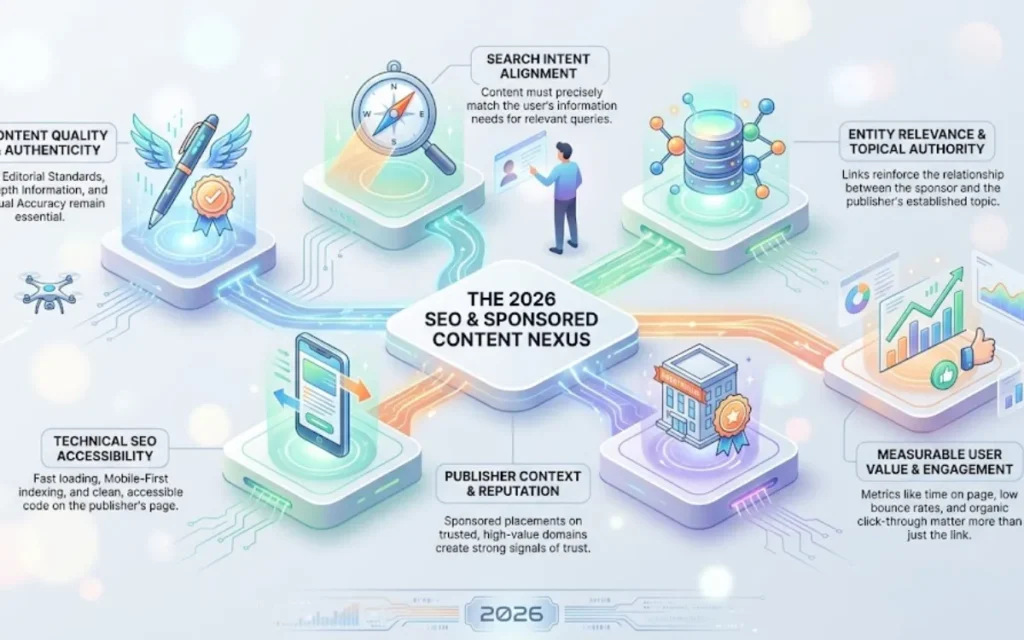
In 2026, ranking-focused sponsored content therefore operates at the intersection of content quality, search intent, entity relevance, technical SEO, publisher context, and measurable user value.