

News-site sponsored content is paid editorial-style content published on a digital news platform to communicate a brand message within a professional media environment. It combines structured storytelling with targeted audience distribution.
Sponsored content appears on news websites in formats such as articles, interviews, explainers, opinion pieces, and business features. The content is paid for by an organisation, while the publication provides the digital media environment.
The key distinction is disclosure. Sponsored material is normally labelled as “Sponsored”, “Advertisement Feature”, “Paid Content”, or a similar term. This identifies the commercial relationship between the advertiser and the publisher.
For London businesses, the format connects corporate information with established digital publishing environments. A technology company, property developer, professional services firm, or consumer brand can use sponsored content to explain a topic in greater detail than a conventional advertisement.
Why do London brands use news websites for sponsored content?
London brands use news websites because these platforms provide access to established digital audiences, structured editorial formats, searchable content, and topic-specific environments that support detailed communication about products, services, companies, and industry developments.
London has a dense concentration of businesses across finance, technology, property, healthcare, professional services, retail, education, and creative industries. These sectors often require more explanation than a short advertising message provides.
A sponsored article creates space for context. It can explain a business model, describe a new product, discuss an industry issue, or present research findings.
Audience relevance
News websites attract readers based on interests, locations, professions, and current events. A financial services article reaches a different audience from a technology feature or property article.
Audience relevance gives sponsored content a defined communication context.
Digital visibility
Published sponsored content creates a web page that readers can access through search, direct navigation, publication channels, or promotional distribution.
This makes the content different from an advertisement that disappears after a campaign placement ends.
How does sponsored content differ from traditional digital advertising?
Sponsored content provides a longer editorial-style format, while traditional digital advertising usually uses shorter visual or text-based placements. Sponsored content focuses on information and narrative, whereas display advertising focuses on immediate visibility and response.
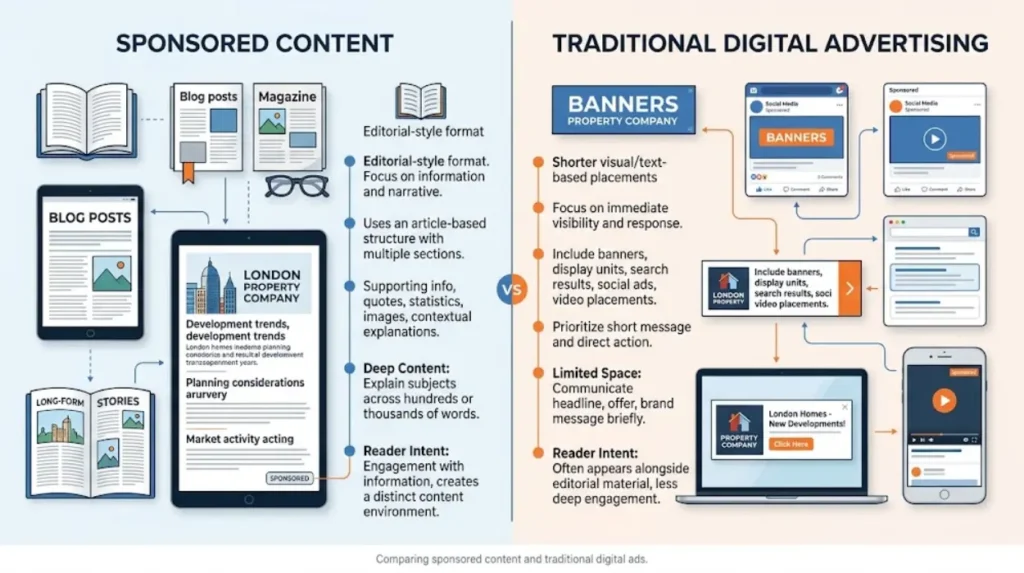
Traditional digital advertising includes banners, display units, sponsored search results, social advertisements, and video placements. These formats often prioritise a short message and direct action.
Sponsored content uses an article-based structure. The page can contain several sections, supporting information, quotations, statistics, images, and contextual explanations.
Content depth
An advertising banner can communicate a headline, offer, or brand message in a limited space. A sponsored article can explain a subject across several hundred or several thousand words.
For example, a London property company can use an article to explain development trends, planning considerations, market activity, and its own perspective within the disclosed sponsored format.
Reader intent
Readers who open an article are engaging with information. This creates a different content environment from an advertising placement that appears beside editorial material.
What types of content do London brands publish on news sites?
London brands publish sponsored articles, interviews, business profiles, industry explainers, thought-leadership features, product stories, and research-led content to address specific communication objectives and provide readers with structured information.
The format depends on the subject and audience.
Sponsored articles
Sponsored articles provide a structured explanation of a business topic. They commonly include a headline, introduction, subheadings, supporting evidence, and a conclusion.
Business profiles
A business profile presents information about an organisation, its activities, market position, leadership, or developments.
Expert interviews
Interview-based content uses questions and answers to present expertise. A London technology company, for example, can discuss artificial intelligence adoption, cybersecurity, or software development through an executive interview.
Industry explainers
Explainers focus on a specific subject rather than a simple promotional message. Examples include changes in financial regulation, property market developments, sustainability requirements, or digital transformation.
Research-led features
Research-based sponsored content uses statistics, surveys, reports, or industry findings as the central information source.
How is a news-site sponsored content campaign structured?
A news-site sponsored content campaign usually follows a defined process covering topic selection, audience identification, content development, publication, disclosure, distribution, and performance measurement across the selected digital media environment.
The process begins with the communication objective. The organisation identifies what information the audience needs to understand.
The next stage involves topic selection. The topic needs a clear connection between the organisation, the intended audience, and the publication environment.
Content development follows. Writers structure the article around a central subject rather than filling the page with repeated promotional claims.
Publication requirements then determine the final format. These requirements include headline length, image specifications, word count, disclosure language, links, formatting, and editorial standards.
Publication
Once approved, the content appears on the selected news website under its required commercial-content label.
Distribution
The published page can receive traffic through the publication’s website, search visibility, social channels, newsletters, direct promotion, or other permitted distribution methods.
Measurement
Campaign measurement focuses on defined indicators. These include page views, referral traffic, engagement, link activity, and other available performance data.
What makes London news-site sponsored content effective?
Effective sponsored content has a defined audience, a relevant subject, clear structure, factual information, transparent sponsorship disclosure, useful evidence, and a strong relationship between the topic and the organisation publishing the message.
Relevance is central to content quality. A business article needs a clear reason for existing beyond repeating company information.
A strong topic answers a recognisable reader question. For example, an article about commercial property can examine office demand, development patterns, workplace changes, or investment considerations.
Clear information architecture
Headings separate major concepts. Short paragraphs improve readability. Lists organise complex information. Supporting examples make abstract subjects more concrete.
Evidence
Statistics, research findings, industry data, expert statements, and documented developments provide substance.
Transparency
Sponsored content requires clear commercial disclosure. Transparency separates paid content from independent editorial reporting.
How does sponsored content support London-focused audience targeting?
Sponsored content supports London-focused targeting by placing business information within digital publications and topics relevant to audiences interested in London companies, industries, markets, communities, and commercial developments.
Location is important for businesses whose customers operate in London.
A property company can focus on London development. A professional services firm can address London business operations. A hospitality organisation can discuss city-centre tourism. A technology company can examine London’s technology ecosystem.
Audience targeting also extends beyond geography.
Industry targeting
Trade and specialist publications attract readers with professional interests. Financial readers seek financial information. Property professionals follow real estate developments. Technology audiences consume information about software, cybersecurity, and artificial intelligence.
National reach from London
London-based content also reaches audiences outside the capital. National news websites give London businesses access to readers across the United Kingdom.
For a deeper explanation of national audience distribution, see
London sponsored content reaches UK national readers.
What are the main benefits of publishing sponsored content on news sites?
News-site sponsored content provides London businesses with a structured digital publishing format, audience access, searchable information, long-form communication, transparent commercial placement, and measurable online activity linked to a defined content topic.
The benefits depend on campaign objectives and publication selection.
Greater communication space
Long-form content provides room to explain complex subjects. This benefits sectors such as finance, healthcare, property, technology, and professional services.
Searchable content
A published article exists as a digital URL. Readers can discover it through search engines and other online channels when the page is indexed and accessible.
Contextual visibility
The content appears within a media environment associated with information consumption. This creates a different context from isolated advertising placements.
Measurable performance
Digital publication enables measurement through available analytics. Metrics can include visits, engagement, referral traffic, and link interactions.
Which London industries use sponsored content?
London industries using sponsored content include financial services, technology, property, healthcare, professional services, retail, education, hospitality, and creative businesses that require detailed communication with defined audiences.
The subject changes according to industry requirements.
Financial services
Financial organisations can publish educational features about market developments, financial technology, investment topics, or regulatory changes.
Technology
Technology businesses can explain software trends, artificial intelligence, cybersecurity, cloud computing, and digital transformation.
Property
Property businesses can address development, commercial real estate, housing, investment, architecture, and urban planning.
Professional services
Legal, accounting, consultancy, recruitment, and business advisory firms can publish educational content around operational and commercial issues.
How should readers evaluate sponsored content?
Readers should evaluate sponsored content by checking its disclosure label, identifying the sponsoring organisation, reviewing the evidence presented, separating factual information from promotional claims, and comparing important claims with reliable independent sources.
Sponsored content is commercial communication. Its purpose differs from independent journalism.
The disclosure label provides the first indication of this distinction.
Readers can then examine the article’s sources, data, quotations, and claims. Important financial, medical, legal, or regulatory information requires additional verification from authoritative sources.
This distinction also helps businesses create better content. Useful sponsored content provides information that remains valuable even when the commercial relationship is disclosed.
Explore More Expert Insights:
How Sponsored Content Reaches Readers Across 15 News Sites
5 Reasons UK Startups Invest in Sponsored Articles
Why is sponsored content becoming an important part of digital media strategy?
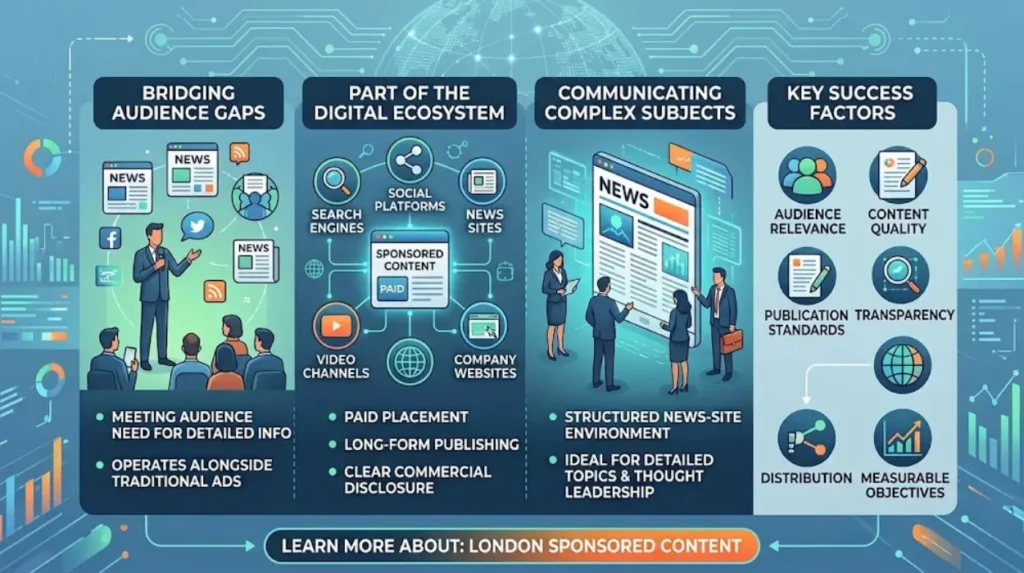
Sponsored content has become an important digital media format because organisations need detailed ways to communicate with online audiences while publishers develop commercial content formats that operate alongside traditional advertising and independent editorial coverage.
The digital media environment has expanded the number of ways organisations communicate.
Search engines, news websites, social platforms, newsletters, video channels, and company websites all contribute to online visibility.
Sponsored content occupies a specific position within this ecosystem. It combines paid placement with long-form digital publishing and clear commercial disclosure.
For London businesses, the format provides a way to communicate complex subjects in a structured news-site environment. Its effectiveness depends on audience relevance, content quality, publication standards, transparency, distribution, and measurable objectives. Businesses ready to explore a specific publishing solution can learn more about:
Understanding these foundations helps businesses assess sponsored content as a digital communication format before comparing providers, publication networks, or campaign approaches.



