Sponsored content is paid editorial-style content created to communicate a company’s expertise, products, research, or perspectives through a publisher’s audience. For UK SaaS companies, it provides a structured format for explaining software solutions while clearly identifying commercial sponsorship.
SaaS, or Software as a Service, describes software delivered through the internet rather than installed permanently on individual devices. UK SaaS companies operate across sectors including financial technology, healthcare technology, cybersecurity, human resources, marketing, accounting, and enterprise software.
Sponsored content forms part of digital media and content marketing. It differs from conventional advertising because the content provides substantive information rather than relying only on short promotional messages. A sponsored article can explain an industry issue, present research findings, discuss operational challenges, or introduce a software category.
For SaaS businesses, this distinction matters because software products often require context. A reader needs to understand the business problem before evaluating the technology designed to address it.
What does sponsored content mean in digital publishing?
Sponsored content means paid media content produced for publication through a publisher or media platform, with the commercial relationship clearly identified. It combines informative material with paid distribution while maintaining defined editorial and advertising disclosure standards.
Sponsored content appears in formats such as sponsored articles, branded features, expert interviews, research-led articles, and industry explainers. The exact format depends on the publisher and campaign objectives.
The term “sponsored” identifies the commercial relationship. This disclosure separates sponsored material from independent editorial coverage. UK publishers use labels such as “Sponsored”, “Advertisement Feature”, “Paid Content”, or similar wording.
The content itself remains structured like an article. It contains a headline, introduction, supporting sections, factual information, and a conclusion. A SaaS company can use this structure to communicate technical subjects in accessible language.
How is sponsored content different from advertising?
Traditional digital advertising frequently uses banners, display placements, search advertisements, or short promotional messages. Sponsored content uses longer-form editorial formats.
For example, a cybersecurity SaaS company can advertise through a display banner promoting its platform. The same company can use sponsored content to explain ransomware risks, security monitoring, compliance requirements, and the role of cloud-based security systems.
Both formats are paid media. Their presentation and information depth differ.
Why is sponsored content relevant to UK SaaS companies?
Sponsored content is relevant to UK SaaS companies because software products require explanation, category education, and business context. Published articles give SaaS businesses space to communicate technical subjects, industry developments, product categories, and customer problems.
SaaS purchasing decisions frequently involve multiple stakeholders. A software buyer can include a chief technology officer, procurement manager, finance director, department head, compliance professional, or business owner.
Each stakeholder evaluates different information. Technical teams examine functionality and integration. Finance teams examine costs and operational value. Compliance teams examine regulatory requirements. Business leaders examine productivity and strategic impact.
Sponsored content provides enough editorial space to address these different information requirements within one topic.
Which SaaS topics fit sponsored content?
Relevant topics include:
- Cloud software adoption
- Cybersecurity and data protection
- Artificial intelligence in business
- Customer relationship management
- Financial automation
- Human resources technology
- Marketing automation
- Enterprise resource planning
- Business intelligence
- Workflow automation
- Compliance technology
- Remote collaboration software
A UK HR SaaS provider, for example, can publish educational content about workforce management technology. A fintech SaaS provider can explain payment automation or financial reporting systems.
The subject needs a clear relationship with the company’s expertise. Strong topical relevance keeps the article useful to its intended audience.
How does sponsored content work for a SaaS company?
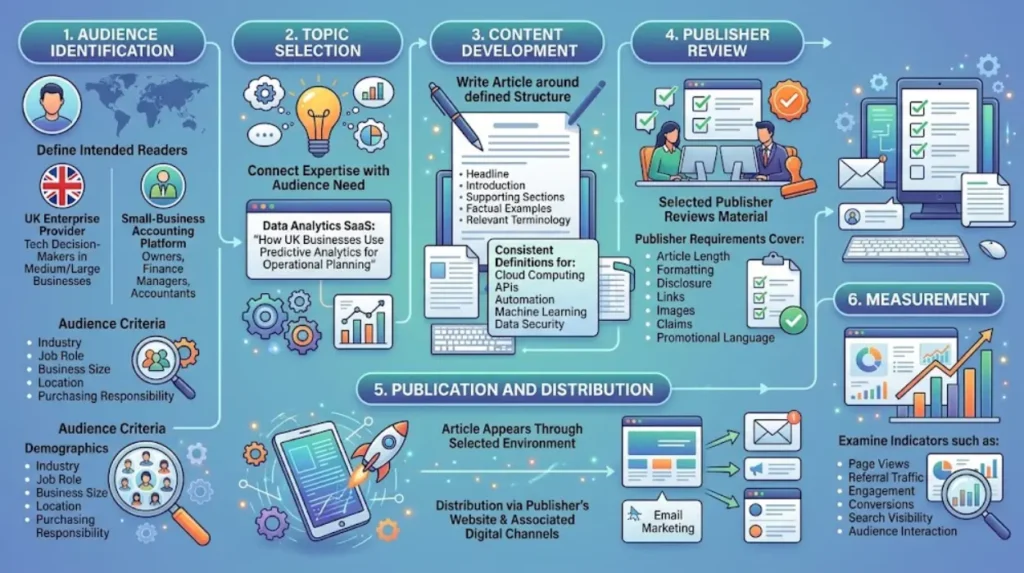
Sponsored content follows a defined publishing process that starts with audience and topic selection, continues through content development and publisher approval, and ends with publication, distribution, and performance measurement across relevant digital media environments.
The process normally contains several stages.
1. Audience identification
The SaaS company defines its intended readers. Audience criteria include industry, job role, business size, location, and purchasing responsibility.
A UK enterprise software provider can target technology decision-makers at medium-sized and large businesses. A small-business accounting platform can target owners, finance managers, and accountants.
2. Topic selection
The topic connects the company’s expertise with an established audience information need.
For example, a data analytics SaaS business can address “How UK Businesses Use Predictive Analytics for Operational Planning”. The subject provides educational value while remaining relevant to the company’s technology category.
3. Content development
The article is written around a defined structure. It includes a clear headline, introduction, supporting sections, factual examples, and relevant terminology.
Technical claims require accuracy. SaaS content also needs consistent definitions for terms such as cloud computing, application programming interfaces, automation, machine learning, and data security.
4. Publisher review
The selected publisher reviews the material according to its publishing requirements. These requirements can cover article length, formatting, disclosure, links, images, claims, and promotional language.
5. Publication and distribution
Once approved, the article appears through the selected publication environment. Distribution can include the publisher’s website and associated digital channels, depending on the agreed format.
6. Measurement
Performance measurement examines indicators such as page views, referral traffic, engagement, conversions, search visibility, and audience interaction.
What are the main components of SaaS sponsored content?
Effective SaaS sponsored content contains a relevant topic, defined audience, informative headline, factual body copy, clear commercial disclosure, appropriate brand references, supporting evidence, and a logical structure that helps readers understand the subject without excessive promotional language.
Relevant headline
The headline establishes the article’s subject. It needs to describe the information accurately.
Examples include:
- “How UK Businesses Use Cloud-Based Financial Systems”
- “What Data Automation Means for Modern Finance Teams”
- “How Cybersecurity Software Supports Remote Workforces”
Informative introduction
The introduction establishes the business or industry context. It answers the basic question of why the topic matters.
Structured body content
The body develops the subject through sections and subtopics. Technical SaaS concepts require clear definitions.
Evidence and examples
Evidence strengthens factual communication. Examples include industry statistics, company research, regulatory information, customer data, and documented technology trends.
Commercial disclosure
Disclosure identifies the paid nature of the content. This distinction supports transparency between sponsored material and independent editorial coverage.
Relevant brand references
Brand references need to remain connected to the subject. Repeated product promotion reduces the informational character of the article.
How does sponsored content support SaaS brand awareness?
Sponsored content supports SaaS brand awareness by placing a company’s expertise within relevant information environments. Repeated exposure to useful topics helps audiences associate the company with a defined software category, industry subject, or business problem.
Brand awareness involves recognition and association. A reader encounters a company name alongside a relevant topic and gains context about its market category.
For example, repeated content about cloud security, identity management, and compliance establishes topical associations for a cybersecurity SaaS provider.
This process differs from direct product advertising. The article provides information first and introduces the company within that context.
What role does expertise play?
Expertise gives SaaS sponsored content substance. Software companies operate in specialised fields with technical terminology and complex processes.
An article about artificial intelligence in recruitment, for example, can explain automated candidate screening, workflow management, data processing, and human oversight.
The company’s expertise becomes part of the information rather than appearing only as a promotional statement.
Can sponsored content help UK SaaS companies reach specialised audiences?
Sponsored content can reach specialised audiences when publication selection matches the SaaS company’s industry, buyer profile, geographic market, and subject area. Relevance between publisher audience and software category determines the quality of potential exposure.
Audience relevance matters because SaaS products often serve specific professional groups.
A healthcare SaaS platform needs exposure among healthcare professionals and organisations. A legal technology platform needs relevant legal and business audiences. A construction management platform needs readers involved in construction operations and project management.
Publisher selection therefore forms an important part of sponsored content planning.
Why does publisher relevance matter?
A large general audience does not automatically provide strong SaaS relevance. A smaller specialist publication can contain readers with greater interest in a specific technology category.
For example, a cybersecurity publication can provide contextual relevance for security software. A financial technology publication can provide contextual relevance for payment and banking software.
The publisher’s audience, editorial subject matter, geographic reach, and content standards all influence suitability.
How does sponsored content differ from independent editorial coverage?
Sponsored content is paid for by an organisation and carries commercial disclosure, while independent editorial coverage is produced according to a publication’s editorial decision-making process without payment for the coverage itself. The two formats serve different communication purposes.
Independent editorial coverage results from editorial selection. Journalists and editors determine whether a development qualifies for coverage.
Sponsored content operates within a commercial publishing arrangement. The organisation pays for the content placement or associated publishing opportunity.
The distinction is important for readers, publishers, and SaaS companies. Transparent labelling prevents confusion between paid communication and independent journalism.
What does editorial transparency mean?
Editorial transparency means clearly communicating the nature of the content. A sponsored article does not present itself as independent journalism.
This principle applies to disclosure labels, commercial relationships, article presentation, and claims.
For SaaS companies, transparency also supports accurate communication about software capabilities, pricing, performance, security, certifications, and customer outcomes.
What benefits can sponsored content provide for SaaS companies?
Sponsored content provides SaaS companies with structured space for education, category awareness, thought leadership, audience communication, and digital visibility. Its value comes from relevant information, appropriate publication environments, transparent disclosure, and consistent subject alignment.
The main benefits include:
- Education: Explains complex software categories and technologies.
- Awareness: Introduces companies to relevant audiences.
- Expert positioning: Communicates specialist knowledge through substantive content.
- Audience relevance: Connects topics with specific professional groups.
- Digital visibility: Creates published content within online media environments.
- Content reuse: Provides material that can support broader content strategies.
- Search discovery: Creates an additional indexed content asset when publisher and search conditions support indexing.
These benefits depend on content quality and publication relevance.
Sponsored content does not replace product documentation, independent reviews, customer references, technical resources, or direct sales communication.
When do UK SaaS companies use sponsored content?

UK SaaS companies use sponsored content across different business stages, including category education, product launches, market expansion, research publication, industry commentary, and awareness campaigns. Each application connects the content topic with a defined communication objective.
For companies exploring how sponsored content is distributed across multiple publishers,
Sponsored content across 15 sites provides the next level of information.
Product launches
A SaaS company launching a new software category can publish educational material explaining the market problem and technology behind the solution.
Market expansion
A company entering the UK market can create content addressing UK-specific business conditions, terminology, regulations, or industry practices.
Research publication
SaaS companies conducting surveys or analysing customer data can publish findings through sponsored articles. Research-led content provides a factual basis for discussion.
Industry education
Companies operating in complex sectors can explain technology developments affecting their audiences.
For example, an HR technology company can discuss automated workforce administration. A financial software provider can explain digital financial reporting.
Thought leadership
Subject-matter experts can contribute perspectives on defined industry topics. The content remains focused on the subject rather than repeated product promotion.
What should readers understand about sponsored content?
Readers should recognise sponsored content as paid communication designed to provide information while supporting an organisation’s commercial objectives. Clear disclosure distinguishes sponsored material from independent journalism and helps readers evaluate claims within their correct publishing context.
Sponsored content occupies a defined position within digital publishing. It combines commercial funding with an editorial-style format.
For UK SaaS companies, the format is particularly relevant because software categories often require detailed explanation. Topics such as cybersecurity, artificial intelligence, cloud infrastructure, automation, and compliance contain technical concepts that short advertisements cannot fully explain.
Explore More Expert Insights:
How Healthcare Brands Build Trust With Sponsored Articles
Why Fintech Brands Use Sponsored Content on UK News Sites
The quality of sponsored content depends on factual accuracy, audience relevance, transparent disclosure, useful information, and clear organisation.
Understanding these principles helps businesses, publishers, and readers distinguish sponsored communication from other forms of digital media. It also establishes a clear foundation for evaluating how SaaS brands use sponsored content across the UK media landscape.