

A free event coverage audit is a structured review of an event’s existing or planned media coverage. It identifies publication reach, story positioning, timing, distribution gaps, SEO value, and opportunities to improve visibility across relevant UK news sites.
An event coverage audit evaluates how effectively an event connects with the UK media landscape. The review focuses on measurable coverage factors rather than general promotional activity.
For an event organiser, brand, business, conference team, or communications department, the audit provides a defined view of media performance. It examines where coverage exists, where coverage is absent, and how distribution affects visibility.
A professional audit also separates media coverage from owned content. A company website announcement is not equivalent to independent news publication. Coverage on recognised news websites provides a different type of visibility and search presence.
The audit also considers event timing. Newsrooms operate according to editorial schedules, publication priorities, embargoes, and news cycles. Understanding these factors creates a clearer basis for event coverage planning.
For organisations evaluating their current approach,
Time Event coverage provides a practical starting point before selecting a distribution strategy.
What does the Times Intelligence event coverage audit examine?
The Times Intelligence event coverage audit examines media reach, publication quality, timing, content positioning, distribution, search visibility, and coverage gaps. These components establish whether an event receives relevant exposure across the UK media environment.
Media publication coverage
The audit identifies publications carrying event-related content. The assessment distinguishes between national, regional, specialist, business, technology, financial, lifestyle, and trade publications.
Examples include UK national news outlets, regional newspapers, industry publications, and specialist business media.
Publication relevance matters because audience alignment affects the practical value of coverage. A technology conference requires different media targets from a property investment event.
Geographic reach
UK event coverage has a strong geographic component. London, Manchester, Birmingham, Edinburgh, Glasgow, Liverpool, Leeds, Bristol, and other locations have distinct regional media ecosystems.
An audit checks whether coverage reflects the event’s geographic relevance.
For example, a Manchester business conference benefits from regional business coverage alongside broader UK media exposure.
Timing and publication sequence
Timing determines when an event announcement reaches journalists and when published stories appear online.
An audit examines announcement dates, event dates, embargoes, and publication timing. It identifies conflicts between the event schedule and the media distribution schedule.
This connects directly with:
News Coverage, where controlled release timing influences when different publications receive and publish event information.
Content positioning
Coverage needs a defined news angle. The audit reviews how an event is presented in media-facing content.
Relevant angles include:
- New product announcements
- Executive appointments
- Industry research
- Major partnerships
- Conference announcements
- Business milestones
- Technology demonstrations
- Investment announcements
- Public-sector initiatives
A conference announcement containing only venue and registration information has limited editorial depth. A conference presenting new industry research creates a stronger news proposition.
How does a free event coverage audit work?

A free event coverage audit starts with event information, reviews existing or planned media activity, evaluates distribution factors, identifies coverage gaps, and produces actionable findings for improving UK media visibility before or after an event.
Step 1: Event information is assessed
The audit begins with core event details.
These include:
- Event name
- Event date
- Location
- Industry
- Target audience
- Speakers
- Announcements
- News angles
- Existing media coverage
- Planned distribution
- Target publications
These details establish the context for the audit.
Step 2: Existing coverage is reviewed
Existing articles and mentions are evaluated across relevant publications.
The review identifies publication names, article topics, dates, geographical relevance, and content positioning.
This process establishes the current media footprint.
Step 3: Distribution gaps are identified
The audit compares existing coverage against the event’s intended audience and media objectives.
A business event with strong trade coverage but no regional coverage has a different distribution profile from an event with national coverage but limited specialist media exposure.
The distinction helps define the next media distribution requirement.
Step 4: Search visibility is examined
Published event coverage creates searchable digital assets. The audit reviews how those assets contribute to online visibility.
Relevant factors include:
- Searchable headlines
- Publication authority
- Keyword relevance
- Brand mentions
- Event-name visibility
- Geographic terms
- Industry terminology
- Article indexing
The objective is to establish how media coverage supports the event’s broader digital presence.
What are the main components of an event coverage audit?
The main components are publication analysis, geographic coverage, editorial relevance, distribution timing, content quality, search visibility, media diversity, and measurable coverage gaps. Together, these factors define the effectiveness of an event media strategy.
Publication analysis
Publication analysis identifies where an event appears and categorises each outlet according to audience and market position.
National coverage provides UK-wide exposure. Regional coverage connects the event with specific locations. Trade coverage reaches specialised professional audiences.
Editorial relevance
Editorial relevance measures the relationship between the event and the publication’s audience.
For example, a fintech event requires financial and technology media relevance. A construction conference requires construction, property, infrastructure, and business media relevance.
Media diversity
Media diversity refers to coverage across different publication categories.
A balanced event media profile can include national publications, regional outlets, trade media, business publications, and specialist websites.
Coverage timing
Timing measures when articles appear relative to the event.
Coverage before an event supports awareness. Coverage during an event supports live relevance. Coverage after an event documents announcements, outcomes, and developments.
Each phase has a different editorial function.
Coverage gaps
Coverage gaps identify missing publications, audiences, locations, or story angles.
For example, an event can have strong national coverage but weak coverage in the city where it takes place. Another event can have extensive trade coverage but limited business-media visibility.
Why is a free event coverage audit useful before an event?
A pre-event audit establishes the media baseline before distribution begins. It identifies target publications, timing requirements, editorial gaps, content requirements, and geographic priorities, giving event teams a defined framework for media coverage planning.
Pre-event analysis creates a measurable starting point.
It also prevents distribution decisions from relying only on publication quantity. Ten unrelated mentions do not provide the same value as coverage across publications that match the event’s audience.
A pre-event audit also clarifies the required media assets. These can include press releases, executive quotes, research findings, speaker information, event photography, data, and post-event announcements.
The audit therefore connects media planning with content preparation.
How does an event coverage audit support UK media distribution?
An event coverage audit supports UK media distribution by matching event information with publication categories, geographical audiences, editorial timing, and search requirements. It provides evidence for selecting distribution priorities instead of relying on undifferentiated media outreach.
UK media distribution operates across multiple publication levels.
National publications address broad audiences. Regional outlets address location-specific audiences. Trade publications address professional sectors. Specialist websites focus on defined interests.
An audit maps these categories against the event.
For example, a Birmingham technology conference can require Birmingham regional media, UK technology publications, business outlets, and specialist innovation websites.
The distribution strategy then reflects the event rather than applying the same media list to every announcement.
What results can an event coverage audit provide?
An event coverage audit provides a defined view of media performance, including publication reach, coverage gaps, timing issues, content weaknesses, geographic opportunities, search visibility factors, and distribution priorities for future event communications.
Typical findings include:
- Strong national publication coverage
- Limited regional coverage
- Missing industry publications
- Weak event-specific search visibility
- Insufficient pre-event timing
- Limited post-event coverage
- Repetitive media targeting
- Weak editorial angles
- Inconsistent publication relevance
These findings turn media coverage into an assessable process.
The audit also supports internal reporting. Marketing, communications, and event teams can use the findings to establish clearer coverage objectives.
Which events can benefit from a free event coverage audit?
A free event coverage audit applies to conferences, product launches, exhibitions, corporate events, trade shows, business forums, webinars, festivals, technology events, healthcare events, and other organised activities requiring measurable UK media visibility.
Corporate events
Corporate conferences and business events require coverage that reaches relevant decision-makers and industry audiences.
Product launches
Product launches require coordinated timing between announcements, event activity, and media publication.
The audit identifies opportunities to strengthen that sequence.
For broader context on how media coverage supports launch visibility, UK product launch coverage provides the educational foundation.
Industry conferences
Industry conferences benefit from specialist and trade publication coverage. The audit identifies relevant sectors and publication categories.
Regional events
Regional events require location-specific media targeting. Coverage in the event’s host city establishes local relevance while national publications provide broader reach.
Virtual and hybrid events
Virtual and hybrid events require different geographic considerations because attendance is not restricted to a physical venue.
The audit focuses on audience relevance, sector alignment, event timing, and publication reach.
How can businesses use the audit when choosing event coverage services?
Businesses can use the audit to compare coverage requirements with available distribution services. The findings establish publication priorities, timing needs, content requirements, geographic targets, and measurable outcomes before a media distribution decision is made.
The audit provides a decision framework.
A business can compare its existing coverage against its intended audience. It can identify whether national, regional, trade, or specialist distribution has the greatest relevance.
It can also evaluate whether the content supports the planned media objective.
For example, a fintech company launching a new service at a London event requires different publication priorities from a construction company hosting a regional infrastructure conference.
The audit makes those distinctions visible.
Explore More Expert Insights:
International Event Coverage on 15 UK News Sites
B2B Summit Coverage on 15 UK News Sites 2026
How can you request a free event coverage audit from Times Intelligence?
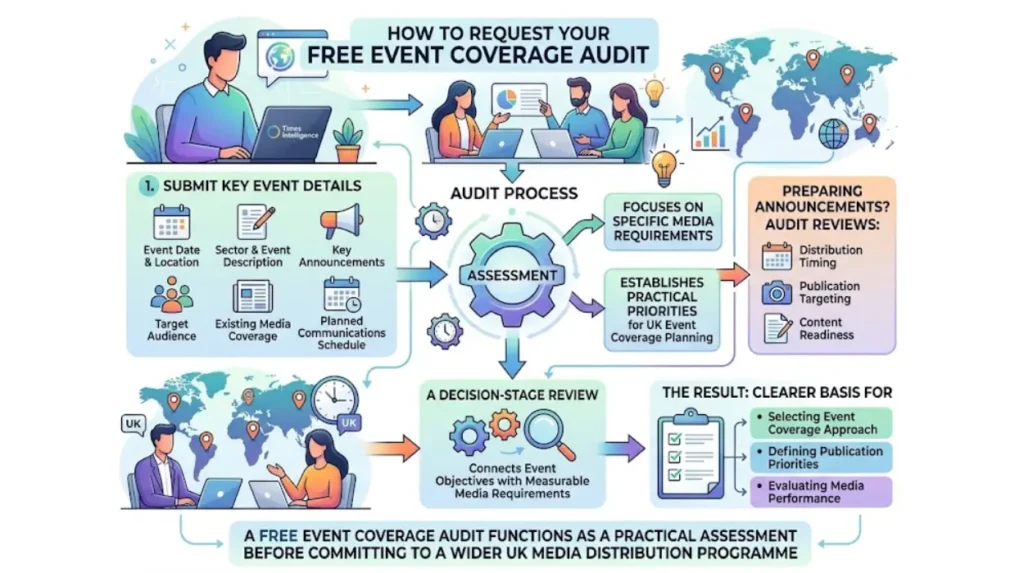
You can request a free event coverage audit from Times Intelligence by providing the event details, existing coverage information, target audience, timing, and media objectives. The audit then establishes practical priorities for UK event coverage planning.
The information required for an effective review includes the event date, location, sector, event description, key announcements, target audience, existing media coverage, and planned communication schedule.
The assessment can then focus on the specific media requirements of the event.
For organisations preparing an upcoming announcement, the audit also creates a useful point for reviewing distribution timing, publication targeting, and content readiness before the event.
A decision-stage review is most useful when it connects the event’s objectives with measurable media requirements.
The result is a clearer basis for selecting an event coverage approach, defining publication priorities, and evaluating media performance.
A free event coverage audit therefore functions as a practical assessment before committing to a wider UK media distribution programme.



