
Winning an award creates a verified achievement that can become a news story. The award identifies an individual, organisation, product, project, or team as a recognised performer within a defined category. News coverage then turns that achievement into public information through editorial reporting.
Award announcements often contain the core facts required for media coverage: the winner’s name, award category, achievement, event, date, location, and supporting evidence. These details give journalists a structured starting point for developing stories across relevant news publications.
What makes an award win newsworthy?
An award win becomes newsworthy when it contains a verified achievement, clear relevance, identifiable people or organisations, timely information, and a useful story angle that gives journalists enough factual material to develop an article for their audiences.
Recognition provides a factual event
An award creates a defined event. The winner has been selected through an established judging or voting process. The result provides a specific fact for publication.
For example, a technology company winning a regional innovation award creates a clear announcement. The story identifies the company, award, category, location, and achievement.
Timing increases editorial relevance
Award coverage is closely connected to timing. News sites need current information that relates to events taking place in the present news cycle.
An award announcement published immediately after a ceremony has stronger temporal relevance than an announcement published several weeks later without additional developments.
Relevance determines audience value
Different news sites serve different audiences. A business publication focuses on commercial achievements. A regional publication focuses on local organisations and people. A technology publication focuses on technology-related awards.
This means the same award win can produce different editorial angles across multiple publications.
How does an award winner become a news story?
An award winner becomes a news story through a sequence involving award verification, story development, factual information, editorial relevance, publication selection, content distribution, and independent editorial decisions by individual news organisations.
1. The award result is confirmed
The first stage is confirmation. The award organisation establishes the winner and category. Supporting information confirms the event, judging process, award title, and result.
Verification gives the announcement a factual foundation.
2. The achievement is turned into a story
The award result alone is often brief. A stronger news story explains why the winner received recognition.
For example, a sustainability award story can identify the winning project, explain its environmental initiative, and describe the measurable result that supported the award.
3. Essential facts are assembled
A useful award announcement normally contains:
- Winner name
- Award name
- Award category
- Date of announcement
- Event location
- Reason for recognition
- Relevant achievement
- Supporting statistics
- Winner statement
- Background information
- Contact information
These elements give journalists clear factual material without requiring extensive reconstruction of the event.
Why can one award story appear on 15 news sites?
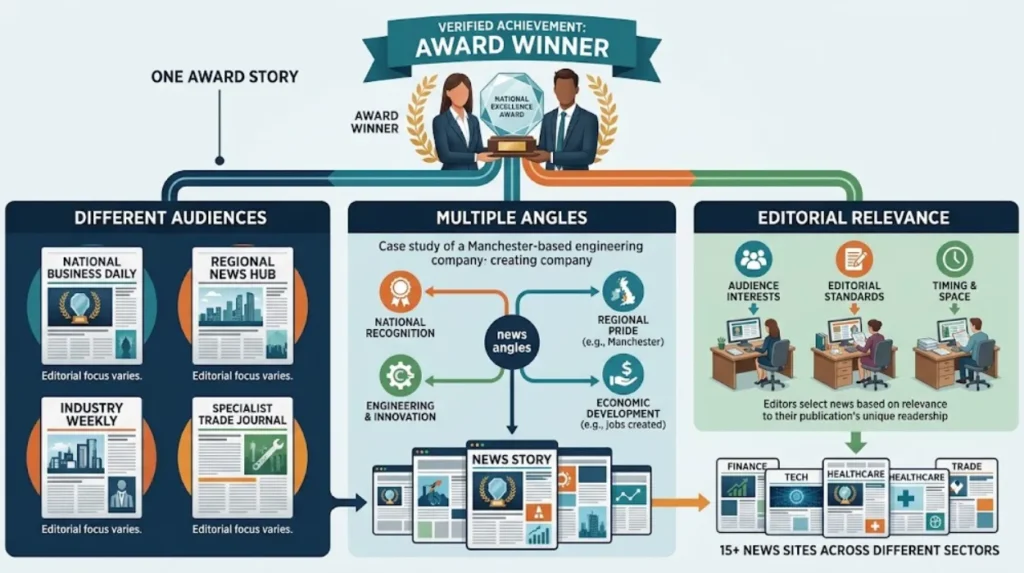
One award story can appear across 15 news sites because publications operate within interconnected media ecosystems where relevant announcements reach different editorial audiences, regional markets, business sectors, and specialist communities seeking timely recognition stories.
Different publications serve different audiences
Fifteen news sites do not necessarily represent fifteen identical audiences. Each publication has its own editorial focus.
For example, one site can focus on national business news, another on regional developments, and another on a specific industry such as finance, construction, healthcare, or technology.
One achievement can support multiple angles
An award winner can have several legitimate news angles.
A Manchester-based engineering company winning a national infrastructure award has a business angle, a regional angle, an engineering angle, and an employment or economic-development angle.
Each angle relates to the same verified achievement while addressing a different audience.
Editorial relevance remains publication-specific
Appearance on multiple sites does not mean every publication treats the story identically. Editors select stories according to relevance, timing, audience interests, editorial standards, and available space.
The award provides the factual event. Editorial relevance determines how that event is presented.
What information do journalists need from an award announcement?
Journalists need accurate award details, winner information, achievement evidence, event context, quotations, dates, locations, supporting statistics, and contact details to assess an award announcement and determine whether it fits their publication’s editorial requirements.
Award details
The announcement needs the exact award title and category. Ambiguous descriptions reduce clarity.
For example, “Business Excellence Award” provides limited context. “2026 UK Sustainable Construction Project of the Year” identifies the subject more precisely.
Winner information
The winner’s full name and organisation name establish the central entity in the story. The announcement also needs a concise description of the winner’s role.
Evidence of achievement
Specific evidence strengthens factual reporting. Examples include revenue growth, project completion figures, innovation results, customer numbers, sustainability measurements, or industry milestones.
Quotations and context
A winner statement adds context to the announcement. A judge or award organiser statement provides an additional perspective on the recognition.
Quotations also help publications build a complete article from the supplied information.
How do journalists evaluate the story angle?
Journalists evaluate an award story by examining its timeliness, relevance, originality, audience value, geographical connection, industry importance, evidence, available quotes, and relationship to current developments within their publication’s editorial coverage.
National angle
National publications focus on achievements with wider significance. A national award, major business milestone, or prominent industry development provides a broader editorial context.
Regional angle
Regional publications focus on local connections. The location of the winner, workplace, project, or award ceremony can establish regional relevance.
For example, a Birmingham company receiving recognition for an infrastructure project creates a clear West Midlands news connection.
Industry angle
Trade publications focus on specialist sectors. An engineering award fits engineering media. A healthcare innovation award fits healthcare publications.
The strongest industry angle explains the achievement in terms that matter to professionals within that sector.
How does the news publication process work?
The news publication process generally involves receiving information, assessing relevance, checking factual details, developing an editorial angle, writing or editing content, applying publication standards, and publishing the final story for the intended audience.
Information assessment
Editors first determine whether the award announcement fits their publication. They examine the subject, timing, location, sector, and potential audience interest.
Editorial development
The publication then determines the most relevant framing. One site can emphasise the award itself. Another can focus on the winner’s local economic contribution.
Fact checking
Names, titles, dates, award categories, statistics, and quotations require accuracy. Clear source information makes verification more efficient.
Publication
Once editorial checks are complete, the story enters the publication workflow. The final article reflects the publication’s style, audience, and editorial standards.
What role does timing play in award coverage?
Timing determines how closely an award story connects with the original event, current news cycles, seasonal reporting patterns, publication schedules, and audience interest, making prompt and accurate information important for maintaining editorial relevance.
An award story is strongest when the information is current.
The announcement date, ceremony date, judging date, and publication date establish the story’s timeline. These details help journalists understand why the achievement is relevant now.
Timing also matters during periods containing major national events, public holidays, elections, sporting events, or significant business announcements. These events affect the volume and composition of news coverage.
For example, an award announced during a major industry conference has an immediate connection to the wider sector news cycle.
How do regional and national publications differ in award coverage?
Regional publications emphasise local people, organisations, projects, and economic activity, while national publications focus on broader significance, prominent organisations, major sectors, recognised individuals, and achievements relevant to audiences across the United Kingdom.
Regional coverage
Regional stories often answer a local question: who from the area has achieved something significant?
Examples include:
- A Leeds company winning a business award
- A Glasgow entrepreneur receiving industry recognition
- A Cardiff construction project winning a design award
The geographical connection forms a central part of the story.
National coverage
National coverage places greater emphasis on wider relevance. A winner with national market activity, significant investment, recognised expertise, or major industry impact has a broader news angle.
Both forms of coverage can describe the same award while serving different editorial purposes.
What benefits does news coverage provide for award winners?
News coverage gives award winners greater public visibility, creates documented evidence of recognition, communicates achievements to relevant audiences, and places verified information about the winner within broader business, regional, professional, or industry news contexts.
Public recognition
News stories extend an award announcement beyond the original ceremony or award website. The achievement becomes accessible to people who did not attend the event.
Reputation evidence
Published coverage provides third-party documentation of an achievement. It records the award, winner, category, and relevant context.
Search visibility
News articles also create additional indexed references to the winner and award. Search engines can encounter the organisation, individual, award, project, and related entities across multiple published pages.
Stakeholder communication
Award coverage gives companies and professionals material to share with customers, employees, partners, investors, suppliers, and industry audiences.
The value depends on the relevance and quality of the coverage rather than the number of URLs alone.
What types of award winners commonly attract news coverage?
Award winners across business, technology, healthcare, construction, finance, education, sustainability, retail, professional services, and creative industries commonly attract coverage when their achievements provide clear relevance to specific audiences or communities.
Business awards
Business awards recognise companies, executives, entrepreneurs, and commercial achievements. Coverage often focuses on growth, leadership, innovation, or market contribution.
Industry awards
Industry awards recognise specialist achievements. Examples include engineering projects, financial technology products, healthcare innovations, construction developments, and professional services.
Community and regional awards
Community awards recognise local contributions. These stories often centre on individuals, charities, schools, local businesses, and community initiatives.
Innovation and technology awards
Technology awards focus on products, platforms, research, digital services, and technical developments. Evidence of innovation gives the story additional substance.
How can award coverage develop into wider media visibility?
Award coverage can develop into wider media visibility when the achievement connects with regional relevance, industry developments, business milestones, expert commentary, measurable results, and subsequent announcements that provide additional factual reasons for journalists to revisit the story.
An award is often the starting point rather than the complete story.
A company that wins an innovation award can later announce a product launch. A construction firm can report project completion. A healthcare organisation can publish new research results. An entrepreneur can announce expansion into a new market.
Each development creates a separate news event.
This relationship explains why award coverage has relevance beyond the ceremony itself. The original recognition establishes a documented achievement that can sit within a broader sequence of organisational news.
For readers researching how award recognition reaches multiple publications,
UK news sites provides the next stage of educational context.
For information about current award-focused media activity,
Awards coverage provides a more advanced point of reference.
What is the key process behind award coverage on 15 news sites?

The process begins with a verified award result, develops the achievement into a factual story, identifies relevant audiences, matches editorial angles with publications, supplies accurate information, and allows each news site to apply its own editorial standards.
The central principle is relevance.
Fifteen news sites can cover the same award because the achievement has multiple legitimate connections with different audiences. A national business publication, regional news site, industry publication, and specialist audience can each identify a distinct reason to report the same event.
Explore More Expert Insights:
What News Coverage Means for UK Product Launches
How International Events Get UK News Coverage
The quality of the underlying information remains essential. Accurate award details, clear achievement evidence, timely publication, strong quotes, and relevant context make the story easier to understand and assess.
Award coverage therefore operates through a combination of recognition, newsworthiness, timing, audience relevance, editorial selection, and factual reporting. Understanding these components explains how a single award result becomes a broader news story across multiple UK publications.