

International event coverage is the process of reporting an event held outside the UK to British audiences through relevant UK news publications, trade media, regional outlets, and digital news platforms using locally relevant editorial information.
International event coverage connects an overseas event with UK readers. The event location remains international, while the editorial distribution targets the United Kingdom.
Relevant events include global conferences, technology summits, healthcare congresses, financial forums, investment events, exhibitions, sporting competitions, and business awards. Examples include Web Summit in Lisbon, Mobile World Congress in Barcelona, and COP climate conferences.
UK news readers encounter international events through several content formats. These include news articles, event reports, interviews, executive commentary, announcement coverage, industry updates, and post-event summaries.
The core requirement is editorial relevance. A publication evaluates whether the event contains information that matters to its UK audience. Location alone does not determine coverage.
Readers interested in the broader educational process can explore:
How does international event coverage reach UK news readers?
International event coverage reaches UK readers through a structured distribution process that connects event information with suitable UK publications, journalists, digital news channels, industry audiences, and search platforms based on subject, audience, timing, and editorial relevance.
The process begins with event information. Organisers provide factual details about the event, including its purpose, location, dates, participants, announcements, speakers, partnerships, research findings, and business developments.
The information then receives editorial positioning for a UK audience. This stage identifies the strongest UK-relevant angle.
1. Identify the news angle
A global event requires a defined news angle. A generic statement about an event attracts less editorial relevance than a specific development.
Examples include:
- A UK company announcing an international partnership.
- A British executive speaking at a global conference.
- A new technology entering the UK market.
- International research affecting UK industries.
- A regulatory announcement relevant to British businesses.
2. Match the story with publications
Different UK publications serve different audiences. National news sites cover broad business and public-interest developments. Trade publications focus on sectors such as fintech, healthcare, technology, construction, energy, and finance.
The distribution process therefore depends on audience alignment rather than publication volume alone.
3. Distribute the news content
Once the story is prepared, it enters relevant media distribution channels. Publications receive information that matches their editorial scope and audience interests.
4. Reach digital readers
Published coverage becomes accessible through news websites, search engines, social sharing, newsletters, and other digital discovery channels. Readers can then find international event stories without attending the event directly.
Which components determine whether UK readers see international event coverage?
The main components are editorial relevance, UK audience alignment, publication selection, timing, factual content, distribution channels, search visibility, and clear event context. Together, these components determine how effectively international event information reaches British readers.
Editorial relevance
Editorial relevance defines why a UK publication and its readers need the information. Strong relevance comes from measurable business, economic, technological, social, or industry implications.
UK audience alignment
Audience alignment connects the event with a specific British readership. A global fintech announcement fits financial and technology audiences. A medical congress fits healthcare publications and professional readers.
Publication selection
Publication selection determines where the story appears. A technology event requires technology-focused publications alongside broader business outlets when the subject supports both audiences.
Timing
Timing affects the usefulness of event coverage. Pre-event announcements create awareness. During-event reporting captures immediate developments. Post-event coverage focuses on outcomes, announcements, and measurable results.
Factual content
News content requires accurate names, dates, locations, statistics, quotations, organisational information, and event details. These elements help publications assess and present the story.
Search visibility
Search visibility allows UK readers to discover coverage after publication. Relevant entities and descriptive terminology help search systems understand the relationship between the event, participants, industry, and location.
How does UK localisation affect international event coverage?
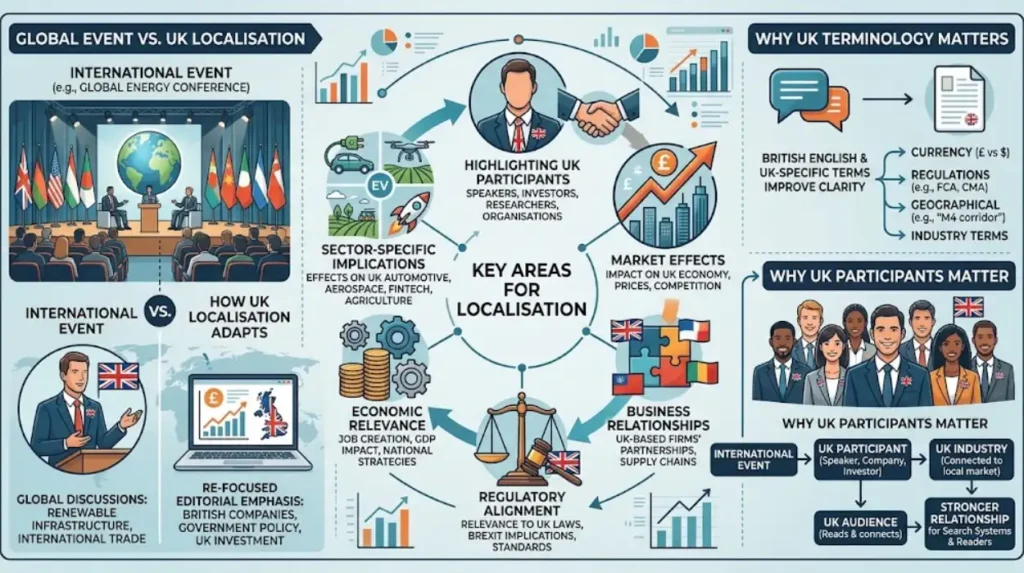
UK localisation adapts an international event story to British editorial and audience requirements by highlighting UK participants, market effects, business relationships, regulations, economic relevance, and sector-specific implications without changing the underlying facts.
Localisation does not require changing the event itself. It changes the editorial emphasis.
For example, an international energy conference can include global discussions about renewable infrastructure. UK-focused coverage adds information about British energy companies, government policy, investment activity, or domestic infrastructure.
Similarly, an international technology conference becomes more relevant to UK readers when coverage identifies British technology firms, UK investment, employment effects, cybersecurity implications, or market adoption.
Why UK terminology matters
British English and UK-specific terminology improve audience clarity. Currency, regulatory references, organisational names, geographical references, and industry terminology require accurate treatment.
Why UK participants matter
A British speaker, company, investor, researcher, or organisation provides a direct connection between an international event and UK readers.
This connection creates a defined entity relationship:
International Event → UK Participant → UK Industry → UK Audience
That relationship gives search systems and readers a clearer understanding of the story.
Which types of international events receive UK news attention?
International events receive UK news attention when they contain developments relevant to British industries, companies, consumers, professionals, investors, policymakers, or specialist audiences across sectors such as technology, finance, healthcare, energy, property, and business.
International business conferences
Business conferences generate coverage through executive announcements, investment developments, partnerships, market data, and corporate strategy.
Technology events
Technology events produce stories around artificial intelligence, cybersecurity, cloud computing, software, telecommunications, and digital transformation.
Healthcare congresses
Healthcare events generate coverage through clinical research, medical technology, pharmaceutical developments, healthcare policy, and professional collaboration.
Financial forums
Financial events focus on investment, banking, fintech, capital markets, economic developments, and financial regulation.
Trade exhibitions
International exhibitions connect manufacturers, suppliers, buyers, distributors, and professional audiences. Coverage often focuses on product launches, commercial partnerships, market expansion, and industry trends.
How do UK news publications select international event stories?
UK news publications select international event stories according to editorial relevance, audience interest, news value, originality, credible sources, factual accuracy, timing, and the strength of the connection between the event and British readers or industries.
Editors and journalists evaluate the information available to them. A press release does not automatically become editorial coverage.
News value
News value comes from developments rather than event attendance alone. A new partnership, investment figure, research result, product announcement, or policy development provides a stronger news basis.
Audience relevance
A publication needs a clear reason for presenting an international event to its UK audience. Sector relevance provides this connection.
Source credibility
Named organisations, executives, researchers, companies, and institutions provide identifiable sources. Clear attribution strengthens factual reporting.
Timing and freshness
Event coverage performs best when information is timely. Announcements distributed weeks after the event lose immediacy unless they contain continuing relevance.
What is the difference between international event awareness and UK media coverage?
International event awareness communicates that an event exists, while UK media coverage presents specific event developments through British publications for defined audiences, creating an editorial record that readers can discover through news and search channels.
Event awareness includes advertising, social media posts, event websites, email campaigns, and direct invitations.
Media coverage is different. It places event information within an editorial environment.
This distinction matters for organisations comparing communication methods. Paid promotion provides controlled messaging. Editorial coverage depends on news relevance and publication standards. Media distribution provides a route for presenting suitable information to multiple publications.
A structured approach often combines event communications with media relations, search optimisation, executive commentary, and sector-specific distribution.
How does international event coverage support UK search visibility?
International event coverage supports UK search visibility by creating published references to event names, organisations, speakers, industries, locations, announcements, and UK connections across indexed digital news environments and relevant publication domains.
Search engines identify entities and relationships within published content. An article containing an international conference name, participating company, UK executive, industry term, and specific announcement creates multiple contextual signals.
Entity relationships
Important entities include:
- Event name
- Event organiser
- Participating companies
- Speakers
- Countries
- UK organisations
- Industry sectors
- Announced products or services
- Research institutions
- Relevant dates
Clear relationships between these entities improve topical understanding.
Search discovery
UK readers search for international events using different query patterns. Examples include:
- International technology conference UK news
- Global fintech event coverage
- UK companies at international conferences
- International healthcare congress news
- Global business summit UK coverage
Coverage that clearly identifies the event and its UK relevance addresses these search contexts directly.
When is international event coverage most useful for UK organisations?
International event coverage is most useful when a UK organisation participates in a global event and needs to communicate a measurable announcement, partnership, market development, research result, executive contribution, or industry development to British audiences.
A UK technology company launching a product at an international conference has a clear media angle.
A British healthcare organisation presenting research at a global congress also has a defined editorial connection.
A UK financial services company announcing an international partnership creates another relevant news angle.
The strongest use cases share three characteristics:
- A clearly identifiable international event.
- A specific development connected to the UK.
- A defined audience that benefits from the information.
How can organisations evaluate international event coverage options?

Organisations can evaluate international event coverage options by comparing publication relevance, UK audience reach, sector alignment, distribution scope, editorial requirements, publication timing, search visibility, reporting quality, and the ability to connect coverage with measurable communication objectives.
A useful evaluation framework separates distribution from editorial relevance.
Publication relevance
Check whether publications reach the intended UK audience. A technology company requires technology and business readership. A healthcare organisation requires healthcare and medical audiences.
Coverage scope
Compare national, regional, business, and trade publication categories. A wider publication mix creates different audience entry points.
Editorial requirements
Review requirements for press releases, quotations, data, executive information, images, attribution, and factual verification.
Reporting
Evaluate whether coverage reporting identifies publication names, article URLs, publication dates, and relevant performance information.
For organisations evaluating specific distribution solutions,
International event coverage provides the next decision-stage context.
What makes international event coverage effective for UK news readers?
Effective international event coverage gives UK readers a clear reason to care about a global event by connecting verified developments with British companies, industries, professionals, markets, regulations, or audiences through relevant publications and timely digital distribution.
The process is therefore more specific than simply sending an international announcement to UK media.
Successful coverage begins with a defined news development. It then establishes UK relevance, identifies appropriate publications, presents factual information, and distributes the story through suitable media channels.
Explore More Expert Insights:
How B2B Summit Coverage Reaches 15 News Sites in 2026
How Pharma Event Coverage Meets UK Regulatory Standards
The result is a structured connection between an international event and a UK audience.
For organisations planning international event communications, the key evaluation points remain consistent: news value, UK relevance, publication fit, timing, factual quality, distribution scope, and search discoverability. These factors determine whether an overseas event becomes accessible and meaningful to UK news readers.



