
Business-to-business summits generate concentrated industry news. Speakers announce strategies, companies present research, executives discuss market changes, and attendees exchange commercial insights. News coverage converts these summit developments into published stories across relevant UK media channels.
In 2026, B2B summit coverage involves more than publishing one press release. Effective distribution combines editorial positioning, newsworthiness, media targeting, release preparation, publication timing, and syndication. The objective is clear: place one summit story across 15 relevant UK news sites while maintaining consistent facts and editorial relevance.
This process also connects with the wider role of summit publicity. Businesses evaluating why:
B2B summit news coverage matters first need to understand how distribution works across multiple publications.
What is B2B summit coverage?
B2B summit coverage is the publication of verified summit-related news across business, trade, regional, and specialist media outlets. It communicates event developments through structured stories, announcements, interviews, and industry-focused reports.
B2B summit coverage focuses on information with business relevance. Common subjects include keynote announcements, partnership launches, investment updates, research findings, policy discussions, technology demonstrations, and executive appointments.
A summit itself is an organised business event involving professionals around a defined industry, commercial, technological, or policy topic. Coverage extends the event’s information beyond physical attendees.
What makes summit coverage newsworthy?
Newsworthiness depends on identifiable developments. A summit agenda alone does not constitute a strong news story.
Examples include:
- A fintech summit announcing a new payments partnership.
- A healthcare summit presenting new industry research.
- A property summit revealing regional investment figures.
- A technology summit announcing an enterprise software launch.
Each example contains a specific event, entity, development, and business context. These elements provide journalists and publishers with clear information to evaluate.
How does B2B summit coverage reach 15 UK news sites?
B2B summit coverage reaches 15 UK news sites through structured content preparation, targeted media distribution, publication relationships, editorial relevance, and coordinated timing. Each stage connects the original summit announcement with suitable UK media destinations.
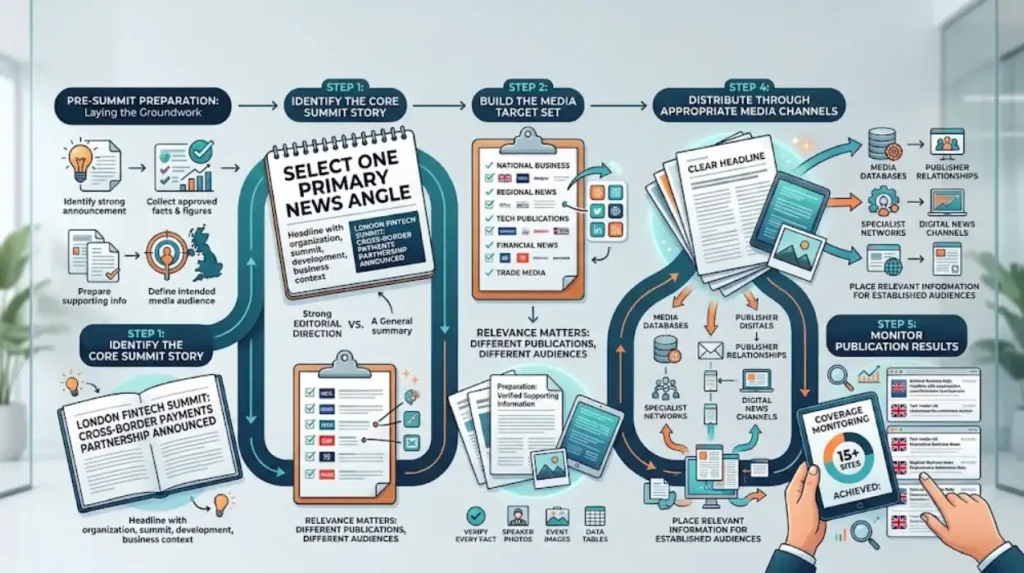
The process starts before the summit. Organisers identify the strongest announcement, collect approved facts, prepare supporting information, and define the intended media audience.
The resulting content then moves through a distribution process designed around publication suitability.
Step 1: Identify the core summit story
The first step is selecting one primary news angle.
A release titled around a specific development provides stronger editorial direction than a general event summary. The headline needs to identify the organisation, summit, development, and relevant business context.
For example, a London fintech summit announcing a cross-border payments partnership has a defined news angle. The story can then connect the partnership with payments, financial technology, and UK business activity.
Step 2: Build the media target set
The next stage involves identifying 15 appropriate UK news destinations.
A targeted list can include national business publications, regional newspapers, technology publications, financial news platforms, and industry-specific trade media.
Relevance matters because different publications serve different audiences. A construction summit fits construction and property publications. A financial technology summit fits fintech and business media.
Step 3: Prepare publication-ready content
The content needs a clear headline, concise introduction, factual body copy, quotations, company information, event details, and contact information.
Supporting assets also contribute to coverage. Examples include speaker photographs, event images, research documents, company logos, and data tables.
Every factual element needs verification before distribution. Names, job titles, dates, locations, statistics, and quotations require consistency across the complete release.
Step 4: Distribute through appropriate media channels
Distribution connects the prepared story with selected publications.
A professional distribution approach uses established media databases, publisher relationships, specialist networks, and digital news channels. The precise combination depends on the subject and target audience.
The purpose is not simply to send identical information everywhere. The purpose is to place relevant information where its subject has an established editorial audience.
Step 5: Monitor publication results
After distribution, coverage monitoring identifies which publications have published the story.
Monitoring records publication URLs, headlines, publication dates, article formats, and relevant media categories. These records establish whether the campaign achieved its intended 15-site coverage target.
Which components determine successful 15-site summit coverage?
Successful 15-site summit coverage depends on news value, accurate content, media relevance, distribution quality, timing, editorial fit, and monitoring. These components work together to create consistent coverage across multiple UK publications without weakening the original story.
Each component serves a different function in the distribution process.
News value
News value provides the foundation. A release needs a concrete development that gives publishers a reason to publish.
Media relevance
Media relevance connects the story with the correct audience. A specialist publication provides stronger contextual relevance for an industry-specific announcement than an unrelated general-interest outlet.
Content accuracy
Accuracy protects the integrity of the coverage. Incorrect statistics, names, dates, quotations, or corporate information create avoidable editorial problems.
Distribution quality
Distribution quality determines how efficiently the story reaches selected media channels. A structured media network provides broader access than an unsegmented contact list.
Timing
Timing affects visibility. Summit announcements need distribution around the event’s key news moments.
Important timing points include:
- Before the summit for speaker and agenda announcements.
- During the summit for breaking developments.
- Immediately after the summit for outcomes and announcements.
- Following the event for research, partnerships, and executive commentary.
Monitoring
Monitoring confirms publication outcomes. It also creates a documented coverage record for internal reporting, stakeholder communication, and future campaign planning.
Why does media relevance matter when targeting 15 UK news sites?
Media relevance matters because each publication serves a defined readership, editorial focus, and geographic market. Matching summit content with appropriate publications increases contextual value and creates a more coherent distribution strategy across the 15 selected UK news sites.
A 15-site campaign does not require 15 identical publication types.
A strong media mix reflects the summit’s subject.
For example, a UK property summit can target:
- Business news publications.
- Property publications.
- Construction publications.
- Regional business media.
- Real estate trade outlets.
A Manchester-based technology summit also has a geographic dimension. Regional business media can cover local economic impact, while technology publications focus on innovation.
This creates multiple editorial contexts around the same underlying event.
How does SEO support B2B summit news coverage?
SEO supports B2B summit coverage by making published stories easier to discover through relevant search queries. Consistent entities, descriptive headlines, contextual terminology, and accurate event information strengthen the searchable relationship between the summit and its coverage.
Search visibility depends on clear information architecture and semantic relevance.
A summit article can naturally include entities such as the event name, organiser, location, industry, speakers, participating companies, and announced developments.
Which SEO elements matter most?
Important elements include:
- Descriptive headlines.
- Relevant event terminology.
- Named companies and speakers.
- Geographic references.
- Industry-specific terminology.
- Accurate publication dates.
- Contextual internal and external references.
- Consistent organisation names.
The objective is not keyword repetition. The objective is clear topical identification.
For example, an article about a Birmingham fintech summit can establish relationships between the event, Birmingham, financial technology, payments, participating companies, and the UK financial sector.
This contextual structure helps search systems interpret the article’s subject.
How does 15-site coverage differ from single-publication coverage?
Fifteen-site coverage creates a wider media footprint than a single publication because the same verified summit development appears across multiple audiences, domains, geographic contexts, and industry environments, producing broader discoverability and stronger documentation of event activity.
Single-publication coverage creates one media reference point. Multi-site coverage creates a broader publication footprint.
The difference involves both reach and context.
A single business publication can reach a valuable audience. Fifteen relevant publications create additional opportunities for discovery across different readerships.
The coverage also creates multiple searchable references to the summit. Each article establishes another digital location containing information about the event.
However, publication count alone does not determine quality. A relevant 15-site campaign has greater strategic value than indiscriminate placement across unrelated websites.
Which B2B summits benefit from 15-site news coverage?
B2B summits with substantial announcements, industry participation, executive speakers, research findings, partnerships, or regional economic relevance benefit most from structured multi-site coverage because these characteristics create multiple editorial angles for UK media.
Several summit categories have clear coverage opportunities.
Financial services summits
Financial services events can generate stories around regulation, payments, banking technology, investment, and market infrastructure.
Technology summits
Technology events commonly produce announcements involving artificial intelligence, cybersecurity, cloud computing, enterprise software, and digital transformation.
Healthcare and pharmaceutical summits
Healthcare events can focus on research, innovation, clinical technology, healthcare systems, and industry partnerships, subject to applicable regulatory and editorial requirements.
Property and construction summits
These events generate regional and sector-specific stories involving investment, development, infrastructure, sustainability, and construction activity.
Manufacturing and energy summits
Manufacturing and energy events can provide coverage around industrial investment, supply chains, technology, sustainability, and operational transformation.
How can organisations evaluate a 15-site coverage strategy?
Organisations can evaluate a 15-site coverage strategy by measuring publication count, media relevance, geographic distribution, industry alignment, article quality, search visibility, referral activity, and consistency between the original summit announcement and published coverage.
A coverage report provides the clearest evaluation framework.
Useful metrics include:
| Metric | What it measures |
|---|---|
| Publication count | Number of confirmed media placements |
| Media relevance | Alignment between publication and summit topic |
| Geographic coverage | Distribution across UK markets |
| Industry coverage | Presence in relevant specialist publications |
| Publication timing | Speed between announcement and publication |
| Search visibility | Discoverability of published coverage |
| Referral activity | Traffic generated from media articles |
| Content consistency | Accuracy across published versions |
These measurements separate distribution volume from distribution quality.
For example, 15 published articles across business, fintech, technology, and regional publications provide stronger evidence of targeted coverage than 15 placements with no relationship to the summit’s subject.
What is the role of professional B2B summit distribution in 2026?
Professional B2B summit distribution provides a structured route from event announcement to targeted UK media publication. It combines content preparation, audience selection, media targeting, distribution management, and coverage monitoring within one coordinated process.
The role is operational rather than purely promotional.
A distribution provider or internal communications team manages the sequence of activities required to move a story from approved content to published coverage.
The appropriate model depends on organisational resources, media requirements, campaign frequency, and reporting expectations.
What should organisations compare between distribution options?
Organisations can compare:
- UK media reach.
- Number and type of target publications.
- Industry-specific media access.
- Regional targeting.
- Content support.
- Publication monitoring.
- Reporting detail.
- Turnaround times.
- Editorial requirements.
- Coverage verification.
This comparison creates a practical framework for selecting a distribution approach without treating publication volume as the only criterion.
How does B2B summit coverage support a wider media strategy?
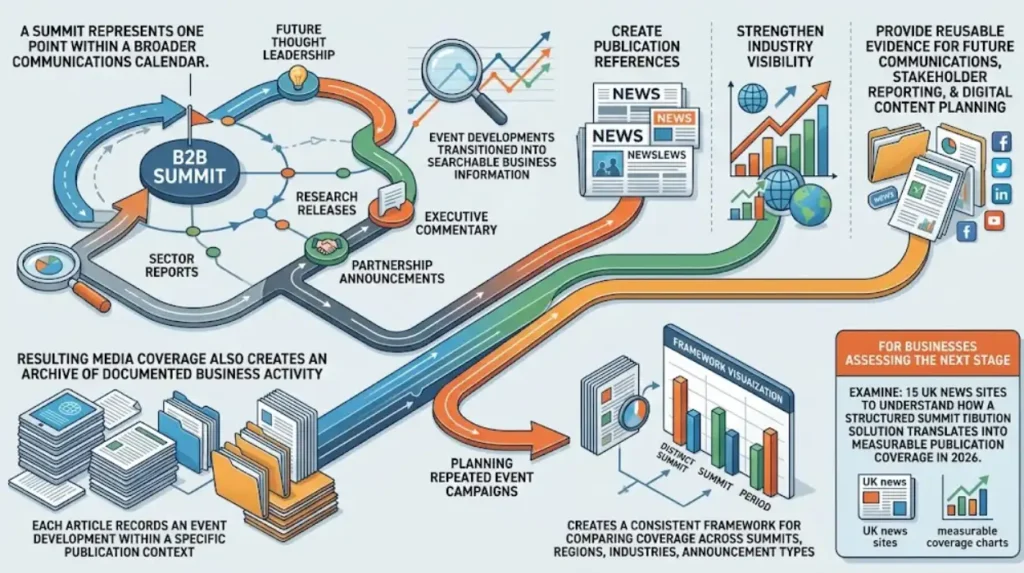
B2B summit coverage supports a wider media strategy by turning event developments into searchable business information, creating publication references, strengthening industry visibility, and providing reusable evidence for future communications, stakeholder reporting, and digital content planning.
A summit represents one point within a broader communications calendar.
Its announcements can connect with future thought leadership, research releases, executive commentary, partnership announcements, and sector reports.
The resulting media coverage also creates an archive of documented business activity. Each article records an event development within a specific publication context.
For organisations planning repeated event campaigns, this creates a consistent framework for comparing coverage across different summits, regions, industries, and announcement types.
Businesses assessing the next stage can examine:
15 UK news sites to understand how a structured summit distribution solution translates into measurable publication coverage in 2026.
What is the key takeaway from 15-site B2B summit coverage?
B2B summit coverage reaches 15 UK news sites through a defined process that connects newsworthy event developments with relevant media audiences. Content accuracy, editorial relevance, targeted distribution, timing, SEO structure, and monitoring determine the quality of the final coverage.
The 15-site model is therefore a distribution framework rather than a simple publication target.
The process begins with a newsworthy summit development. It continues through content preparation, media selection, targeted distribution, publication monitoring, and performance evaluation.
Explore More Expert Insights:
How Pharma Event Coverage Meets UK Regulatory Standards
What a Full Event Coverage Package Includes Across 15 Sites
For UK B2B organisations, this approach creates a measurable structure for extending summit announcements beyond attendees and event channels.
In 2026, effective summit coverage combines news value, media relevance, distribution discipline, search visibility, and verified publication results. These elements provide the foundation for a consistent multi-site B2B media strategy.



