

B2B summits generate announcements, expert insights, executive commentary, partnerships, product developments, and industry discussions. News coverage converts these event outcomes into published media assets that extend visibility beyond the summit venue.
In 2026, B2B summit coverage on 15 UK news sites provides a structured route for reaching business audiences across national, regional, trade, and specialist publications. The approach combines editorial content, targeted distribution, search visibility, and measurable media placement.
For organisations evaluating a UK media distribution service, the key issue is not simply whether an event receives coverage. The decision depends on publication quality, distribution reach, content accuracy, timing, reporting, and relevance to the target audience.
Businesses planning their media strategy can first understand the wider mechanics behind:
B2B summit coverage before assessing a specific distribution approach.
What does B2B summit coverage on 15 UK news sites mean?
B2B summit coverage on 15 UK news sites means distributing a professionally prepared summit story across 15 relevant UK publications, creating multiple media placements that extend event visibility, communicate business developments, and provide measurable digital coverage after the event.
The term describes a defined media outcome rather than general event promotion. A summit organiser, sponsor, speaker, exhibitor, or participating company provides newsworthy information. That information becomes an editorial-style press release or news article.
The content then enters a targeted UK distribution network. The objective is to secure publication across 15 news websites that serve business, technology, finance, professional, regional, or industry audiences.
A 15-site campaign also creates a measurable media footprint. Each placement provides a published URL, publication name, publication date, headline, and coverage record.
What makes the 15-site model different?
The model uses multiple publications instead of relying on one media outlet. This creates broader exposure across distinct digital audiences.
For example, a London fintech summit can generate coverage across business news, technology publications, finance media, and relevant regional outlets. A construction summit can target property, infrastructure, construction, and regional business publications.
The publication mix remains important. Fifteen low-relevance websites do not provide the same value as 15 relevant UK publications with established audiences and editorial standards.
How does a B2B summit reach 15 UK news sites?
A B2B summit reaches 15 UK news sites through a structured process covering story development, editorial preparation, media targeting, distribution, publication monitoring, and reporting, with each stage designed to maintain accuracy, relevance, consistency, and measurable coverage.
The process begins before distribution. The event team identifies the strongest news angle and gathers verified information.
1. Identify the news angle
A summit needs a specific story. Suitable angles include:
- A major industry announcement
- A new partnership
- Executive appointments
- Research findings
- Investment announcements
- Technology launches
- Policy discussions
- Market forecasts
- Sustainability initiatives
- Strategic collaborations
For example, a UK cybersecurity summit announcing a new industry partnership has a stronger media angle than a generic statement that the event was successful.
2. Prepare the media content
The release establishes the event name, date, location, organisers, speakers, key announcements, supporting facts, and relevant quotations.
The headline communicates the main development. The opening paragraph answers the core news questions. Supporting sections provide context and evidence.
3. Select relevant publications
Distribution focuses on publications aligned with the summit’s subject and audience.
A healthcare summit requires different media targets from a property investment summit. The same principle applies to fintech, manufacturing, technology, professional services, energy, and infrastructure events.
4. Distribute and monitor
The completed release enters the selected UK media network. Publication monitoring identifies live placements.
The final report records the websites that published the story and provides the relevant coverage details.
What should a 15-site B2B summit coverage package include?
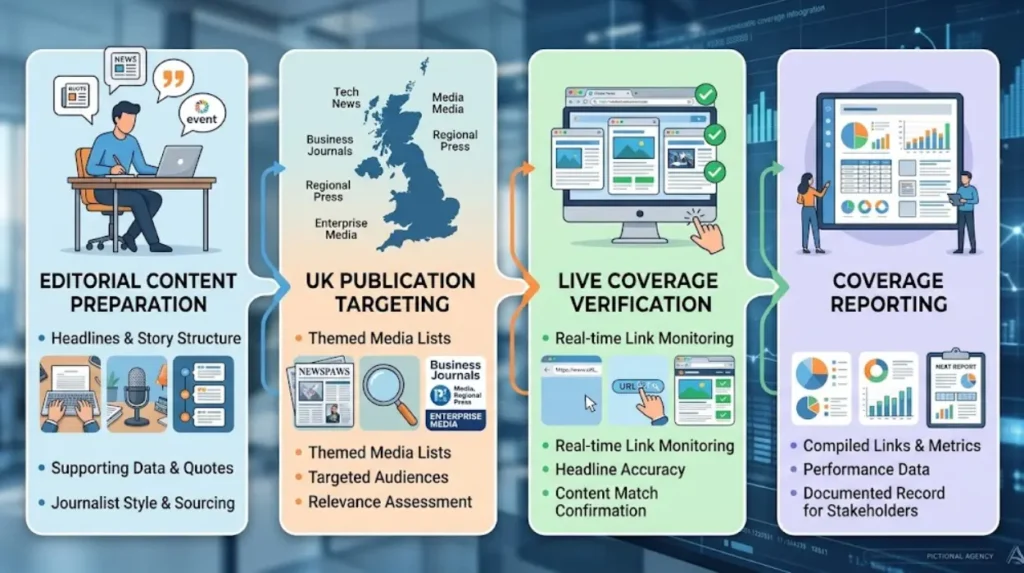
A complete 15-site B2B summit coverage package includes editorial content preparation, UK media distribution, publication targeting, live-link monitoring, placement verification, and coverage reporting, giving event organisers a documented record of where their summit story appeared across digital news publications.
A decision-ready service requires more than a distribution promise. Buyers need to understand exactly what the package contains.
Editorial content preparation
Content preparation establishes the factual foundation of the campaign. It includes headline development, structure, quotations, event details, and supporting information.
The copy needs to follow journalistic conventions. Promotional claims require careful wording. Statistics require accurate sourcing.
UK publication targeting
The media list determines the campaign’s relevance. A strong distribution strategy separates publications by subject and audience.
For example, a B2B technology summit can target technology news, enterprise technology, startup, business, and regional publications.
Live coverage verification
Published placements need verification. A live URL confirms that the article or release is accessible online.
Verification also establishes whether the final published headline and content match the distributed material.
Coverage reporting
A useful report records publication names, URLs, publication dates, headlines, and other available performance information.
This documentation gives marketing teams evidence for internal reporting and future media planning.
Why does B2B summit coverage matter after the event?
B2B summit coverage extends the commercial and informational life of an event by turning event developments into searchable media content, supporting brand visibility, executive positioning, stakeholder communication, referral traffic, and a documented record of industry participation.
A summit ends when the event programme closes. Its news value continues when important developments are published online.
Coverage creates a digital record of announcements and discussions. Search engines can index published pages. Prospects researching the organisation can encounter the coverage after the event.
Search visibility
Published news pages create additional indexed references to the organisation, event, executives, products, and industry topics.
For example, a manufacturing summit featuring an automation announcement can create coverage containing relevant terms such as industrial automation, manufacturing technology, UK manufacturing, and digital transformation.
Executive visibility
Speaker quotations give executives a documented media presence. The content connects the individual with a specific business topic and event.
This supports executive communication strategies when coverage is accurate, relevant, and distributed through credible publications.
Stakeholder communication
Partners, investors, customers, employees, and prospects receive evidence that the organisation participated in a significant industry event.
Published coverage also provides reusable media assets for corporate communications, event reports, newsletters, and social media.
How does 15-site coverage support SEO and AI search visibility?
Fifteen published news placements create multiple online references to an organisation, summit, executive, and announcement, supporting discoverability through indexed content, consistent entity information, contextual mentions, and broader digital evidence surrounding the event.
SEO value depends on the quality and relevance of the published content. Distribution alone does not guarantee rankings.
The strongest coverage maintains consistent entity information across publications. This includes the organisation’s name, event name, executive names, location, industry terminology, and factual announcement details.
Entity consistency
Entity consistency helps search systems associate related references with the same organisation or event.
For example, a summit organiser appearing consistently with its official name, event title, location, and executive spokesperson creates a clearer digital information pattern.
Contextual relevance
Relevant publications provide contextual signals around the subject. A fintech summit covered by finance and technology publications creates stronger topical alignment than coverage on unrelated websites.
AI search discovery
AI-powered search systems use information from digital sources when generating answers. Consistent, factual media coverage increases the number of published references available around an entity and topic.
This does not mean every placement becomes an AI citation. The objective is to build a stronger and more complete digital information footprint.
What types of B2B summits benefit from 15 UK news placements?
B2B summits with a clear business development, industry, technology, investment, policy, or leadership angle benefit from targeted UK news coverage because their announcements connect directly with defined professional audiences and searchable industry topics.
Different summit categories require different publication strategies.
Technology and fintech summits
Technology events produce stories around artificial intelligence, cybersecurity, software, payments, financial technology, cloud infrastructure, and digital transformation.
Healthcare and pharmaceutical summits
Healthcare events focus on research, innovation, healthcare technology, professional collaboration, investment, and policy developments. Content requires accurate terminology and careful treatment of regulated claims.
Property and construction summits
These events generate stories around development, infrastructure, investment, planning, sustainability, construction technology, and the UK property market.
Energy and sustainability summits
Energy events provide angles around renewable energy, energy efficiency, infrastructure, environmental initiatives, and corporate sustainability.
Professional services summits
Legal, financial, consulting, procurement, and business leadership summits provide opportunities for expert commentary, market analysis, partnerships, and strategic announcements.
How can businesses evaluate a 15-site UK news coverage service?
Businesses evaluating a 15-site UK news coverage service need to assess publication relevance, confirmed distribution scope, editorial standards, content support, placement verification, reporting quality, turnaround time, and alignment between media audiences and the summit’s commercial objectives.
The purchase decision needs measurable criteria.
Check the publication scope
Ask for clarity about the 15 sites included in the service. Confirm whether the sites represent UK audiences and relevant industry categories.
Check editorial requirements
Understand how content is reviewed and whether the provider supports factual, editorially structured copy.
Check placement verification
Confirm that the service provides live URLs for published coverage. A publication list without verifiable links provides limited evidence of delivery.
Check reporting
The final report needs to identify completed placements clearly. It also needs to distinguish confirmed coverage from distribution or submission.
Check timing
Summit coverage needs coordination with the event schedule. Pre-event announcements, live-event developments, and post-event stories require different publication timing.
When should a B2B summit use 15-site UK news distribution?
A B2B summit should use 15-site UK news distribution when it has a defined news angle, a clear target audience, verified event information, and a measurable requirement for wider media exposure beyond attendees, speakers, partners, and existing communication channels.
Timing affects the campaign structure.
Before the summit
Pre-event coverage can establish awareness of the event, speakers, agenda, partnerships, and expected announcements.
During the summit
Live developments provide immediate news angles. These include keynote announcements, partnership agreements, research findings, and executive statements.
After the summit
Post-event coverage documents outcomes and gives the organisation a longer-lasting digital media asset.
A post-event campaign works particularly well when the summit produces a specific announcement rather than simply reporting attendance.
What results can businesses expect from 15 UK news placements?
A 15-site campaign delivers a defined media footprint consisting of published coverage across selected UK news websites, creating measurable digital assets that support visibility, stakeholder communication, search discovery, executive positioning, and post-event marketing activity.
The primary measurable output is confirmed publication.
Additional outcomes depend on publication quality, audience relevance, content strength, search indexing, and the organisation’s wider marketing strategy.
Useful campaign metrics include:
- Number of confirmed publications
- Number of live URLs
- Publication dates
- Publication categories
- Potential audience indicators
- Referral traffic where available
- Search visibility for relevant queries
- Engagement with associated marketing assets
These metrics provide a practical basis for comparing campaigns and planning future summit communications.
Is 15-site B2B summit coverage worth buying in 2026?
Fifteen-site B2B summit coverage provides a defined media distribution solution when the campaign targets relevant UK publications, delivers verified placements, uses accurate editorial content, and supports measurable business communication objectives beyond the physical summit itself.
The buying decision depends on the summit’s objectives.
An organisation seeking broad UK visibility needs a publication mix that reflects its industry and audience. An organisation seeking specialist exposure needs tighter trade-media targeting.
The service also needs clear delivery terms. Buyers need confirmation of the number of targeted sites, reporting method, content requirements, expected workflow, and verification process.
A 15-site campaign therefore works as a defined media asset rather than an undefined publicity activity.
For organisations comparing distribution approaches, B2B summit coverage provides the relevant framework for understanding how multi-site media distribution operates. A decision-focused service evaluation can then assess whether a 15-site UK campaign matches the event’s audience, announcement, timing, and reporting requirements.
Explore More Expert Insights:
Pharma Event News Coverage Across 15 Compliant UK Sites
Why Times Intelligence Beats UK Event Coverage Competitors in 2026
How should a business prepare its B2B summit for media distribution?
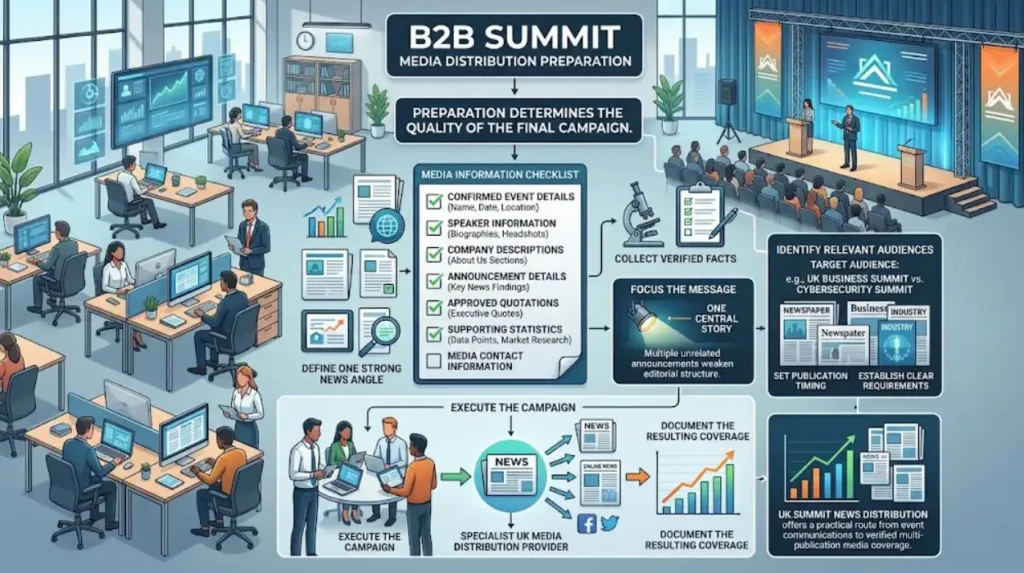
Businesses prepare a B2B summit for media distribution by defining one strong news angle, collecting verified facts, preparing executive quotations, identifying relevant UK audiences, setting publication timing, and establishing clear reporting requirements before distribution begins.
Preparation determines the quality of the final campaign.
The organisation needs a confirmed event name, date, location, speaker information, company descriptions, announcement details, approved quotations, supporting statistics, and media contact information.
The final release needs one central story. Multiple unrelated announcements weaken the editorial structure.
The distribution brief also needs a clear audience. A UK-wide business summit and a specialist cybersecurity summit require different publication targets.
Once the content, audience, timing, and publication requirements are established, a specialist UK media distribution provider can execute the campaign and document the resulting coverage.
For businesses assessing the next stage,
UK summit news distribution offers a practical route from event communications to verified multi-publication media coverage.



