
Leeds is one of the UK’s major centres for business, culture, education, sport and entertainment. Events held across the city generate information with local relevance and wider national interest. Reaching 15 UK news websites involves identifying news value, preparing accurate information, matching editorial interests and distributing event stories across relevant publications.
Understanding this process helps event organisers, businesses, institutions and community groups recognise how Leeds event coverage develops from a local occurrence into broader UK news visibility.
What does Leeds event coverage mean?
Leeds event coverage is news reporting about conferences, exhibitions, festivals, awards, launches, business gatherings and public events held in Leeds. It explains what happened, who participated, why it matters and how the event connects with its audience.
Event coverage converts an event into an editorial story. The content focuses on verifiable details rather than promotional claims.
Common examples include:
- A technology conference at Leeds Beckett University.
- A business summit in Leeds city centre.
- A cultural festival at a major Leeds venue.
- A healthcare conference involving regional organisations.
- A sports event attracting national participation.
- An awards ceremony recognising Yorkshire businesses.
The subject determines the potential audience. A local community event has strong Leeds relevance. A national industry conference has wider UK relevance. Both require clear news angles.
Why can a Leeds event attract attention from UK news websites?
A Leeds event attracts UK news attention when it contains a clear news angle, identifiable participants, timely developments, useful statistics or wider relevance. Strong stories connect the event with business, culture, technology, society, sport or another recognised national topic.
Location provides the first layer of relevance. Leeds is a major UK city with established business, cultural, academic and professional communities.
The second layer comes from the event itself. A conference announcing a major industry development has stronger editorial relevance than an event containing only routine attendance information.
The third layer comes from participants. Recognised executives, academics, public figures, organisations and subject specialists create identifiable news entities.
The fourth layer comes from outcomes. Announcements, awards, research findings, partnerships and policy discussions provide specific information for journalists and readers.
For example, a Leeds technology event announcing new research has a stronger national news angle than a general networking evening without a defined announcement.
How does an event story move from Leeds to 15 UK news websites?
A Leeds event story reaches 15 UK news websites through a structured editorial process involving news-angle development, factual preparation, publication targeting, distribution, editorial review and online publication. Each stage determines whether the story fits a publication’s audience.
1. Identify the news angle
The process starts with the central event development. The strongest angle answers a simple question: what happened that readers need to know?
Possible angles include a new business announcement, significant award, research result, major appointment, public initiative or industry development.
2. Build the factual story
The article requires accurate names, dates, locations, event details, quotations and supporting information.
A clear structure helps journalists understand the story quickly. The opening paragraph establishes the main development. Supporting paragraphs provide context and evidence.
3. Identify suitable publications
Fifteen UK news websites do not represent one identical audience. Publications have different editorial priorities.
A Leeds business event fits business publications. A university research conference fits education or science coverage. A cultural festival fits arts and entertainment publications.
4. Submit the story
The prepared article or news release enters the relevant editorial channels. Publication decisions depend on relevance, accuracy, timing and editorial standards.
5. Track published coverage
Once stories appear online, coverage can be monitored across the selected websites. Published URLs, headlines, dates and publication names provide a record of the event’s media presence.
Readers interested in how this regional and national approach works can explore:
Regional and national news coverage.
What types of Leeds events receive UK news coverage?
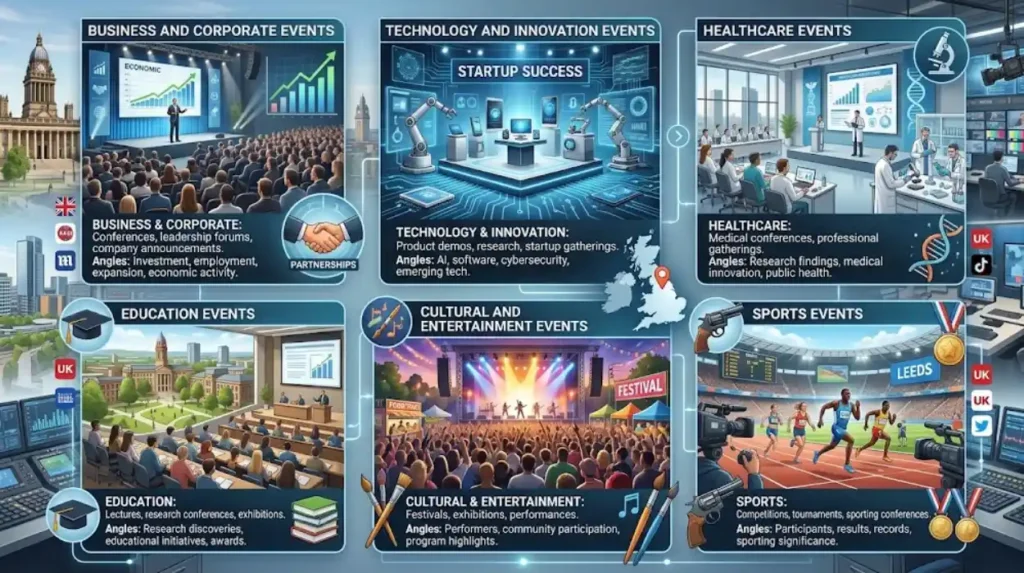
Leeds events span business, technology, healthcare, education, culture, sport, property, finance, charity and professional sectors. Each category creates distinct editorial angles based on participants, announcements, audience relevance, locations, outcomes and measurable developments.
Business and corporate events
Business events include conferences, leadership forums, networking programmes and company announcements. Their strongest angles often involve investment, employment, expansion, partnerships and economic activity.
Technology and innovation events
Technology events include product demonstrations, research conferences, startup gatherings and innovation showcases. Stories often focus on artificial intelligence, software, cybersecurity, data and emerging technologies.
Healthcare events
Healthcare conferences and professional gatherings generate stories involving research, medical innovation, public health, healthcare delivery and professional development.
Education events
Universities, colleges and training organisations host lectures, conferences, exhibitions and research events. Relevant stories include research findings, educational initiatives, awards and institutional developments.
Cultural and entertainment events
Leeds hosts festivals, exhibitions, performances and cultural programmes. Coverage focuses on performers, artists, programmes, attendance, community participation and significant announcements.
Sports events
Sports competitions, tournaments and sporting conferences generate coverage through participants, results, records, venues and wider sporting significance.
How do local and national news websites differ?
Local news websites prioritise Leeds, Yorkshire and nearby communities, while national publications focus on developments with wider UK relevance. A strong event story connects local facts with broader themes that interest audiences beyond Leeds.
Local publications examine community impact, nearby businesses, venues and regional participation.
National publications focus on issues that extend beyond the city. These include economic developments, technology announcements, major appointments, research findings, industry trends and nationally relevant initiatives.
This distinction affects story construction.
A Leeds property conference can contain local information about the city’s development market. It also contains national relevance when speakers discuss UK construction trends, investment conditions or housing policy.
This creates two connected editorial perspectives. One explains why the event matters in Leeds. The other explains why its subject matters across the United Kingdom.
The combination strengthens the overall information structure of event coverage.
What information makes a Leeds event story newsworthy?
Newsworthy event coverage contains specific information about the event, participants, announcements, outcomes and wider significance. Accurate details create an editorial foundation that helps journalists assess relevance and gives readers enough context to understand the development.
Important information includes:
- Event name.
- Date and location.
- Organising body.
- Main speakers or participants.
- Primary topic.
- Significant announcement.
- Supporting statistics.
- Relevant quotations.
- Event outcomes.
- Industry or community context.
Specificity improves clarity.
For example, “Leeds hosted a major business event” provides limited information. “A Leeds conference brought together 300 technology professionals to discuss artificial intelligence adoption in UK businesses” establishes subject, location, audience and scale.
Statistics also strengthen factual reporting. Attendance figures, research results, funding values and project numbers provide measurable information.
Quotes provide direct statements from relevant participants. They also identify the source of an announcement or viewpoint.
How does timing affect Leeds event coverage?
Timing affects event coverage because news websites prioritise current information. Publishing close to an event keeps announcements relevant, supports timely reporting and gives readers immediate access to confirmed developments, results, statements and event outcomes.
Pre-event information can establish what is scheduled. It focuses on speakers, programme details, expected announcements and event purpose.
During-event information captures active developments. It includes speeches, awards, announcements and notable participation.
Post-event coverage records confirmed outcomes. It provides results, quotations, attendance figures and completed activities.
Different events require different timing.
A business announcement requires rapid publication after confirmation. An awards ceremony benefits from timely reporting of winners. A conference report requires accurate post-event information.
The principle remains consistent: event coverage performs best when the information is current and factually complete.
How do 15 UK news websites create broader visibility for a Leeds event?
Coverage across 15 UK news websites creates multiple editorial entry points for one Leeds event. Different publications expose the story to distinct audiences, locations and subject communities while preserving the central facts and event identity.
A multi-publication approach separates audience reach into several categories.
Local readers encounter the Leeds connection. Yorkshire audiences gain regional context. Business readers find industry developments. Technology audiences find innovation stories. National readers encounter broader UK relevance.
The same event therefore supports multiple discovery paths.
For example, a Leeds fintech conference can interest local business readers, financial professionals, technology audiences and national business readers. Its core facts remain consistent while its editorial relevance differs by publication.
This structure also increases the number of places where readers encounter the event online.
Readers looking at the next stage of event media planning can explore:
What are the benefits of UK news coverage for Leeds events?
UK news coverage gives Leeds events a documented media presence, expands audience access, records important developments and connects local activity with national topics. Published coverage also creates searchable references that preserve event information after the event finishes.
Wider audience access
Coverage reaches people who did not attend the event. News websites provide an additional information channel beyond physical attendance.
Editorial credibility
Independent publication creates a formal record of the event. Readers can access information through established news environments.
Search visibility
Published articles create indexed web pages containing event names, participants, topics and locations. These pages help people searching for related information discover the event.
Long-term reference value
Event coverage remains accessible after the event. Future readers can use published stories to understand what happened, who participated and what outcomes emerged.
Regional-to-national positioning
Coverage connects Leeds activity with broader UK conversations. This relationship is important for events involving industries, institutions and organisations operating beyond Yorkshire.
Which Leeds events benefit from multi-publication coverage?
Events with clear news angles, measurable outcomes, recognised participants or wider subject relevance benefit most from coverage across multiple UK news websites. Examples include conferences, awards, business launches, research events, festivals and major sporting programmes.
A Leeds conference with a national industry theme has strong multi-audience relevance.
An awards ceremony creates identifiable winners and achievements.
A research event creates findings and expert commentary.
A business launch creates information about products, investment, employment or expansion.
A cultural festival creates stories around performers, programmes, attendance and community participation.
A sports event creates results, participants and competitive outcomes.
These examples demonstrate an important principle: the event itself does not automatically create news coverage. The editorial value comes from the information surrounding the event.
How can readers understand the full Leeds event coverage process?
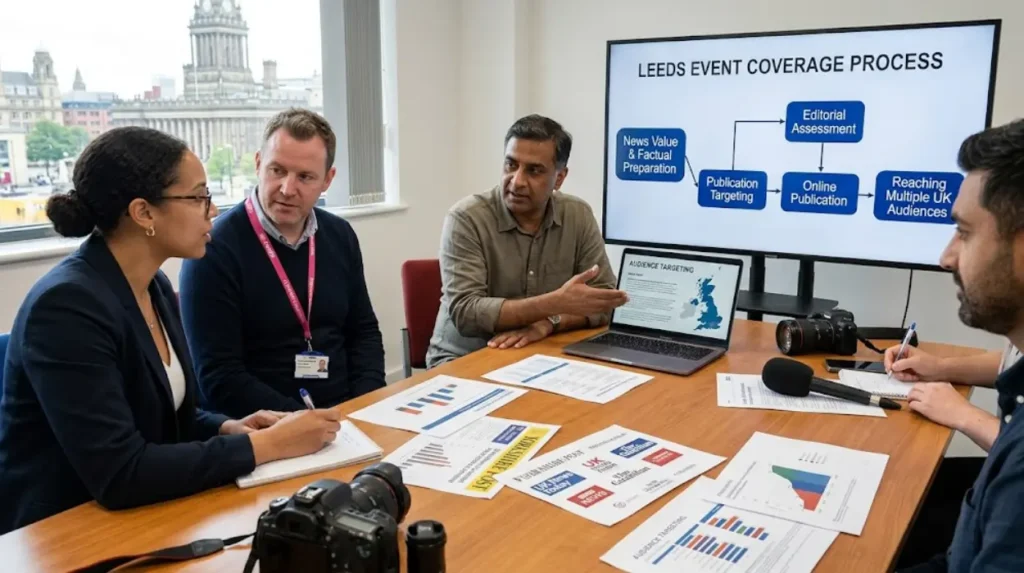
The Leeds event coverage process begins with news value and factual preparation, then moves through publication targeting, editorial assessment and online publication. Understanding each stage explains how one local event becomes a story for multiple UK audiences.
The process can be summarised as:
- Identify the event’s strongest news angle.
- Confirm the essential facts.
- Define the relevant audience.
- Develop an accurate news story.
- Match the story with suitable UK publications.
- Submit the story through appropriate editorial channels.
- Monitor published coverage.
- Record publication details and URLs.
- Assess the regional and national audience reached.
- Preserve the coverage as a lasting online record.
Leeds events operate within a wider UK media environment. Their coverage depends on news value, editorial relevance, factual quality and audience fit.
Explore More Expert Insights:
Why Award Ceremonies Need National News Coverage in 2026
How AI Is Reshaping UK Event News Coverage in 2026
A local event becomes nationally relevant when its subject connects with issues, industries or developments that matter beyond Leeds. Fifteen UK news websites provide multiple editorial environments for presenting those connections.
Understanding this process gives event organisers and readers a clearer view of how Leeds events move from physical gatherings into searchable UK news coverage.



