Award ceremony coverage on 15 UK news sites is a coordinated media distribution strategy that places one award announcement across 15 relevant UK publications, increasing national visibility, search presence, credibility, and accessible coverage for winners, organisers, sponsors, and brands.
Award ceremony coverage turns an event result into published news. It focuses on verified winners, award categories, event details, judges, organisers, and business relevance.
A 15-publication campaign creates multiple opportunities for an announcement to appear across the UK media landscape. Coverage can include business publications, regional news outlets, industry publications, lifestyle media, and other relevant editorial channels.
The objective is not simply to publish a press release. The objective is to distribute a structured news story through suitable publications and create a measurable record of media exposure.
For organisations investing in event publicity, this approach provides a defined distribution target. It also creates a clearer basis for evaluating media performance.
Businesses evaluating the mechanics behind this model can first review:
Award ceremony coverage reaches 15 UK publications to understand how distribution works before selecting a coverage service.
How does a 15-site award ceremony coverage campaign work?
A 15-site campaign starts with a newsworthy award story, develops an editorially structured release, selects relevant UK publications, distributes the announcement, monitors publication results, and reports the resulting coverage across the selected media network.
1. Identify the award announcement
The campaign begins with the core news event.
Examples include:
- A company winning a national business award
- A founder receiving an industry leadership award
- A charity receiving recognition for social impact
- A technology company winning an innovation award
- A professional receiving a lifetime achievement award
- A local business winning a regional award
The announcement needs factual detail. The release identifies the award name, winner, category, event date, location, organiser, and reason for recognition.
2. Build the media release
The release converts event information into a publishable news format.
A strong award announcement normally includes the winner in the headline, the award category in the opening paragraph, supporting details about the event, a quotation, and relevant company information.
This structure gives journalists and publishers a clear explanation of what happened and why the announcement has news value.
3. Select 15 UK publications
Publication selection determines the relevance of the campaign.
A targeted list can include business media, regional publications, technology outlets, professional trade media, and specialist publications.
For example, a fintech award announcement requires a different publication mix from a property award or healthcare award. Sector relevance improves contextual fit.
4. Distribute and monitor
The completed release enters the selected distribution network. Published URLs, publication names, dates, and other available performance information are then recorded.
The result is a measurable coverage set rather than an untracked publicity effort.
What does an award ceremony coverage service include?
An award ceremony coverage service typically combines press release preparation, UK media targeting, distribution across selected publications, publication monitoring, coverage verification, and reporting so organisations can evaluate the reach generated by their award announcement.
Press release preparation
The service starts with the announcement itself. Information is organised into a media-ready format.
The content needs accurate names, award categories, dates, quotations, organisation details, and supporting facts.
UK publication targeting
Targeting determines where the announcement is distributed.
A 15-site campaign needs a defined publication list or network. Each outlet needs relevance to the announcement, its sector, its audience, or its geographic significance.
For example, a Manchester-based property award has stronger contextual relevance when property, business, construction, and Manchester-focused publications form part of the distribution strategy.
Distribution
Distribution places the release in the selected media network.
The purpose is to generate published coverage rather than simply circulate an announcement internally.
Coverage monitoring
Monitoring confirms which publications have carried the announcement.
Each result can be recorded by publication, URL, publication date, headline, and relevant article details.
Reporting
Reporting converts media activity into an evidence-based result.
A useful report identifies the publications reached and provides direct links to the resulting articles. This gives marketing and communications teams a record they can retain for future campaigns.
Why do organisations use 15 UK publications for award announcements?
Organisations use 15 UK publications to expand the number of media environments carrying an award announcement, create broader evidence of recognition, improve online discoverability, and give stakeholders multiple published sources confirming the achievement.
One publication provides one media reference. Fifteen publications provide a wider coverage footprint.
This distinction matters for organisations using awards as part of reputation building. A published award announcement creates an external record that can be referenced in corporate communications, social media, presentations, websites, and stakeholder materials.
Greater publication diversity
Different publications reach different audiences.
A business publication reaches business readers. A regional publication reaches a geographic audience. A trade publication reaches professionals within a defined industry.
For example, a construction award can target construction media, regional business publications, property publications, and broader business outlets.
Stronger search visibility
Published articles create additional indexed references to the organisation and its award.
Search visibility depends on many factors, including content quality, relevance, authority, indexing, and competition. Media coverage provides additional public-facing content associated with the organisation and award.
More usable third-party references
Published coverage creates independent media references.
An organisation can use these references when communicating an achievement to customers, partners, employees, investors, or prospective clients.
How does award ceremony coverage support SEO and AI search visibility?
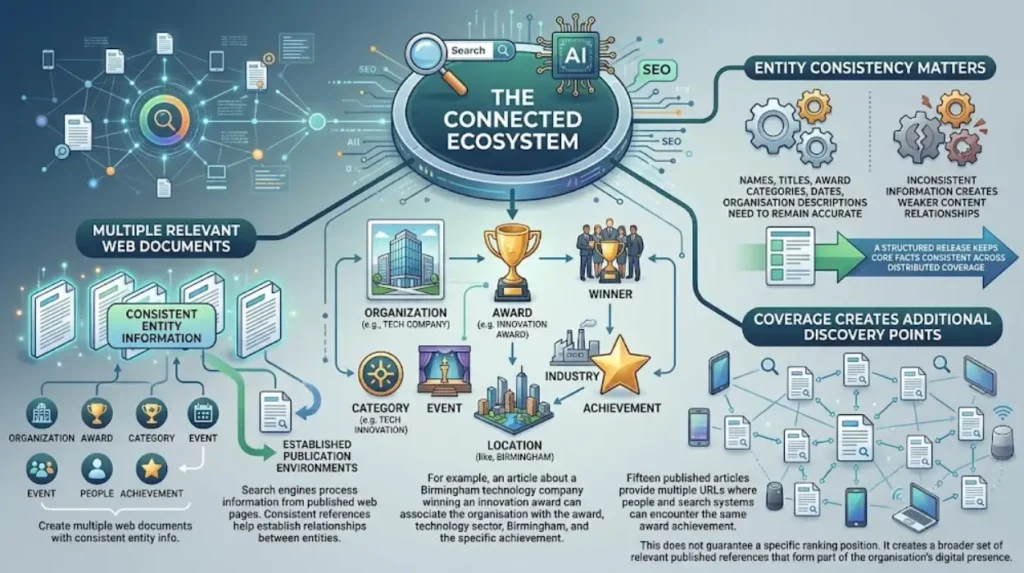
Award ceremony coverage supports SEO and AI search visibility by creating multiple relevant web documents containing consistent entity information about the organisation, award, category, event, people, and achievement across established publication environments.
Search engines process information from published web pages. Consistent references help establish relationships between entities.
An award article can connect:
- Organisation
- Award
- Winner
- Category
- Event
- Industry
- Location
- Achievement
For example, an article about a Birmingham technology company winning an innovation award can associate the organisation with the award, technology sector, Birmingham, and the specific achievement.
Entity consistency matters
Names, titles, award categories, dates, and organisation descriptions need to remain accurate.
Inconsistent information creates weaker content relationships. A structured release keeps core facts consistent across distributed coverage.
Coverage creates additional discovery points
Fifteen published articles provide multiple URLs where people and search systems can encounter the same award achievement.
This does not guarantee a specific ranking position. It creates a broader set of relevant published references that form part of the organisation’s digital presence.
What makes award ceremony coverage worth the investment?
Award ceremony coverage becomes commercially valuable when the resulting media exposure supports measurable objectives such as reputation building, brand visibility, stakeholder communication, search discovery, sales enablement, and long-term evidence of industry recognition.
The value depends on the organisation’s objective.
A startup can use coverage to establish credibility after winning an innovation award. A professional services company can use recognition to strengthen its market profile. A charity can use coverage to demonstrate external recognition of its work.
Reputation
Award coverage provides third-party publication references associated with an achievement.
Sales enablement
Published recognition can support sales conversations by giving prospects additional evidence about the organisation.
Brand communication
Marketing teams can reuse coverage across corporate channels.
Examples include:
- Company websites
- Social media posts
- Email campaigns
- Investor communications
- Award announcements
- Corporate presentations
- Sales materials
Long-term visibility
Published articles create a historical record of the achievement.
The coverage remains useful after the ceremony because the award becomes part of the organisation’s public profile.
Which organisations benefit most from 15-site award ceremony coverage?
Award ceremony coverage fits organisations that need documented media exposure for a specific achievement, including businesses, founders, charities, professional services firms, event organisers, technology companies, and industry leaders receiving recognised awards.
Businesses and SMEs
SMEs use award recognition to communicate growth, innovation, leadership, and sector achievements.
Founders and executives
Founder and leadership awards create personal visibility alongside corporate recognition.
A leadership award announcement can focus on the recipient’s role, achievement, organisation, and industry contribution.
Charities
Charities use award coverage to communicate recognition for community programmes, fundraising initiatives, inclusion work, or social impact.
Technology companies
Technology awards provide news angles around innovation, product development, artificial intelligence, cybersecurity, software, and digital transformation.
Professional services firms
Legal, accounting, consulting, recruitment, and financial services firms use industry recognition to communicate expertise and market standing.
How do you choose an award ceremony coverage provider?
Choose an award ceremony coverage provider by assessing publication relevance, confirmed distribution scope, editorial standards, reporting quality, turnaround times, pricing, campaign process, and evidence of published coverage rather than relying only on the promised number of media outlets.
Check the publication network
Ask for the types of UK publications included in the campaign.
A relevant 15-publication network provides greater value than a larger but poorly matched list.
Confirm what counts as coverage
Define whether the service counts only live published articles or also includes syndicated copies, feeds, directories, or distribution placements.
This distinction creates accurate campaign measurement.
Review reporting
A professional report identifies the publications carrying the story and provides usable evidence of publication.
Evaluate the workflow
The provider needs a clear process covering content submission, review, distribution, monitoring, and reporting.
Assess sector relevance
The publication mix needs to match the award.
A healthcare award requires different media targeting from a technology award, property award, education award, or financial services award.
What results can you expect from award ceremony coverage on 15 UK news sites?
A 15-site award ceremony campaign provides a defined media distribution target, published coverage opportunities, measurable publication results, reusable media references, and a broader digital footprint supporting the organisation’s award announcement across relevant UK audiences.
Results depend on the newsworthiness of the announcement, content quality, publication relevance, distribution network, and editorial acceptance.
The number 15 creates a measurable campaign framework. It allows organisations to compare planned distribution against confirmed published results.
A useful campaign report records:
- Target publications
- Published publications
- Article headlines
- Publication dates
- Live article URLs
- Coverage status
- Relevant audience or sector
- Campaign completion information
This information gives marketing teams a practical record of the campaign.
Explore More Expert Insights:
AI-Powered Event Coverage Across 15 UK News Sites 2026
DEI Event News Coverage Services Across 15 UK Sites
How can you get started with award ceremony coverage?
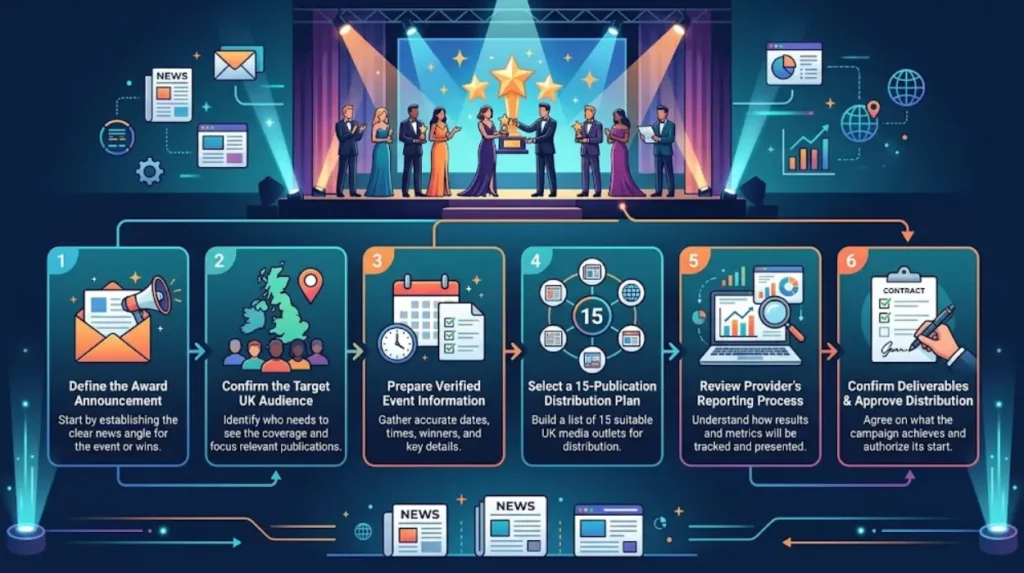
Start by defining the award announcement, confirming the target UK audience, preparing verified event information, selecting a 15-publication distribution plan, reviewing the provider’s reporting process, and confirming the campaign deliverables before approving distribution.
The first step is to establish the news angle.
The second step is to prepare accurate content. The third step is to identify the required publication profile. The fourth step is to confirm distribution and reporting terms.
For organisations ready to move from planning to execution,
Award ceremony coverage can provide the next decision point for selecting an appropriate coverage solution.
A 15-site campaign works best when every stage has a defined purpose. The announcement needs a clear news angle. The media network needs relevant UK publications. The distribution process needs measurable outputs. The final report needs verifiable publication evidence.
This approach turns an award ceremony from a single event into a structured media asset with measurable UK coverage.