Leeds event coverage is a media strategy that connects local relevance with wider UK visibility. It positions an event within Leeds news while distributing its strongest news angles to national publications and broader audiences.
Leeds event coverage focuses on events taking place in Leeds and the surrounding West Yorkshire area. Regional news provides geographic relevance. National news provides broader public visibility. Combining both creates a wider media footprint without removing the event’s local context.
Regional publications often focus on Leeds businesses, community developments, local leaders, venues and organisations. National publications focus on issues with wider relevance, such as business growth, technology, healthcare, finance, education and major cultural developments.
For event organisers, the distinction is important. A Leeds conference about fintech has local relevance because it takes place in the city. Its discussion of financial technology also creates a national business story.
The educational foundation for this approach is covered in:
Why combine regional and national news coverage for a Leeds event?
Regional and national coverage serve different media objectives. Regional publications establish local relevance and community recognition. National publications extend the story beyond Leeds, increasing exposure among UK audiences, industry stakeholders, customers, partners and professional networks.
Regional coverage strengthens geographic relevance. A story published by a Leeds-focused publication directly connects the event with its location, local economy and community.
National coverage establishes wider significance. A national business publication can position a Leeds event within a UK industry trend.
Regional coverage builds local relevance
Regional media commonly covers:
- Leeds business activity
- West Yorkshire economic developments
- Local cultural events
- Community initiatives
- University activity
- Property and construction projects
- Local technology companies
- Hospitality and tourism events
For example, a Leeds property conference can attract regional coverage because it addresses development activity across Yorkshire.
National coverage expands the audience
National media focuses on stories with relevance beyond one city. A Leeds event enters this category when its content addresses a wider market.
Examples include:
- A fintech conference discussing UK financial regulation
- A healthcare event addressing NHS innovation
- A technology summit covering artificial intelligence
- A business forum examining UK investment
- An awards event recognising national industry achievements
The event location remains Leeds. The news relevance becomes national.
How does a Leeds event move from local news to national news?
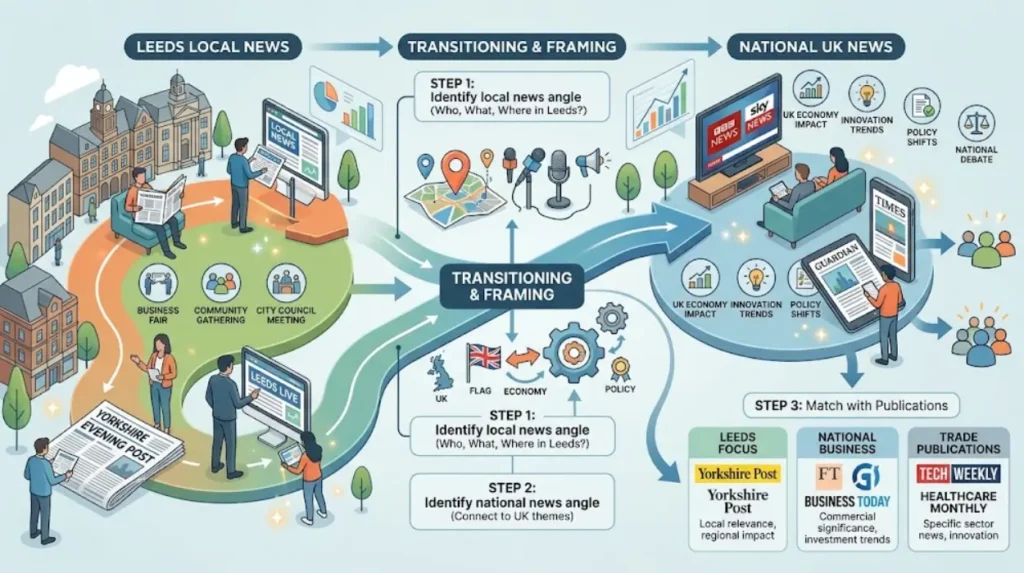
A Leeds event moves from local to national coverage when its central story connects a specific event with a wider UK issue. The process starts with event facts, develops distinct news angles, and matches each angle with relevant publication types.
The first step is identifying the event’s core news value. This includes the organiser, speakers, topic, location, audience, announcement and measurable outcomes.
The second step is separating local facts from wider themes.
A Leeds technology event, for example, contains several potential angles. Its local angle concerns Leeds technology businesses and attendees. Its national angle concerns the UK technology sector and emerging technology adoption.
Step 1: Identify the local news angle
The local angle answers questions such as:
- Why is this event taking place in Leeds?
- Which Leeds organisations are involved?
- Who from the region is attending?
- What local issue does the event address?
- What impact does the event have on Leeds?
These details create regional relevance.
Step 2: Identify the national news angle
The national angle connects the event to a UK-wide subject.
A business event can focus on investment. A healthcare conference can focus on healthcare innovation. A technology summit can focus on AI adoption.
The national angle requires a clear connection between the event and a broader UK development.
Step 3: Match angles with publications
Different publications have different editorial priorities. Leeds-focused media requires local relevance. National business media requires broader commercial significance. Trade publications require sector-specific information.
This matching process creates a more structured distribution strategy.
Which elements create strong regional and national event coverage?
Strong Leeds event coverage combines location, people, subject matter, data, timing and news value. Each element supports a different editorial purpose, helping regional publications understand local significance while national publications identify broader UK relevance.
Location
Leeds establishes the geographic foundation. Mentioning the venue, district and regional connection provides clear local context.
People
Speakers, founders, executives, academics and community leaders add identifiable news value. Their roles also create opportunities for specialist coverage.
For example, a Leeds university professor speaking at a technology conference provides an academic and regional angle.
Subject matter
The event topic determines its wider relevance. Finance, healthcare, technology, education, sustainability and property all connect to national discussions.
Data
Specific numbers strengthen factual reporting.
Useful event data includes:
- Number of attendees
- Number of speakers
- Number of organisations represented
- Investment value
- Jobs linked to an announcement
- Number of participating businesses
- Percentage growth
- Funding figures
A statement such as “500 professionals attended a Leeds technology summit” provides stronger news information than “many professionals attended”.
Timing
Timely events receive stronger editorial relevance. A conference addressing a newly announced UK regulation has a different news value from an event discussing an outdated policy issue.
How do regional and national publications differ in Leeds event coverage?
Regional publications prioritise Leeds and Yorkshire relevance, while national publications prioritise UK-wide significance. The same event therefore requires different editorial angles, supporting information and headlines for each publication category.
Regional and national media are not interchangeable. Each serves a different audience.
Regional publication focus
Regional coverage often emphasises:
- Leeds organisations
- Yorkshire investment
- Local employment
- Community impact
- Regional business leaders
- Local venues
- City developments
The story needs a clear Leeds connection.
National publication focus
National coverage emphasises:
- UK market developments
- Industry trends
- Economic implications
- Regulation
- Investment
- Technology
- National business performance
The story needs a broader reason for national readers to care.
Trade publication focus
Trade publications provide another layer. They target defined professional sectors.
A Leeds construction conference, for example, can have three distinct angles:
- Regional: Construction activity in Leeds.
- National: UK construction market conditions.
- Trade: Technical developments affecting construction professionals.
This segmentation improves editorial relevance.
What role does content structure play in combined Leeds event coverage?
Content structure determines whether journalists can quickly identify the event, its significance and its strongest news angle. A clear release separates essential facts, local relevance, national context, supporting evidence and attributable statements.
A strong event release begins with the most important fact. The opening explains what happened, where it happened and why it matters.
The following sections provide supporting context.
Essential content components
A structured event story commonly includes:
- Event name
- Leeds location
- Event date
- Organiser
- Main speakers
- Attendance figures
- Key announcement
- Relevant industry context
- Direct quotations
- Supporting statistics
- Contact information
Each element supports editorial verification.
Quotes add attributable commentary. Statistics add measurable evidence. Industry context explains why the event matters beyond the venue.
What are the benefits of combining Leeds regional and national news?
Combining regional and national coverage creates a broader media presence while preserving local relevance. It supports geographic visibility, sector recognition, brand awareness, search visibility, stakeholder communication and consistent representation across different UK audiences.
Wider geographic visibility
Regional coverage connects the event with Leeds and Yorkshire. National coverage extends the story across the UK.
Stronger sector visibility
A single event can reach business, technology, healthcare, property, education or other specialist audiences through relevant publication categories.
Greater message consistency
A coordinated approach keeps the event name, key facts, statistics and quotations consistent across coverage.
Stronger search presence
Published event stories create additional indexed references to the organisation and event. Consistent entity information helps search engines associate the organisation with its activities, location and sector.
The quality of the publication and relevance of the coverage remain important. A larger number of pages does not automatically equal stronger search performance.
Which Leeds events benefit from regional and national coverage?
Leeds conferences, business events, awards, exhibitions, launches, festivals and industry gatherings benefit from combined coverage when they contain a clear local connection and a wider news angle relevant to UK audiences or specific professional sectors.
Business conferences
A Leeds business conference can focus on investment, entrepreneurship, economic development or company growth.
Technology events
Technology events often support national angles involving AI, cybersecurity, software, digital transformation and innovation.
Healthcare conferences
Healthcare events can connect Leeds institutions with wider NHS, medical technology or public health developments.
Awards ceremonies
Awards provide identifiable winners, organisations, categories and achievements. Regional media can highlight Leeds-based winners. National media can focus on sector achievements.
Property and construction events
These events connect directly with Leeds development while also addressing UK construction, infrastructure and property markets.
Cultural and community events
Festivals, exhibitions and community programmes often have strong regional relevance. National coverage becomes relevant when the event addresses a wider cultural, tourism or social issue.
How can organisations choose the right Leeds event coverage approach?
Organisations can choose the right approach by assessing location, audience, industry, news value, publication relevance and campaign objectives. Regional distribution suits local recognition, national distribution suits wider awareness, and combined coverage suits events with both dimensions.
Start with the event objective.
If the objective is local awareness, regional media receives greater emphasis. If the objective is national industry visibility, national publications receive greater emphasis.
A combined strategy fits events with two clearly defined audiences.
A practical assessment
Ask five questions:
- Is Leeds central to the story?
- Does the event address a UK-wide issue?
- Does the subject have sector-specific relevance?
- Are there measurable facts or announcements?
- Does the event involve recognised people or organisations?
A “yes” across several questions indicates strong potential for combined regional and national coverage.
What should organisations consider before distributing Leeds event news?
Organisations need accurate facts, a clear news angle, publication relevance, consistent messaging and realistic distribution objectives. Effective Leeds event coverage depends on editorial fit rather than simply sending identical information to every publication.
The event announcement needs factual accuracy. Names, titles, dates, locations, attendance figures and quotations require verification.
The story also needs a defined audience. A regional business story and a national technology story require different editorial framing.
Distribution planning also benefits from publication segmentation. Regional, national and trade outlets each require relevant context.
For organisations evaluating structured distribution options,
Leeds event coverage services provides the next decision-stage reference.
How does combined coverage create a complete Leeds media strategy?
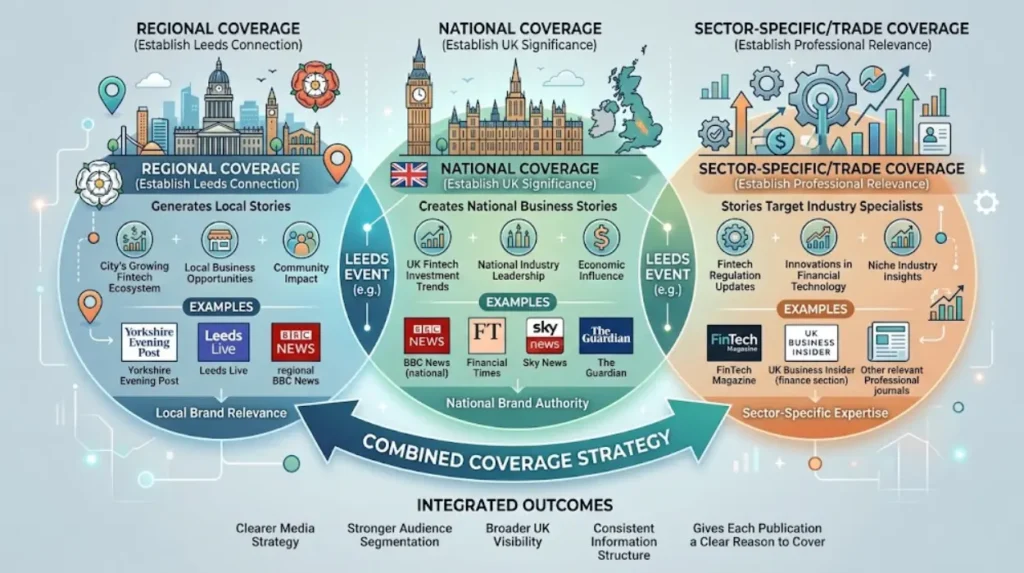
A complete Leeds media strategy connects local relevance, national significance and sector-specific information into one structured campaign. It uses distinct editorial angles to place the same event within appropriate regional, national and specialist media environments.
The strongest approach does not treat regional and national coverage as competing objectives. They perform separate communication functions.
Regional coverage establishes the Leeds connection. National coverage establishes UK significance. Trade coverage establishes professional relevance.
Together, these layers create a structured media presence around the event.
For example, a Leeds fintech conference can generate a local story about the city’s financial technology ecosystem, a national business story about UK fintech investment, and a trade story about financial technology regulation.
This approach gives each publication a clear reason to cover the event. It also creates a consistent information structure for audiences searching for the organisation, event and related industry topics.
Explore More Expert Insights:
How Award Ceremony Coverage Reaches 15 UK Publications
How AI Speeds Up Event Coverage Across 15 News Sites
Leeds event coverage therefore works most effectively when regional and national news are planned as connected but distinct editorial channels. The result is a clearer media strategy, stronger audience segmentation and broader UK visibility for events with genuine local and national news value.