

Award ceremony coverage is the process of turning an awards event into verified editorial content for relevant UK publications. It combines event information, news angles, media targeting, editorial writing, distribution, and post-publication monitoring to extend visibility beyond the event venue.
For organisations running business awards, industry ceremonies, professional recognition events, charity awards, or corporate honours, publication coverage creates a structured record of winners, achievements, speakers, and event outcomes.
Understanding how award ceremony coverage reaches 15 UK publications helps event organisers assess distribution methods, editorial requirements, publication relevance, and measurable media outcomes.
This process connects event activity with the UK news ecosystem. It also explains why a single announcement does not automatically produce coverage across multiple publications.
What does award ceremony coverage mean?
Award ceremony coverage is editorial reporting about an awards event, its winners, key announcements, speakers, and achievements, distributed to relevant publications through targeted media outreach, news distribution, editorial review, and publication monitoring.
Award ceremony coverage differs from simply posting an event announcement on an organisation’s website. Editorial coverage places event information within a publication environment where journalists, professionals, customers, investors, and search engines can discover it.
A typical award ceremony story contains several identifiable entities. These include the event organiser, award programme, winning organisations, individual recipients, venue, location, speakers, judges, sponsors, and event date.
For example, a Manchester technology awards ceremony can generate coverage around its winning fintech company, keynote speaker, regional business impact, and industry category.
What makes an awards event newsworthy?
Newsworthiness comes from a clear development. Winners provide the central development because their recognition represents a defined outcome.
Other strong editorial elements include:
- Named winners and award categories
- Senior executives receiving recognition
- Industry-specific achievements
- New award programmes
- Significant judging panels
- Charity or community impact
- Regional business recognition
- Major partnerships announced during the ceremony
The strongest coverage connects the ceremony with information relevant to the publication’s audience.
How does award ceremony coverage reach 15 UK publications?
Award ceremony coverage reaches 15 UK publications through a planned workflow covering story preparation, publication selection, editorial distribution, content processing, publication, and monitoring across national, regional, business, and specialist media outlets.
The process starts before distribution. Event organisers prepare accurate information about the ceremony, winners, categories, speakers, and organisational context.
The content then receives an editorial structure. The headline identifies the main news event. The introduction answers who, what, where, and when. The body provides supporting facts and relevant quotes.
Publication selection follows. A distribution strategy identifies suitable UK outlets based on geography, sector, audience, and editorial relevance.
The completed story then enters the distribution stage. Publications receive the content through appropriate media channels. Each outlet applies its own editorial standards and publishing process.
The final stage involves monitoring. Published URLs, publication names, dates, headlines, and story variations are recorded.
What are the main stages?
The workflow contains six core stages:
- Event research – Collect ceremony facts, winners, categories, speakers, and quotes.
- News preparation – Convert event information into an editorially structured story.
- Media targeting – Identify 15 relevant UK publications.
- Distribution – Submit or distribute the story through appropriate media channels.
- Publication – Track where the story appears and how each outlet presents it.
- Reporting – Record publication links, dates, headlines, and coverage results.
This sequence creates a repeatable framework for multi-publication award ceremony coverage.
How are the 15 UK publications selected?
The 15 publications are selected according to editorial relevance, audience, geography, industry focus, publication authority, and story fit, creating a targeted media mix rather than distributing identical event content without considering each publication’s readership.
Publication selection determines whether an awards story reaches audiences that matter to the event organiser.
A national business publication has a different audience from a regional newspaper. A technology publication also has different editorial priorities from a professional association magazine.
For example, an Edinburgh-based business awards ceremony can use a combination of Scottish business media, UK-wide business publications, regional outlets, and industry-specific publications.
What types of publications can carry award coverage?

A 15-publication strategy can include several media categories:
- National publications: UK-wide business and general news audiences.
- Regional publications: City, county, and regional business audiences.
- Trade publications: Sector-specific professional readers.
- Business publications: Entrepreneurs, executives, investors, and companies.
- Specialist publications: Technology, healthcare, finance, property, education, or other defined sectors.
The selection depends on the event’s subject and audience.
A healthcare awards ceremony requires different media targeting from a property awards ceremony. Relevant publication selection increases contextual alignment between the story and its intended audience.
What information does an award ceremony story need?
An award ceremony story needs verified event facts, named winners, award categories, organisational details, relevant quotations, location information, event timing, and a clear news angle that gives UK publications enough substance for editorial consideration.
Accuracy is essential because awards coverage contains multiple names, titles, categories, organisations, and results.
A basic story information set includes:
- Ceremony name
- Event date
- Venue and city
- Organiser name
- Award categories
- Winner names
- Winning organisations
- Short achievement descriptions
- Judges or judging panel
- Key speakers
- Relevant quotations
- Event purpose
- Contact information
Why do named winners matter?
Named winners provide specific entities for readers and search systems to identify. They also create clear editorial value.
For example, “North West Business Awards announce 2026 winners” establishes the event. “Lancashire fintech company wins Innovation Award at 2026 ceremony” creates a more specific news angle.
The second structure identifies the location, sector, organisation, achievement, and event context.
This entity-based approach improves clarity and gives publications a defined story rather than a generic event recap.
How does editorial optimisation improve award ceremony coverage?
Editorial optimisation improves award ceremony coverage by placing the most important facts in clear headlines, introductions, subheadings, quotations, and supporting paragraphs while maintaining factual accuracy and publication-ready language for UK media audiences.
Editorial optimisation does not mean filling a story with keywords. It means structuring information so the news event is immediately understandable.
The headline identifies the strongest development. The first paragraph provides the essential event context. Subsequent paragraphs explain the achievement and supporting details.
What does an optimised structure include?
A strong award ceremony article commonly follows this structure:
Headline: Identifies the main award development.
Opening paragraph: States the ceremony, winners, location, and core announcement.
Supporting paragraph: Explains the significance of the award or achievement.
Winner details: Provides information about recipients and organisations.
Quote section: Adds statements from organisers, winners, judges, or speakers.
Event context: Explains the ceremony’s purpose and industry relevance.
Closing section: Provides additional factual information about the organisation or award programme.
This structure supports human readers and AI systems because important entities and relationships appear in predictable positions.
How does coverage differ between national and regional UK publications?
National and regional publications differ in audience, geography, editorial priorities, and story selection, so effective award ceremony coverage adapts the event narrative to publication relevance while preserving the same verified facts across the wider distribution strategy.
National publications focus on developments with broad UK relevance. Regional publications focus on local businesses, professionals, communities, and achievements.
A Birmingham-based construction awards ceremony has a strong regional angle when local companies win major categories. The same ceremony also has a national angle when winners represent a significant development within the construction industry.
Why does regional relevance matter?
Regional relevance creates a direct connection between the event and its local audience.
Examples include:
- A Leeds company winning a national sustainability award
- A Cardiff organisation receiving an innovation award
- A Glasgow professional receiving an industry leadership award
- A Manchester technology company winning a fintech category
These details give regional publications a clear reason to consider the story.
What benefits does coverage across 15 UK publications provide?
Coverage across 15 UK publications expands the number of media environments carrying an award story, increases discoverable references to winners and organisers, supports reputation building, and creates a measurable collection of published coverage assets.
Multi-publication coverage creates several measurable outcomes.
First, the organisation gains multiple published references rather than one isolated article. Second, winners receive additional public recognition. Third, the event creates a wider digital footprint.
The coverage also creates reusable media assets. Published articles can support stakeholder communications, award promotion, winner announcements, investor communications, recruitment campaigns, and future event marketing.
How does multi-publication coverage support search visibility?
Published coverage can create additional web references containing the names of the event, organiser, winners, organisations, locations, and award categories.
These references provide search engines with additional publicly available information about the entities involved.
Backlinks can also appear when publications link to an organisation’s website. The value of each link depends on the publication, placement, relevance, and editorial context.
The objective is not simply to maximise link volume. The objective is to create relevant, credible coverage around a defined news event.
Which award ceremonies benefit from multi-publication coverage?
Business awards, industry ceremonies, corporate recognition events, professional awards, charity ceremonies, technology awards, healthcare awards, and regional recognition programmes all provide structured stories suitable for targeted UK publication coverage.
Different event categories produce different editorial angles.
Which sectors have strong award coverage opportunities?
Examples include:
- Fintech: Innovation, financial technology, payments, and digital banking awards.
- Healthcare: Clinical innovation, healthcare leadership, and medical service awards.
- Property: Development, architecture, construction, and real estate awards.
- Technology: Software, artificial intelligence, cybersecurity, and digital transformation awards.
- Education: Teaching, leadership, training, and institutional achievement awards.
- Charities: Community impact, fundraising, volunteering, and social enterprise recognition.
Each sector requires relevant publication targeting and terminology.
How can organisations evaluate a 15-publication coverage strategy?
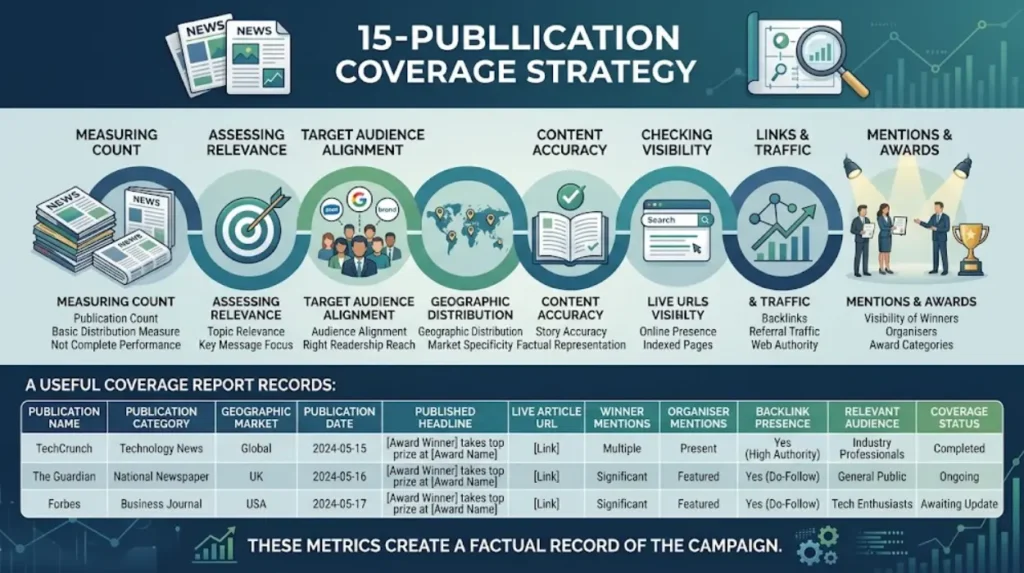
Organisations can evaluate a 15-publication strategy by measuring publication count, relevance, audience alignment, geographic distribution, story accuracy, live URLs, backlinks, referral traffic, and the visibility of winners, organisers, and award categories.
Publication count provides the basic distribution measure. It does not provide the complete performance picture.
A useful coverage report records:
- Publication name
- Publication category
- Geographic market
- Publication date
- Published headline
- Live article URL
- Winner mentions
- Organiser mentions
- Backlink presence
- Relevant audience
- Coverage status
These metrics create a factual record of the campaign.
Explore More Expert Insights:
How AI Speeds Up Event Coverage Across 15 News Sites
How DEI Event Coverage Reaches 15 UK News Sites
What does successful coverage look like?
Successful award ceremony coverage creates relevant publication placements with accurate information and clear connections to the event.
The strongest campaigns maintain consistency across the core facts while allowing publication relevance to shape the presentation.
For event organisers evaluating their next step,
Award ceremony coverage on 15 UK news sites represents the decision-stage model for turning one ceremony into a structured multi-publication media campaign.
Understanding the process first helps organisations compare distribution approaches, publication targeting methods, editorial requirements, and reporting standards before selecting a specific coverage solution.



