ESG event coverage connects sustainability-focused events with UK audiences interested in environmental, social and governance issues. It transforms event activity into searchable news content that reaches business leaders, investors, sustainability professionals, policymakers, journalists, charities and purpose-driven consumers.
For organisations planning ESG communications, understanding this pathway helps determine which coverage formats, media channels and editorial messages fit their audience. Effective distribution depends on news relevance, audience alignment, publication selection, search visibility and the quality of information supplied to journalists.
Readers can first understand why ESG events attract media attention through:
ESG event coverage. The next step is understanding how that coverage reaches specific UK readers through relevant publications and distribution networks.
What is ESG event coverage?
ESG event coverage is editorial reporting about events focused on environmental, social and governance issues, including conferences, summits, forums, awards, panels and corporate sustainability announcements for defined UK audiences.
ESG stands for environmental, social and governance. The term covers measurable organisational activities involving climate impact, resource use, workforce practices, community relationships, corporate governance, ethical conduct and responsible investment.
An ESG event provides a source of information for media coverage when it contains a clear news angle. Examples include a company announcing a measurable emissions target, a sustainability conference publishing new research, or an industry forum discussing changes in environmental regulation.
Coverage converts event information into an editorial format. This format can include news articles, event reports, interviews, speaker features, research summaries and announcement-based stories.
Why does purpose matter in ESG media coverage?
Purpose-driven readers actively consume information connected with responsible business, sustainability and social impact. This audience includes sustainability managers, ESG professionals, investors, procurement teams, academics, policymakers and consumers interested in corporate responsibility.
The editorial relevance of an ESG event increases when the story contains specific facts. Examples include investment amounts, carbon reduction figures, workforce statistics, policy developments, research findings and named initiatives.
How does ESG event coverage reach UK readers?
ESG event coverage reaches UK readers through editorial publication, digital distribution, search indexing, social discovery, newsletters and industry channels that connect sustainability stories with defined professional and purpose-driven audiences.
The process begins with the event itself. Organisers identify the strongest news elements and prepare accurate information for media use.
The second stage involves editorial positioning. The event is presented according to its relevance to a particular audience. A climate technology conference requires different messaging from a social impact awards ceremony.
The third stage involves media distribution. Coverage reaches relevant UK publications through established editorial relationships, distribution networks and targeted outreach.
The fourth stage involves digital discovery. Published stories become accessible through search engines, news platforms, publication websites and social channels.
The fifth stage involves audience engagement. Readers discover the story through search queries, publication subscriptions, newsletters, professional communities or direct visits.
What role does editorial relevance play?
Editorial relevance determines whether an ESG story fits the interests of a publication and its audience. Editors prioritise information that has a clear subject, defined impact and identifiable news value.
For example, a UK sustainability publication focuses on developments affecting sustainability professionals. A business publication focuses on corporate investment, leadership, markets and operational impact.
This distinction matters because broad ESG messaging does not automatically create targeted readership. The subject, evidence and audience need to align.
Which media channels connect ESG events with purpose-driven audiences?
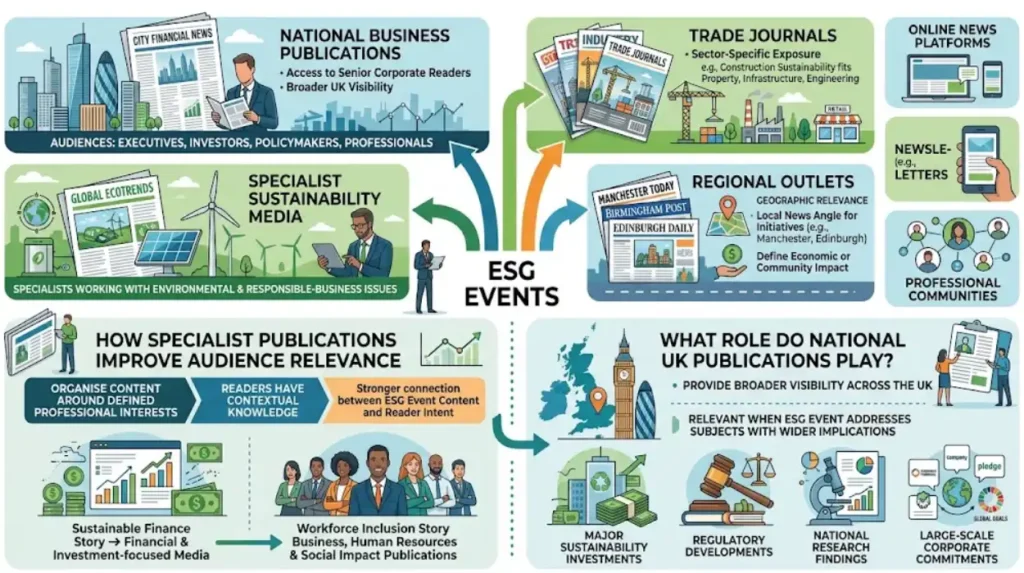
Different media channels reach different ESG audiences, including national business publications, specialist sustainability media, trade journals, regional outlets, online news platforms, newsletters and professional communities across the UK.
Media selection influences audience composition. A national business publication provides access to senior corporate readers. A sustainability publication reaches specialists working with environmental and responsible-business issues.
Trade publications provide sector-specific exposure. For example, an ESG event focused on construction sustainability fits publications covering property, infrastructure, engineering and the built environment.
Regional publications provide geographic relevance. A sustainability initiative launched in Manchester, Birmingham or Edinburgh has a stronger local news angle when its economic or community impact is clearly defined.
How do specialist publications improve audience relevance?
Specialist publications organise content around defined professional interests. Their readers already have contextual knowledge about subjects such as renewable energy, responsible investment, social value, sustainable procurement and corporate governance.
This creates a stronger connection between ESG event content and reader intent.
A story about sustainable finance therefore benefits from financial and investment-focused media. A story about workforce inclusion fits business, human resources and social impact publications.
What role do national UK publications play?
National publications provide broader visibility across the UK. Their audiences include executives, investors, policymakers, professionals and general business readers.
National coverage becomes more relevant when an ESG event addresses a subject with wider implications. Examples include major sustainability investments, regulatory developments, national research findings and large-scale corporate commitments.
How does search visibility help ESG event coverage reach readers?
Search visibility allows published ESG event stories to reach readers after the event through relevant keywords, indexed pages, descriptive headlines, structured information and content that directly answers sustainability-related search queries.
Search behaviour provides an additional route to discovery. A reader searching for information about ESG conferences, sustainability leadership, responsible investment or climate initiatives can encounter relevant event coverage after publication.
Search visibility depends on the relationship between the article topic and the language used by the audience.
For example, an article about a sustainability summit can naturally include terms such as ESG event, sustainability conference, responsible business, climate strategy, social impact and corporate governance.
Why are entity relationships important?
Entity relationships help search systems understand the subject of an article. An ESG event can contain several identifiable entities, including the event organiser, speakers, companies, locations, industries, sustainability initiatives and research organisations.
Clear references establish relationships between these entities.
For example, an article can identify a sustainability conference, its London location, its corporate speakers, its climate technology theme and its research publication. This creates a clearer semantic structure than generic promotional language.
What information makes ESG event coverage more useful to UK readers?
Useful ESG event coverage provides specific information about the event, participants, ESG topic, evidence, location, business relevance, social impact and measurable outcomes so UK readers understand both what happened and why it matters.
Strong coverage answers practical reader questions quickly. These include:
- What was the event?
- Who organised it?
- Where did it take place?
- Which ESG issue did it address?
- Who participated?
- What evidence was presented?
- What findings or announcements emerged?
- Which organisations were involved?
- What measurable outcomes resulted?
Specific information improves editorial clarity.
For example, stating that an organisation announced a 30% emissions reduction target provides more useful information than stating that it strengthened its environmental commitment.
How do speakers and organisations influence relevance?
Named speakers create identifiable entities within event coverage. Their roles establish authority and context.
A sustainability director discussing corporate emissions has different relevance from an investor discussing ESG risk. A policymaker addressing environmental regulation creates another editorial angle.
Organisations also add context. Universities, companies, charities, government bodies and professional associations each connect the event with different reader groups.
How can organisations compare ESG event coverage options?
Organisations can compare ESG coverage options by examining audience alignment, publication relevance, editorial quality, geographic reach, search visibility, reporting depth and measurable distribution outcomes across selected UK media channels.
A useful comparison focuses on outcomes rather than publication volume alone.
What should an ESG media comparison measure?
Relevant criteria include:
- Audience alignment — Does the publication reach the intended ESG audience?
- Geographic relevance — Does it reach UK readers or a defined regional audience?
- Editorial relevance — Does the publication regularly cover ESG topics?
- Content quality — Does the coverage provide substantive information?
- Search visibility — Is the article accessible through relevant search queries?
- Publication diversity — Does distribution cover national, regional and specialist media?
- Reporting — Does the distribution process provide measurable coverage records?
A publication appearing in a distribution report has limited value if its audience does not match the communication objective.
Why does publication diversity matter?
Different publications attract different reader groups. National business media reaches broad professional audiences. Specialist sustainability publications reach ESG practitioners. Regional publications reach geographically defined communities.
Combining relevant categories creates broader audience coverage without treating every publication as equivalent.
Which ESG events benefit most from targeted UK coverage?
ESG conferences, sustainability summits, responsible investment forums, social impact events, climate technology showcases, governance forums and corporate ESG announcements benefit from targeted coverage when each has a clear audience-relevant news angle.
How do ESG conferences generate coverage?
Conferences generate multiple editorial opportunities through keynote speeches, research announcements, panel discussions and industry findings.
A conference focused on sustainable finance can produce coverage around investment trends, regulatory developments and responsible capital allocation.
How do social impact events reach readers?
Social impact events focus on community outcomes, inclusion, workforce development, education, health access or charitable initiatives.
Coverage becomes more relevant when it provides measurable evidence. Examples include the number of beneficiaries, investment levels, participating organisations or documented programme outcomes.
How do corporate ESG events differ?
Corporate ESG events often focus on organisational commitments, sustainability reporting, governance changes, investments and operational programmes.
The strongest coverage identifies the business action and its measurable consequence. This gives professional readers information that supports evaluation and comparison.
How does ESG event coverage support a broader communications strategy?
ESG event coverage supports communications by extending event visibility beyond attendees, creating searchable editorial assets, reaching specialised audiences and establishing a consistent information trail around environmental, social and governance activities.
An event has a defined duration. Published coverage creates an ongoing digital record.
This record supports later discovery by journalists, investors, employees, customers and professional stakeholders. It also provides contextual evidence when future ESG announcements reference previous activities.
Coverage therefore functions as part of a wider content ecosystem. The event provides the source material. Editorial articles provide third-party information environments. Search engines provide discovery. Professional media provides audience access.
Organisations evaluating distribution approaches can therefore compare targeted media coverage with other communication methods based on audience, editorial relevance and measurable reach.
What are the key steps for reaching purpose-driven UK readers?
The process involves defining the ESG audience, identifying the strongest news angle, selecting relevant UK publications, preparing evidence-based content, distributing the story, monitoring publication and assessing audience and search visibility.
The workflow is structured:
- Define the audience. Identify sustainability professionals, investors, business leaders, policymakers or purpose-driven consumers.
- Define the news angle. Select the event announcement, finding, investment, research result or measurable ESG action.
- Select media categories. Separate national, specialist, trade and regional publications.
- Prepare factual content. Include names, figures, dates, locations, quotes and supporting evidence.
- Distribute the story. Use appropriate editorial and media distribution channels.
- Monitor publication. Record where the story appears and how it is presented.
- Assess visibility. Review audience relevance, search accessibility and coverage breadth.
This framework gives organisations a structured method for evaluating ESG event communication before selecting a specific distribution approach.
For organisations assessing wider media outcomes,
ESG event news coverage provides a further decision-stage perspective on coverage across purpose-driven UK publications.
How can organisations measure whether ESG coverage reached the right readers?

Organisations measure audience reach through publication relevance, coverage volume, geographic distribution, referral activity, search visibility, engagement indicators and alignment between published content and the original ESG communication objective.
Coverage measurement needs defined criteria.
Publication count provides one metric. Audience relevance provides another. Search visibility provides a third. Geographic distribution adds another dimension.
For example, coverage across 15 relevant UK publications provides a clearer distribution profile when the publications span sustainability, business, trade and regional audiences that match the campaign objective.
Explore More Expert Insights:
How Startup Launch Coverage Reaches UK Tech Readers
How Charity Gala Coverage Reaches 15 UK News Sites
The evaluation process also identifies which media categories consistently produce relevant visibility.
ESG event coverage therefore works as a structured communication process rather than a single publication activity. Audience definition, editorial relevance, media selection, search accessibility and measurement determine how effectively ESG stories reach purpose-driven UK readers.